Max Verstappen Praises Robert Kubica's Resilience and Talent
Max Verstappen knows greatness when he sees it. So when he pauses in the paddock to talk about Robert Kubica, people listen.
The three-time world champion has watched Kubica’s story from a distance: the dazzling early years in Formula 1, the horrific rally crash in 2011 that almost cost him his arm, and the long, stubborn road back. Fourteen years after that accident, Kubica stood on the top step at Le Mans in 2025, winning the 24-hour classic in the #83 AF Corse Ferrari Hypercar alongside Yifei Ye and Phil Hanson.
“It’s special,” Verstappen said. “Robert was a fantastic driver, and of course he still is. He had an enormous amount of talent.”
Then came the line that still stings in F1 circles. If you ask anyone in the paddock, Verstappen insisted, they’ll tell you Kubica was destined for far more in Formula 1 before fate intervened. One crash changed everything. Le Mans, in its own way, has given something back.
Norris wrestling with a different McLaren
On the current grid, another story of adaptation is unfolding. Lando Norris is the reigning world champion, but he is still learning how to drive his own car.
McLaren’s 2025 machine is not an evolution. It’s a reset.
“I certainly think this year’s car is different to last year by quite a long way,” Norris admitted. “You have to adapt to that.”
He has spent much of the season recalibrating instincts formed over previous years. McLaren’s cars have long carried a reputation for being quirky, and Norris leaned into that theme.
He pointed out that every driver who has sampled a McLaren and another team’s car has remarked on how “odd and unique” the McLaren is to drive. That hasn’t changed. What has changed is how extreme the difference feels from last year’s era of car to this one.
“You have to drive it in a very different way,” he said. The adaptation process has dominated his early season: learning the limits, understanding what the car wants, and working out whether its traits are uniquely McLaren or simply this specific concept. Even he is not sure where that line sits.
The team’s answer is to bring hardware. Big hardware.
McLaren will arrive in Baku with what they describe as their most significant upgrade of the season: a new floor, fresh aero components and, stealing the headlines, the return of the rotating “Macarena” H-wing.
Fast corners have exposed the car’s weaknesses. The new floor is designed to fix that, giving Norris and his team-mate the confidence they have lacked when the speed climbs and the walls close in. The revised H-wing, which had to be removed in Madrid because it didn’t suit the required downforce level, is back in a new guise.
Baku, with its long straights and tricky high-speed sweeps between concrete, will show quickly whether McLaren have guessed right.
Red Bull play the long game with Hadjar
At Red Bull, the focus has been less on bodywork and more on bones. Specifically, a wrist.
Team principal Laurent Mekies has been unflinching for weeks: Isack Hadjar would not be rushed back. Not for points. Not for pressure. Not for anything.
F1 has seen what happens when a driver comes back too soon. Lance Stroll famously dragged himself to sixth place in Bahrain in 2023 just two weeks after breaking his wrist in pre-season training. The performance was lauded. The price was heavy. Chronic pain, a second corrective surgery, and a missed race anyway.
That caution framed Hadjar’s layoff. The Frenchman’s stock is rising fast after a strong rookie year and a blistering start at Red Bull, where he has already taken a podium and, crucially, has not folded under the weight of being Verstappen’s team-mate. Red Bull simply could not afford to break him in the name of bravado.
Their patience has been rewarded. Hadjar has now been cleared to withstand the brutal loads that go through a driver’s wrist at 200mph, and he will be back in the car for the Azerbaijan Grand Prix.
“Oracle Red Bull Racing is delighted to welcome Isack back this weekend,” read the team’s statement. He returns to action at the Baku City Circuit on Thursday, the message confirmed.
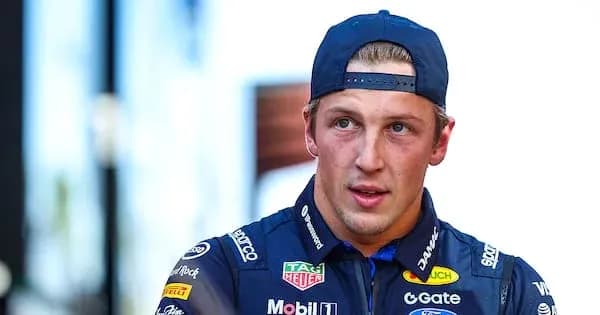
Red Bull also took the time to publicly thank Liam Lawson, who stepped in for three races under awkward circumstances and delivered solid work. The team praised his professionalism, dedication and contribution, wishing him well as he heads back to Visa Cash App Racing Bulls.
The driver rotation has been messy for the wider Red Bull camp. Long term, though, both the team and Hadjar are likely to gain from the conservative approach. A rushed comeback could have derailed a career that currently points only one way: up.
Mekies hits back at Rosberg over Lawson criticism
Not everyone in the paddock has been so kind to Lawson.
Nico Rosberg, never shy with an opinion, has cast doubt on whether any of Red Bull’s current or potential Verstappen partners are truly at the level the team craves. Speaking to Sky F1, the 2016 world champion said Red Bull are hunting “the next Max Verstappen and the next Sebastian Vettel” – and that, in his view, “everything else is just not good enough.”
Lawson, he suggested, has not yet shown he belongs in that category.
Mekies pushed back hard. From his vantage point, Lawson did what very few drivers can: jump into a different team, a different car, mid-season, and make it look largely seamless.
“I think he’s done a very good job,” Mekies said. The reality of stepping into a Red Bull, under the microscope, with limited preparation, is brutal. Lawson took sixth place in Spain, repeating the kind of points-scoring composure he had shown at Zandvoort. In Monza, Mekies argued, he was on for something similar before contact with Nico Hülkenberg and front wing damage derailed his race.
The contrast with Lawson’s first stint in the team in early 2025 was stark. This time, he looked sharper, more assured, more ready. Red Bull, Mekies stressed, are “thankful and happy” with what he delivered.
Rosberg’s wider point still lingers in the background, though. He questioned whether Lawson, Hadjar or even rising star Arvid Lindblad truly match the generational bar set by Verstappen and Vettel. For Red Bull, that is the standard. Anything less invites scrutiny.
F1 signs off on shorter, freer races
While teams juggle drivers and upgrades, the sport itself is changing shape.
The FIA has confirmed a series of significant tweaks for next season after the latest F1 Commission meeting, reshaping how grands prix will run.
The old rule that a race must be completed within a maximum two-hour window inside a three-hour slot is gone. Race control will now have more breathing space when red flags, heavy rain or lengthy repairs disrupt the schedule. No more frantic clock-watching when circumstances conspire against a full-distance race.
The race distance itself is changing too. The standard length drops from 305km to 290km, with Monaco staying at its traditional 260km. On paper it’s a modest cut. On track it could be decisive.
The shift is tied to the revised power unit structure coming in next year, after the 2026 regulations attracted heavy criticism from teams and fans. With the new framework, the shorter distance should allow drivers to run closer to full throttle more often, with less fuel and energy saving. Less management. More flat-out racing.
Gearbox homologation has also been scrapped for next season. That move, signed off by the Sporting Advisory Committee, is designed to preserve development freedom for suppliers. In a cost-conscious era, it’s a rare loosening of the reins, and it will give teams another performance lever to pull.
The direction is clear: faster sprints to the flag, more scope for technical ingenuity, and a grid full of drivers and teams trying to prove they belong in the sport’s next great chapter – whether they’re chasing a Le Mans fairytale, wrestling a difficult McLaren, or fighting for the one seat alongside Max Verstappen that can define a career.