Behind the Scenes of the Singapore Grand Prix
By 1am on Monday, the Marina Bay roar is gone. The lights on the Padang stages flick off, the last echo of the engines drifts over the bay, and the grand prix weekend is officially over.
On paper, anyway.
On the ground, a different kind of race starts.
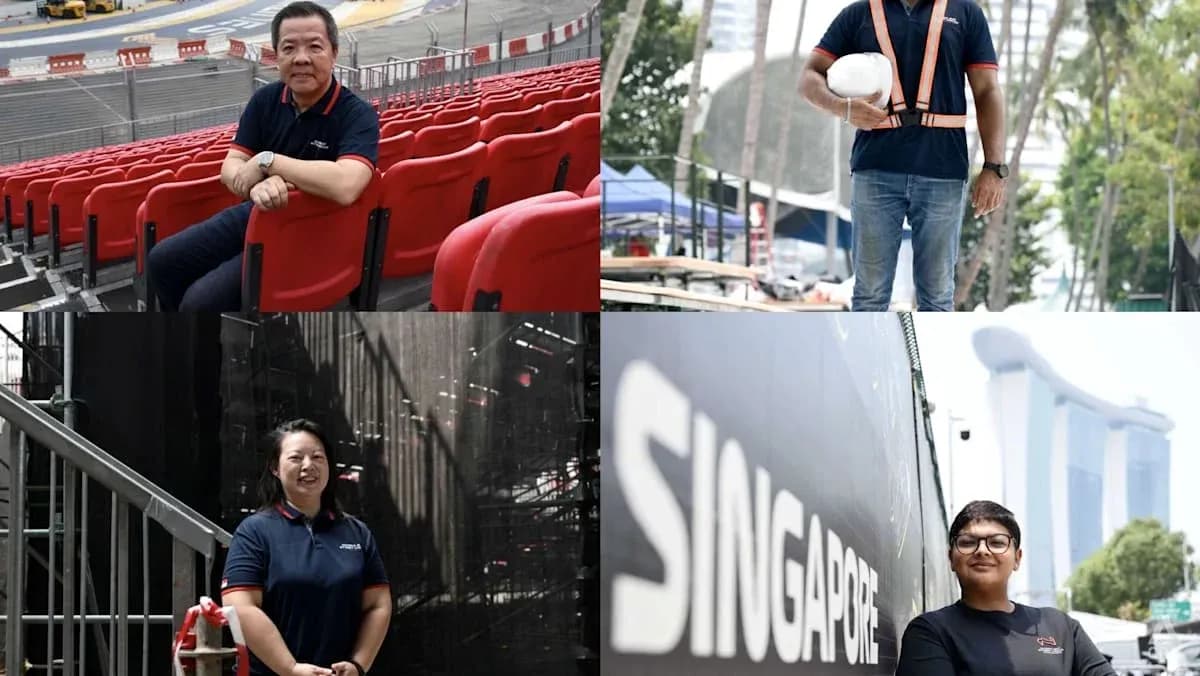
Senior manager Shiv Raj Panday and his technical crew have four and a half hours to do what looks impossible from the outside: peel back parts of a Formula 1 circuit stitched into the heart of a live city and hand the roads back to commuters by dawn. By 5.30am, the same lanes that saw cars hit more than 300 km/h just hours earlier must carry buses, taxis and office workers.
That pressure-cooker window is the most visible slice of an operation that never really stops.
A three‑day show, a 362‑day grind
For fans and teams, the Singapore Grand Prix is a three‑night spectacle. For race promoter Singapore GP, it is a year-long loop that restarts almost as soon as the chequered flag falls.
The company runs on a core of about 70 full-time staff. Around them, a shifting army of contractors, vendors, students and part-timers builds, runs and dismantles one of the sport’s most distinctive events.
Raj, who spent more than a decade with one of the race’s contractors before joining Singapore GP, sits in the middle of the steel-and-concrete reality. His technical department spends months on feasibility studies before a single barrier goes up.
“We will take at least about two, three months to plan, before commencing set-up and build of the circuit,” he said. Space inside the circuit park is limited and contested. Every year, his team squeezes grandstands, hospitality suites, paddock infrastructure and public walkways into a tight waterfront footprint that also has to keep a city moving.
That reset has played out almost every year since 2008, when Singapore staged Formula 1’s first night race. Only the COVID-19 cancellations in 2020 and 2021 broke the rhythm. The current deal, renewed in January 2022, locks the race in until 2028. This season’s edition, from Oct 9 to 11, will be the latest the event has ever been held in the calendar year.
The date moves. The workload doesn’t.
Tickets that never sleep
Inside Singapore GP’s offices, another clock is always ticking.
“Enormous,” is how director of ticketing and accreditation Clarence Lai describes the time needed to get one race over the line, even as most people still see it as a long weekend with fireworks.
Ticketing is not a sprint. It’s a loop. The “super early bird” sale for one year opens during race week of the previous year and runs right through to the event itself, before the cycle starts again. Lai, who previously served as assistant director from 2011 to 2013 before returning to lead the department in 2022, oversees everything tied to access: public tickets, accreditation for vendors and contractors, and the delicate puzzle of who sits where.
His team constantly reviews seating capacity, deciding whether new grandstands are needed and how to improve the experience in seats that, quite literally, don’t exist for most of the year.
Security and fraud have crept into that picture too. Last year, Singapore GP rolled out mobile ticketing. It cut down on scams that had plagued PDF tickets, where unsuspecting buyers could end up with duplicate digital passes from third-party sellers.
On another floor, the marketing and partnerships team is already selling the next edition before this one is even run.
Senior director for marketing and partnerships Sasha Rafi, one of the earliest members of Singapore GP when she joined in October 2007, leads the post-race inquest. As soon as the lights go out, her team breaks down what worked and what didn’t, across marketing, sustainability and stakeholder engagement with both government and private sector partners.
“Even before the race takes place, we are already planning for next year,” she said.
Her group spends months scanning what’s new in tech, what’s hot in entertainment, and how global events might affect demand. A war, a downturn, a travel squeeze – all of it can ripple into ticket sales for a night race in Singapore.
This year, they have a new toy to sell: a two-day sprint bundle.
Singapore is hosting one of six sprint weekends on the F1 calendar. Sprint qualifying lands on Friday, the sprint itself on Saturday. The 100 km dash – roughly a third of a full race distance and designed to run in about 30 minutes with no pit stops – is a relatively new format for the sport, and it is debuting in Marina Bay.
“We have looked at bundling and packages of different kinds over the years,” Sasha said. The sprint bundle stands out because it breaks their usual model. “When we look at the sprint bundle, it is one of the only few times that we have a two-day ticket package. We've always had three-day or single-day (packages).”
The idea is simple: catch fans who don’t want to commit to all three days but don’t want to miss the sprint. The sales machine stretches even further ahead. Super early bird tickets for the 2027 race will again go on sale this year.
The calendar never really breathes.
Building a circuit around a living city
The Marina Bay Street Circuit is a piece of temporary engineering that has to behave like a permanent facility for three days and then vanish.
Some grandstands go up one and a half months before the race. That early build gives teams time to test sightlines and capacity, but it also opens the door to last-minute headaches. A stand might return to the same location year after year, only for rows to shift or layouts to change when the structure is rebuilt.
Lai’s team walks every section, checks that every seat is present, properly labelled and safe. Sun, rain and wind hit the structures long before fans do.
For Raj, the real squeeze comes in the hours when the city has to share space with the race.
He points to the Connaught Grandstand at the end of Esplanade Bridge, perched along a live road open to public traffic for most of the year. In race week, his crew closes the road in the small hours of Wednesday morning. They then work through a tight window to build as much as they can before morning traffic returns.
The same knife-edge timetable plays out on Sunday night. As soon as the race ends, the priority flips: open key stretches of track, like Esplanade Drive, as public roads by 5.30am. The show has to disappear just as quickly as it arrived.
Training a thousand new faces
Operations director Melissa Phua has been with Singapore GP since 2008. Her job stretches well beyond barriers and bridges.
Each year, she works with students from the Institute of Technical Education and Republic Polytechnic, with Singapore GP offering training and employment for nearly 1,000 of them across the circuit park. They serve as grandstand and gate officials, look after general patron welfare and form much of the event’s human interface.
Her team also shoulders the responsibility for public safety: how crowds move, how they disperse, how they get home.
“I think part of our KPI is also in making sure that they leave safely,” she said. Complaints from patrons who feel short-changed or unsafe are not just bad optics; they are markers of failure in a complex operation.
The toughest test comes after the nightly concerts at the Padang. Tens of thousands pour out at once, many funneling towards MRT stations to catch late trains. Phua’s staff stay on the ground, making sure the right gates are open and spectators follow planned routes designed for efficient dispersal.
Those routes don’t always match the paths fans used to enter the circuit. Some resist being diverted, but the detours are deliberate – to avoid bottlenecks, to prevent crushes.
“It's about making sure that ushers are there and we are there on the ground, making sure that nobody gets yelled at or gets crushed,” she said.
Inside a city that looks familiar on Monday morning, the race weekend version can feel like a maze. Even staff can lose their bearings once the track is closed and fencing goes up. For foreign visitors, the transformation is even more disorienting.
From “elitist” curiosity to repeat destination
When Sasha first started, Formula 1 in Singapore was a hard sell at home. The sport carried an “elitist” tag in some quarters, and many locals simply didn’t know what to make of it.
The early years focused on explaining the product to Singaporeans and introducing the race to the international market. That has shifted. The Marina Bay night race is now a fixture on the global calendar, and the challenge lies in convincing fans to come back, and to choose Singapore out of 24 races.
To broaden the appeal, Singapore GP built a wide range of ticket categories and experiences: hardcore sports fans chasing lap times, corporate visitors looking to network, locals more interested in the concerts than the grid.
“We were the first circuit in Formula 1 to actually inject entertainment into the racing experience that you get over the weekend,” Sasha said. That formula – big-name acts under the skyline alongside the race – has since become part of the event’s identity.
The hardware has changed too. The 2026 race will look very different from 2008’s original layout. In 2023, the track was re-routed behind the Floating Platform after the removal of one of F1’s largest grandstands to make way for NS Square. Every tweak forces the ticketing and operations teams back to the drawing board.
For Lai, that’s the constant headache of a temporary street circuit. “It's unlike a fixed venue, let's say, the National Stadium. The seats are always there, so most of the time you won't go wrong, it will not disappear,” he said. In Marina Bay, everything disappears. Then it has to come back, often in a slightly different shape.
The removal of the Bay Grandstand still hurts capacity. The team has not been able to fully replace the lost seats and has had to get creative. This year, the grandstand at Turn 2, just after the exit from the pit straight, will be merged from two structures into one larger stand, with extra viewing platforms bolted on alongside to claw back vantage points.
Playing the long game in a city that never stops
A city race offers one major advantage: fans can leave in multiple directions, bleeding out into hotels, bars and trains instead of queuing for a single car park. But the flip side is a downtown that looks unfamiliar for days, sliced up by fences, bridges and barriers.
Phua remembers 2022, when a heavy downpour delayed the start by an hour. The schedule buckled, but the rest of the operation could not. Trains still had to be caught, roads still had to reopen, and that 5.30am deadline still loomed over the dismantling crews.
The Marina Bay race sells itself on spectacle: the skyline, the night lights, the spray of sparks off the cars. The real story sits in the grind behind it – in four-and-a-half-hour windows, year-round ticket cycles, students learning on the job, and staff who start planning the next edition before this one is done.
The chequered flag falls on Sunday. For Singapore GP, the season never really does.