Briatore's Courtroom Drama at Monza Press Conference
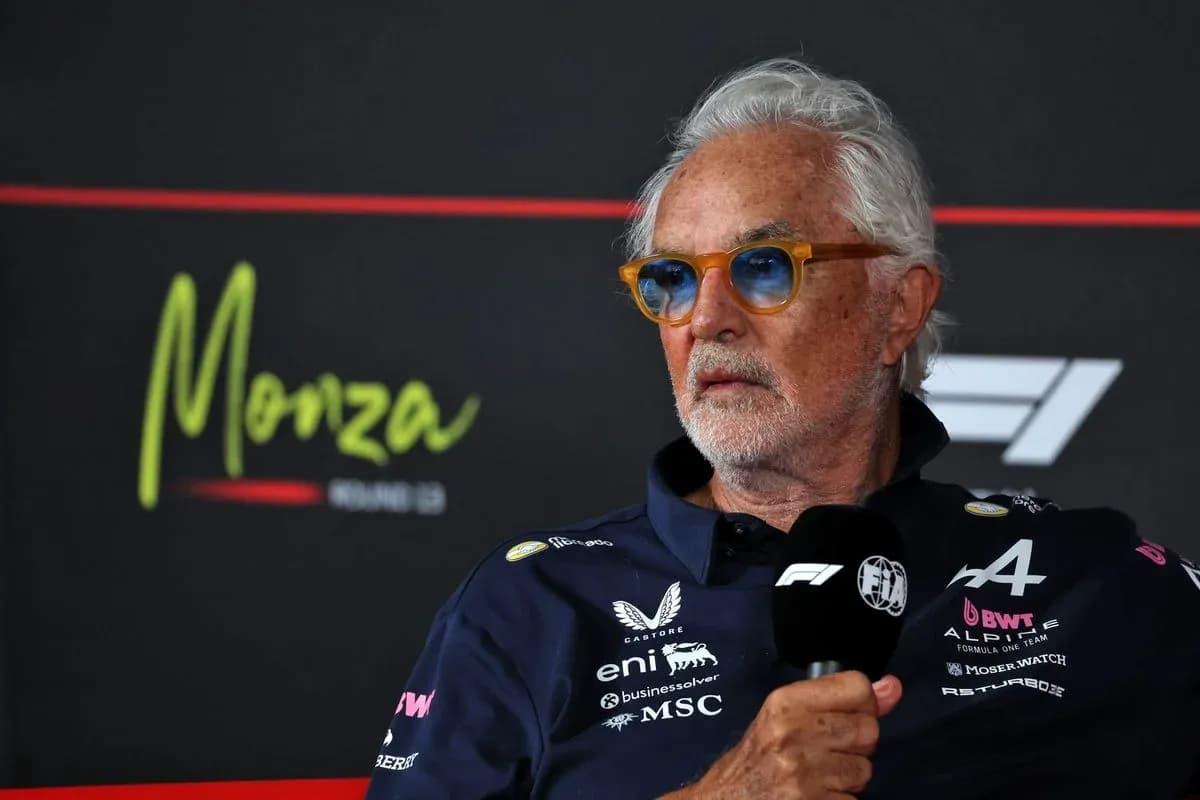
Flavio Briatore has never been one to waste a microphone. On Friday in Monza, he turned a routine Formula 1 press conference into a courtroom drama.
Hours after the FIA’s International Court of Appeal stripped Alpine and Pierre Gasly of their Monaco Grand Prix podium – reinstating the penalties that had dropped him out of the top three – the Alpine executive advisor went on the attack. Not against the verdict itself, but against one of the men who delivered it.
Briatore lights the fuse
Reading from a piece of paper, Briatore named Italian lawyer Filippo Marchino, one of the ICA judges, and accused him of having links to McLaren – the very team that had successfully appealed Alpine’s result.
“Filippo Marchino is a judge, he was very nasty during the hearing, was acting as a prosecutor,” Briatore said. “And after, we found out what is the reason why so nasty, this guy. He is very linked with McLaren.”
He called the situation “very unfair” and claimed Alpine had uncovered evidence only after the hearing.
Briatore spoke of “a nice picture” of Marchino giving a speech for McLaren in 2018 at MSO in Beverly Hills. He did not show the image, but pressed on.
“He has a foundation, it's called One Drop Foundation, and McLaren gave two, three McLaren cars,” he added. “This was quite unfair.”
Those cars, he was referring to, formed part of a charity auction in 2019 in aid of the One Drop Foundation, on whose board Marchino sits. One Drop was created by Guy Laliberté, the Cirque du Soleil co-founder and long-time associate of former McLaren chief Ron Dennis. McLaren providing cars for such an auction fits that long-standing relationship.
For Briatore, it was enough to raise the question. For McLaren, it was a line crossed.
McLaren hit back
Andrea Stella, usually one of the paddock’s calmer voices, bristled at the implication that McLaren had any improper influence over the court.
“I find that this conference going in this direction is quite insulting for McLaren, for the reputation of a team that deserves a lot of respect,” the McLaren team principal said.
“If anybody makes these kind of allegations – which seem quite serious – they are going to have to take the responsibility for what they are saying in a public forum.
“The hearing, the whole International Court of Appeal, was conducted to the highest standards and we should not question this phase like it’s been done.”
The temperature in the room spiked. What had started as a debrief of a legal outcome had become a public dispute over integrity.
Briatore, though, hinted Alpine might not leave it there.
“We’ve been thinking about it,” he said when asked if the team would pursue the matter. “Just pass the weekend and after that we think about it. For the moment, I don’t know.”
How far can Alpine really go?
That is the crux of it. The International Court of Appeal is the FIA’s highest judicial body. Its decisions cannot be appealed in the conventional sense.
There is, however, a narrow escape route: a right of review. Like the mechanism available for race stewards’ rulings, it allows a case to be reopened if “important new evidence is discovered which was unknown at the outset of the case before the ICA”.
Briatore insists Alpine only learned of Marchino’s alleged links after the hearing. “We found out, after the meeting, logically, not before,” he said. “We found out this guy was linked with the McLaren team.”
Whether that meets the bar for “important new evidence” is another matter entirely.
The FIA stressed on Friday that the composition of the ICA panel goes through a stringent vetting process. The court has a roster of 36 leading legal experts. For each case, at least eight are shortlisted and that list is sent to the parties in advance.
Teams then have the chance to raise any “serious and objective reasons” why a judge should be recused, including potential conflicts of interest. Alpine did not object at any stage, which allowed ICA president Laurent Anselmi to select four judges for the Monaco appeal.
There is another twist. Under F1’s own regulations, at least one judge in any ICA hearing related to the world championship must be someone elected to the pool at an FIA general assembly on the proposal of at least five teams or three manufacturers.
In 2023, Marchino – along with Luigi Fumagalli, who also sat on the Monaco appeal – was nominated at the FIA’s general assembly after being proposed by teams. Any such candidates face due diligence by the FIA compliance officer, then scrutiny by an ad hoc panel, before an eligibility assessment committee signs them off.
Even once they are in the pool, judges must confirm before each case that they are free from any conflict of interest. Only after that declaration does the FIA finalise the panel, and the identities of the judges remain secret from the parties until the day of the hearing.
That process is the FIA’s shield. Alpine would need to prove that what Briatore highlighted goes beyond optics and into the territory of genuine, disqualifying conflict.
A three‑month saga that won’t die
The Monaco Grand Prix took place in May. The fight over its podium has dragged on for three months. Now, with the ICA verdict published and Gasly’s top-three finish officially erased, the sport finds itself waiting again.
Either Alpine push for a right of review and try to prise open a door that usually stays shut, or they swallow a decision they clearly believe stinks of injustice.
In a championship already defined by tight margins and sharper tongues, the next move will say as much about Alpine’s appetite for confrontation as it will about Formula 1’s faith in its own justice system.