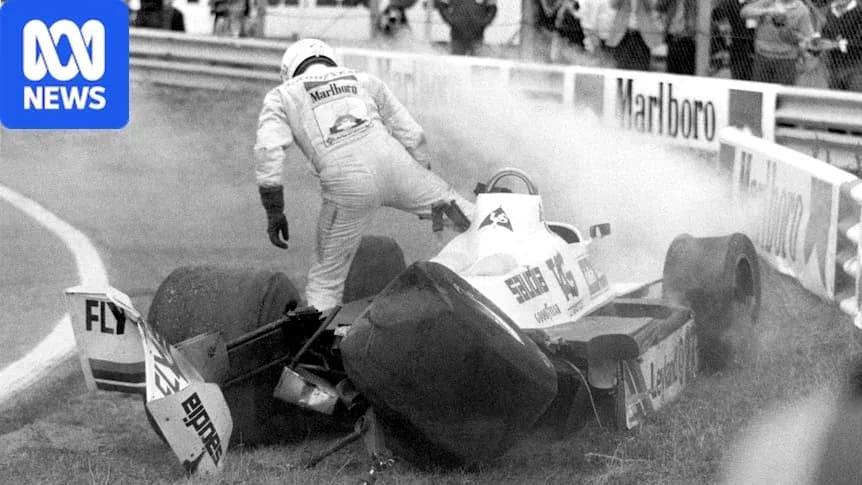
Alan Jones: A Champion from Formula 1's Brutal Era
Alan Jones has died at 80, and with him goes one of the last great links to Formula 1’s most brutal age — a time when world titles were won on Sunday and funerals followed on Monday.
The Australian, a 12-time grand prix winner and 1980 world champion, built a career on grit and raw speed. He also built it in a paddock where every driver knew the next car to disappear from the grid might never come back.
His story is stitched together with trophies, but also with tragedy.
Baptism of Fire in Barcelona
Jones’s first taste of Formula 1 came at one of the sport’s darkest weekends.
The 1975 Spanish Grand Prix at Montjuïc Park should never have started. Drivers complained that the barriers were not properly bolted in. Members of the Grand Prix Drivers Association refused to go out. There were threats, rumours that the Guardia Civil might seize the cars if teams pulled out. Under that cloud, the race went ahead.
Jones, driving for Hesketh, qualified 21st. His own race barely began — a collision ended his afternoon after just three laps.
The real horror came later.
On lap 26, race leader Rolf Stommelen’s rear wing failed. His Hill-Ford snapped out of control, cleared the barriers and ploughed into the crowd. Five spectators died. Stommelen was badly injured. The race limped on for four more laps before officials finally stopped it.
Montjuïc entered history for another reason that day: Lella Lombardi finished sixth and became the first, and still the only, woman to score Formula 1 world championship points.
For Jones, it was a stark introduction. Formula 1 was glamorous from a distance. Up close, it was lethal.
A Drive Born from Death
By the end of 1976, Jones had fallen out with Team Surtees and was out of Formula 1. His career at the top level looked like it might already be over.
Then came Kyalami, 1977.
Renzo Zorzi’s Shadow pulled off on the main straight with a fuel leak and a small fire. Two marshals sprinted across the live track carrying fire extinguishers. One car swerved and missed them. Tom Pryce did not.
Pryce, Zorzi’s teammate, hit 19-year-old marshal Frederik Jansen van Vuuren at full speed. The teenager died instantly. The extinguisher he was carrying smashed into Pryce’s helmet and killed the Welshman on impact.
Niki Lauda won the race, unaware of the full scale of the disaster until a Goodyear representative reached him before the podium and told him what had happened.
Those needless deaths opened a door. Shadow needed a driver. They turned to Alan Jones for the next race in the United States.
He took the seat. Later that year in Austria, he delivered Shadow its only Formula 1 victory — a hard, attacking drive that announced him as a serious contender and set him on the path to a championship future.
His rise was built on opportunity. The sport’s cruelty had created it.
Williams Glory and the Ferrari That Never Was
From 1979 to 1981, Alan Jones stood at the peak of the Formula 1 world.
In a Williams that became the benchmark, he won 11 grands prix in three seasons and clinched the 1980 world title. Aggressive, uncompromising and relentlessly quick, he suited Frank Williams’s operation perfectly. The partnership felt inevitable.
It very nearly never happened.
Before that Williams run, Ferrari had sounded him out. The Italian giants told Jones he was second on their list if they failed to land Mario Andretti. They did miss out on Andretti, who went on to win the 1978 title with Lotus. Instead, Ferrari signed a young Canadian with a wild streak: Gilles Villeneuve.
Jones headed to Williams. Villeneuve became a Ferrari icon. Two careers, two directions, both framed by what came next.
In 1982, a year after Jones’s first retirement, Ferrari endured a season of nightmares. Villeneuve died during qualifying at the Belgian Grand Prix after hitting the back of a much slower car. His Ferrari was launched into the air, disintegrated, and he was thrown clear as it smashed back to the ground.
Later that year in Germany, Didier Pironi suffered appalling leg injuries when he ran into the rear of Alain Prost’s Renault in poor visibility. His Formula 1 career was effectively over in an instant.
Jones would later say Ferrari contacted him that season, asking if he would return to fill in for the closing races. He hesitated. They moved on to another driver. Another fork in a career shaped by fate and timing.
A Champion from a Horrifying Era
Between Jones’s debut in 1975 and his final retirement in 1986, five drivers died on grand prix weekends. Two more were killed in testing. Australian Brian McGuire also lost his life at Brands Hatch in 1977 while driving an F1 car.
It was an era that demanded bravery just to line up on the grid. The risk was not theoretical; it was visible, week after week, in black armbands and hastily arranged memorials.
Jones thrived in that world. He raced hard, fought hard, and walked away with a championship, knowing many of his peers never had that chance.
The sport he left in 1986 would not stay frozen in that time.
From Open Cockpits to the Halo
After Jones stepped away, Formula 1 slowly began to change. Circuits were modified. Barriers improved. Medical response became sharper. The sport went several years without a fatal accident.
Then came Imola, 1994. Ayrton Senna and Roland Ratzenberger died on the same weekend at the San Marino Grand Prix, a shattering reminder that progress had not gone far enough.
Since then, only one driver has died as a result of a Formula 1 race incident: Jules Bianchi, who slid off a soaked Suzuka circuit in 2014 and struck a recovery crane that was attending Adrian Sutil’s stranded car. The crash, and the circumstances around it, again forced the sport to confront its procedures and its conscience.
Modern Formula 1 looks, and is, far safer than the world Alan Jones entered. The Halo — the wishbone-shaped titanium structure above the cockpit — has already justified its existence several times over. It helped save Romain Grosjean in Bahrain in 2020 when his car split the barriers and burst into flames. It shielded Lewis Hamilton when Max Verstappen’s Red Bull landed on top of his Mercedes at Monza in 2021. It protected Guanyu Zhou as his Alfa Romeo skated upside down and vaulted the barriers at Silverstone in 2022.
Each of those drivers climbed out and walked away. In Jones’s day, many would not have.
Alan Jones leaves behind a world champion’s record and a reputation for toughness that matched the era he raced in. He also leaves behind a sport that finally learned, through the loss of men like Pryce, Villeneuve, and so many others, that speed without safety carries an unbearable cost.
The cars are faster now. The circuits are safer. The risk will never be zero.
But every time a driver survives a crash that would once have been unthinkable, part of that survival traces back to the brutal lessons of the age that shaped Alan Jones.