Alan Jones' Historic Win at the 1977 Austrian Grand Prix
The engines howled on the grid at the 1977 Austrian Grand Prix, the air thick with exhaust and expectation.
On pole sat Niki Lauda, the iron-willed local hero, barely a year removed from the inferno at the Nürburgring that had burned his face and almost taken his life. Just behind him, James Hunt – all swagger, hair and charisma – the Englishman Lauda once admitted was the only man he ever envied. Third was Mario Andretti, the American superstar with a résumé that would come to define motorsport greatness: F1 world champion, four-time IndyCar king, Daytona 500 winner.
And way back in 14th, in a car that had never tasted victory, waited Alan Jones.
No glamour. No myth. Just a 30-year-old from Victoria who’d joined the F1 grid only months earlier, stepping into the seat left empty by the tragic death of Tom Pryce in South Africa.
Jones, who died on Thursday aged 80, never fit the sport’s poster-boy mould. He was called overweight. Laconic. Underprepared. He didn’t stalk the paddock like a movie star or an assassin. He looked more like someone who might process your bank loan than hurl a grand prix car through high-speed corners.
But he could drive. That was never in doubt.
On that grey August afternoon at the Österreichring, the bloke who once sold Holdens at his dad’s dealership in suburban Melbourne would rip up the script.
The rain had cleared just enough to cause chaos. Half the grid rolled the dice on wet-weather tyres, the rest on slicks. Lauda, on wets, struggled for grip in the greasy early laps. Andretti pounced, slicing past both Lauda and Hunt after a minor tangle between the two headline acts.
Eyes went straight to Andretti, the favourite now out front, and to Gunnar Nilsson, the Swede storming through the field from 16th to second, his wet tyres biting into the damp surface.
Somewhere behind the noise and the narrative, Jones was quietly carving his own.
From 14th to fourth, he threaded his Shadow through the traffic, trusting slicks on a track that still glistened in places. It was a brave call. Others hesitated. Jones committed.
As the sun finally broke through and the circuit dried, Nilsson’s gamble unravelled. His tyres shredded, forcing him into the pits. Then Andretti’s Lotus detonated in a plume of smoke and shattered hopes, his engine failure blowing apart what had looked like a certain win.
That left Hunt in front, Jones locked onto him, and Lauda – now on fresh tyres and charging – back in the hunt in third.
It was a fitting trio for the era: Hunt and Lauda, the central figures of the rivalry later immortalised in “Rush”, split by a round-faced Australian who preferred letting the stopwatch do his talking.
The race tightened. The laps ticked down.
Then came the moment that changed everything.
Hunt’s McLaren erupted, sparks and flames licking from the rear as his car coasted to a halt by the side of the circuit. Marshals swarmed, clouds of extinguisher dust swallowing the stricken machine.
Out of that haze emerged the unlikely new leader.
Alan Jones, in a Shadow that had never won a race, now headed Lauda and the rest of the field. He didn’t blink. He didn’t flinch. He just drove.
He held Lauda off to the flag, taking the first of his 12 grand prix victories – and the only win Shadow would ever claim in its eight-year existence in Formula One.
His mechanics spilled onto the track, disbelieving and delirious. The circuit announcer, unsure of the history he was witnessing, told the crowd it was Australia’s first F1 victory in seven years.
“The first Grand Prix win for Alan Jones, and the first Grand Prix win for the hard-working Shadow team,” came the call over the PA.
“And, we think, the first Grand Prix win for Australia in seven years.”
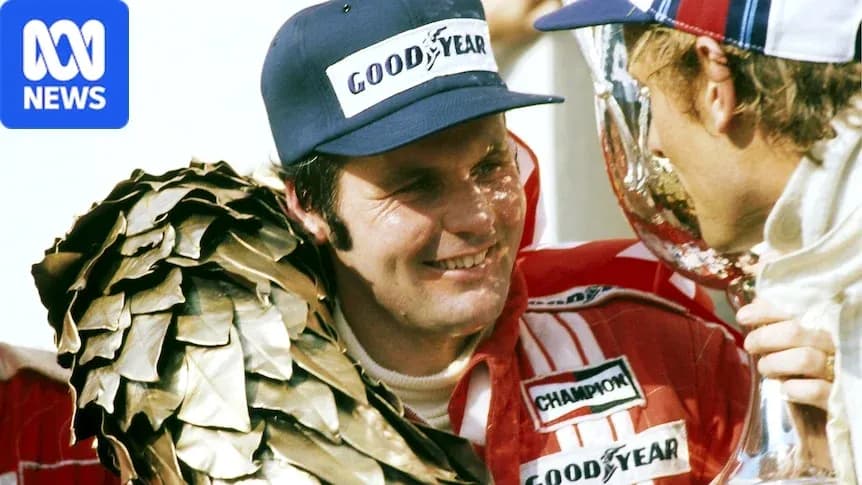
In pit lane, the unvarnished Aussie was suddenly the centre of the racing universe. With his then-wife Beverley in one arm and a bottle of champagne in the other, he planted a big kiss on her, then – at her urging – cracked the bottle, took a long swig and headed for the podium.
Draped in a golden wreath, band blaring in the background, Jones created one of the sport’s great stories – and one of its most enduring half-truths.
“[The win] was a bit of a surprise to everybody,” he later told Wide World of Sports co-host Daryl Eastlake.
“In fact they had trouble finding the Australian national anthem, so some drunk played Happy Birthday on a trumpet.
“That’ll give you an idea how prepared they were for me to win.”
It made for a brilliant tale. The reality was slightly different.
Audio from the day captures trumpeters in the distance rattling through tunes like “La Cucaracha” before they finally launch into “Advance Australia Fair” as Jones takes his trophy.
The official anthem at the time, “God Save the Queen”, never rang out. Australia had reinstated it in 1976 after Gough Whitlam’s government had first introduced “Advance Australia Fair” in 1974. The country’s musical identity was in flux; the podium soundtrack reflected the confusion.
Maybe, in the blur of emotion and noise, Jones mistook “Advance Australia Fair” for “Happy Birthday to You”. Maybe he barely heard it at all, only remembering the boozy trumpet blasts and carnival atmosphere before he stepped onto the top step. Maybe he simply didn’t recognise the tune that had already been the anthem, stopped being the anthem, then would become the anthem again.
What can’t be argued is what followed.
Over the next few years, Formula One organisers learned the Australian anthem the hard way – by hearing it. Often. Jones made sure of that.
In an era many still call the golden age of F1, Australia’s leading man wasn’t a matinee idol or a marketing dream. He was a straight-talking, broad-shouldered racer who looked more like a bank teller than a film star, and drove like his life depended on every lap.
That contrast, that lack of polish wrapped around a core of steel and talent, became his calling card – and the source of a quiet, enduring pride for Australian motorsport that no amount of gloss could ever improve.