Monza: The Heart of Formula 1's Triumphs and Tragedies
The story of Formula 1 begins in Italy, and inevitably, it begins at Monza.
In 1950, at the end of the sport’s very first season, Giuseppe Farina hurled his Alfa Romeo around the royal park and sealed the inaugural world championship. An Italian, in an Italian car, crowned champion on Italian soil. No one has repeated that particular trifecta since. The image of Farina in that moment is more than a snapshot; it’s the opening line of a saga that would make Monza one of the most mythic venues in motorsport.
Champions on a Knife-Edge
By 1953, the cast list at Monza read like the sport’s founding scripture. Farina again. Juan Manuel Fangio in a Maserati. Alberto Ascari in a Ferrari. Three men who would share the first eight world titles between them, lining up on a grid that felt like a roll call of destiny.
Fangio won that race, but Ascari walked away with the championship. The pattern was set early at Monza: you could win the battle and still lose the war, or vice versa, and the crowd would roar just as loudly either way.
The mid-1950s brought a different kind of theatre. In 1956, Fangio, Stirling Moss and Peter Collins fought on Monza’s steep, intimidating banking, a relic of a more brutal age that would survive in use until 1961 and still looms, ghostlike, over the modern circuit. Moss, in a Maserati, claimed the win. Behind him, Ferrari’s Fangio and Collins shared second place after Collins, in a remarkable act of sportsmanship and sacrifice, handed his car over to his team-mate. The points from that day helped Fangio secure the fourth of his five titles. Monza, again, decided the shape of greatness.
When the Cost Turned Unbearable
The same strip of asphalt that crowns champions has also delivered some of Formula 1’s darkest days.
In 1961, Ferrari’s Wolfgang von Trips arrived at Monza on the brink of the world championship. He never left. On the second lap, he collided with Jim Clark’s Lotus. Von Trips’ car was launched into a crowd on an embankment. He and 14 spectators were killed. The photograph of him before the race, unaware of what was coming, has become one of the sport’s most haunting images.
Nine years later, tragedy struck again. Nina Rindt sat in the pits in 1970, stopwatch in hand, timing her husband Jochen during practice. Moments later, on the approach to Parabolica, a likely suspension failure on his Lotus sent him to his death. Weeks after the accident, Rindt was crowned Formula 1’s only posthumous world champion. Even in its mourning, the sport could not escape Monza’s influence on its history.
The pattern would not stop there. At the start of the 1978 Italian Grand Prix, a multi-car accident erupted behind the leaders. Ronnie Peterson’s Lotus was smashed, the Swede trapped inside with severe leg injuries. Other drivers dragged him from the wreckage. The injuries did not initially appear fatal, but long delays in treatment and complications led to his death the following morning. On the same day, his team-mate Mario Andretti clinched the world title. His words afterwards cut to the bone: “Unfortunately, motor racing is also this.”
Slipstreams, Photo Finishes and Chaos
For all its sorrow, Monza has also staged some of the most exhilarating racing the sport has seen. Before chicanes tamed its straights, the circuit turned grands prix into high-speed dogfights, with slipstreaming battles that ran right to the flag.
In 1969, Jackie Stewart’s Matra beat Jochen Rindt’s Lotus, Jean-Pierre Beltoise’s Matra and Bruce McLaren’s own car by less than two tenths of a second. Four cars, separated by a blink. Two years later, the finish somehow got even tighter. In 1971, BRM’s Peter Gethin crossed the line ahead of Ronnie Peterson, Francois Cevert, Mike Hailwood and Howden Ganley. The top five were covered by just six tenths of a second. Monza turned the stopwatch into a weapon and the finish line into a knife-edge.
The circuit’s character seeped into everything, even off-track moments. In 1973, team owner Frank Williams organised a race around the circuit for drivers and team members. James Hunt led the pack visually and predictably drew the eye, bare-chested and flamboyant. Williams, grinding away behind him, actually won and pocketed the £750 prize. At Monza, even a fun run carried a competitive edge.
Scars, Redemption and the Weight of a Title Fight
Some drivers have arrived at Monza carrying more than just championship hopes.
Niki Lauda turned up in 1976 with his burns still raw from his near-fatal crash at the Nürburgring. Six weeks after being pulled from a burning Ferrari, he strapped himself back into a car at Monza, still in significant pain, to keep his title fight with James Hunt alive. Lauda finished fourth that day, extending his lead over the McLaren driver. Hunt would eventually snatch the championship by a single point, but Lauda’s return at Monza stands as one of the sport’s most courageous acts.
Decades later, another champion’s vulnerability spilled out in the same paddock. In 1999, Mika Hakkinen spun out of the lead and into the gravel, then broke down in tears, convinced he had thrown away the title. The image of the usually ice-cool Finn weeping by the track underlined what Monza often does: it strips away the armour and leaves the raw emotion of a title fight exposed. Hakkinen would recover and beat Ferrari’s Eddie Irvine to the championship, but the scar of that afternoon never quite faded.
Family, Legacy and the Tifosi’s Roar
Monza is not just about speed and fear. It has always had a human, almost domestic side too.
In 1967, Graham Hill sat in the Lotus pits, calmly adjusting his helmet and visor. Around him, his family gathered: wife Bette and their children, including a six-year-old Damon Hill standing at the front. In that single frame, two generations of world champions shared the same concrete floor. The circuit that so often delivers brutal endings also quietly records the beginnings of dynasties.
Then there is the bond between Monza and Ferrari, a relationship that feels more like religion than sport. The tifosi turn the main straight into a red, heaving mass of devotion. In 1988, they had their moment in the most dramatic circumstances. McLaren had dominated the year and looked set for a clean sweep until Jean-Louis Schlesser, standing in for Nigel Mansell at Williams, collided with Ayrton Senna as the Brazilian tried to lap him with two laps remaining. Senna’s retirement opened the door for Ferrari to finish one-two, Gerhard Berger leading Michele Alboreto. The victory came just weeks after Enzo Ferrari’s death. Joy, grief, catharsis – all of it poured out on to the tarmac.
In 2000, the tifosi flooded the start-finish straight again, this time to celebrate Michael Schumacher. His win at Monza proved pivotal on the road to his first of five consecutive drivers’ titles with Ferrari. The sea of red that engulfed the circuit that day confirmed what everyone already knew: when Ferrari wins here, it feels less like a result and more like a national event.
Collisions, Survival and the Modern Era
Monza’s first chicane has long been a magnet for chaos. The funneling of cars from flat-out speed into a tight right-left has produced countless near-misses and pile-ups. The 2011 start captured that perfectly: cars pointing in all directions, drivers scrambling for grip and space, the race exploding into disorder before it had truly begun.
Some of Monza’s most striking modern images, though, have come from the sport’s evolving safety story. At the same Variante where Senna was wiped out by Schlesser in 1988, he tangled again with a Williams in 1993 – this time driven by Damon Hill. Both continued, and Hill came back to win, but the echo of the earlier incident hung in the air.
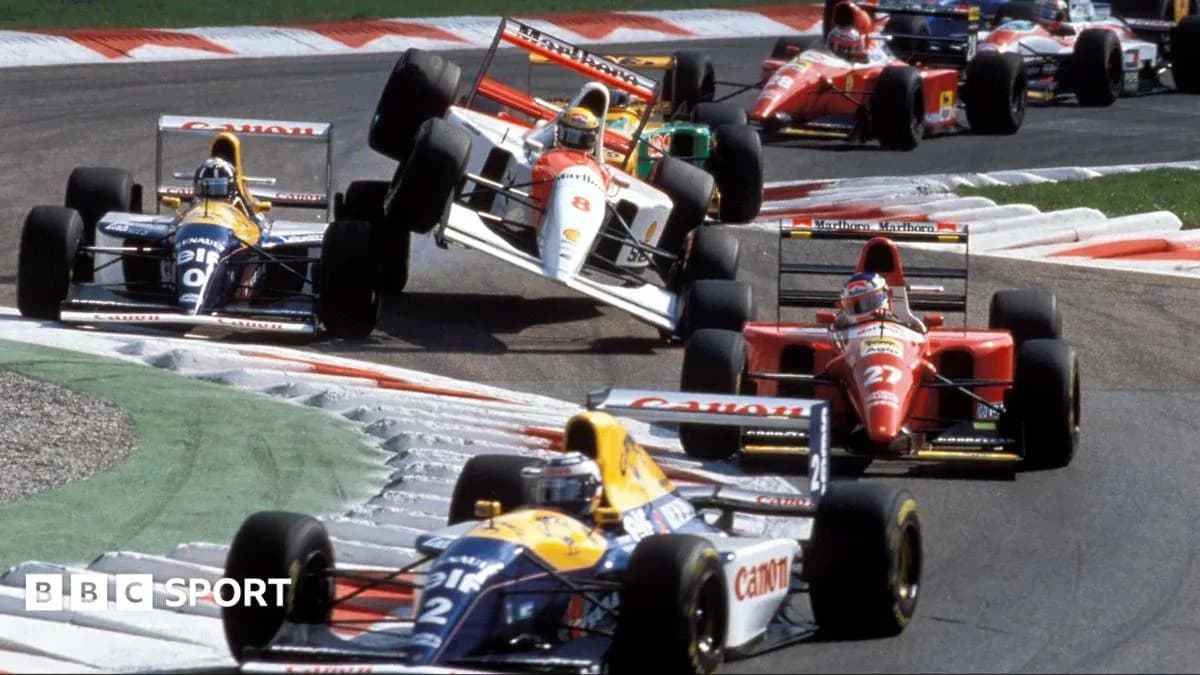
Later that same race, Christian Fittipaldi’s Minardi somersaulted over team-mate Pierluigi Martini’s car on the run to the finish line. The Minardi flipped, landed back on its wheels, and Fittipaldi’s forward momentum carried him across the line. He finished eighth, one place behind Martini, both drivers unhurt. It was the kind of surreal, heart-in-mouth moment that only Monza seems able to conjure.
In 2021, the circuit delivered another defining image. Max Verstappen and Lewis Hamilton, locked in a ferocious title battle, collided at the first chicane. Verstappen’s Red Bull rode up over Hamilton’s Mercedes, the rear of the car landing on the Briton’s cockpit. The halo device, once controversial, suddenly looked indispensable. The structure likely saved Hamilton from serious injury. On a track that has witnessed so much loss, the sight of both men climbing out and walking away felt like a quiet revolution.
A Circuit That Refuses to Be Tamed
Across seven decades, Monza has been a constant in a sport that changes its cars, its rules and its stars with relentless speed. It has crowned champions, broken hearts and forced Formula 1 to confront its own mortality more than once.
The old banking still stands, a crumbling monument to a wilder era. The chicanes have slowed the lap times but not the drama. The tifosi still pour over the fences when the chequered flag falls, and the drivers still talk about the place with a mix of awe and unease.
Monza does not just host Formula 1. It shapes it. And as long as the engines fire in the royal park, the sport will keep returning to the scene of its greatest triumphs and its hardest lessons, chasing glory on a circuit that never truly forgives.