The Madring: F1’s New Bold Arena in Madrid
Formula 1 rolls into unknown territory this weekend. The Madring, wrapped around Madrid’s IFEMA Exhibition Centre and skirting the city’s main airport, is the championship’s first brand-new venue since Las Vegas in 2023 – and it looks nothing like a stopgap street track.
Half of it feels like a permanent circuit, carved into the exhibition grounds and climbing towards a vast banked corner that already dominates every conversation. The other half snakes through tighter, more traditional street-style sections. On foot, the place feels big, fast and unforgiving.
Drivers won’t turn a wheel in anger for another day, but the early walkabouts have told their own story. This could be a spectacular weekend. It could also be brutal.
La Monumental: the showpiece that could define the circuit
Everyone in the paddock is talking about one corner. La Monumental.
On the first drawings it looked ambitious. In reality, it’s something else entirely.
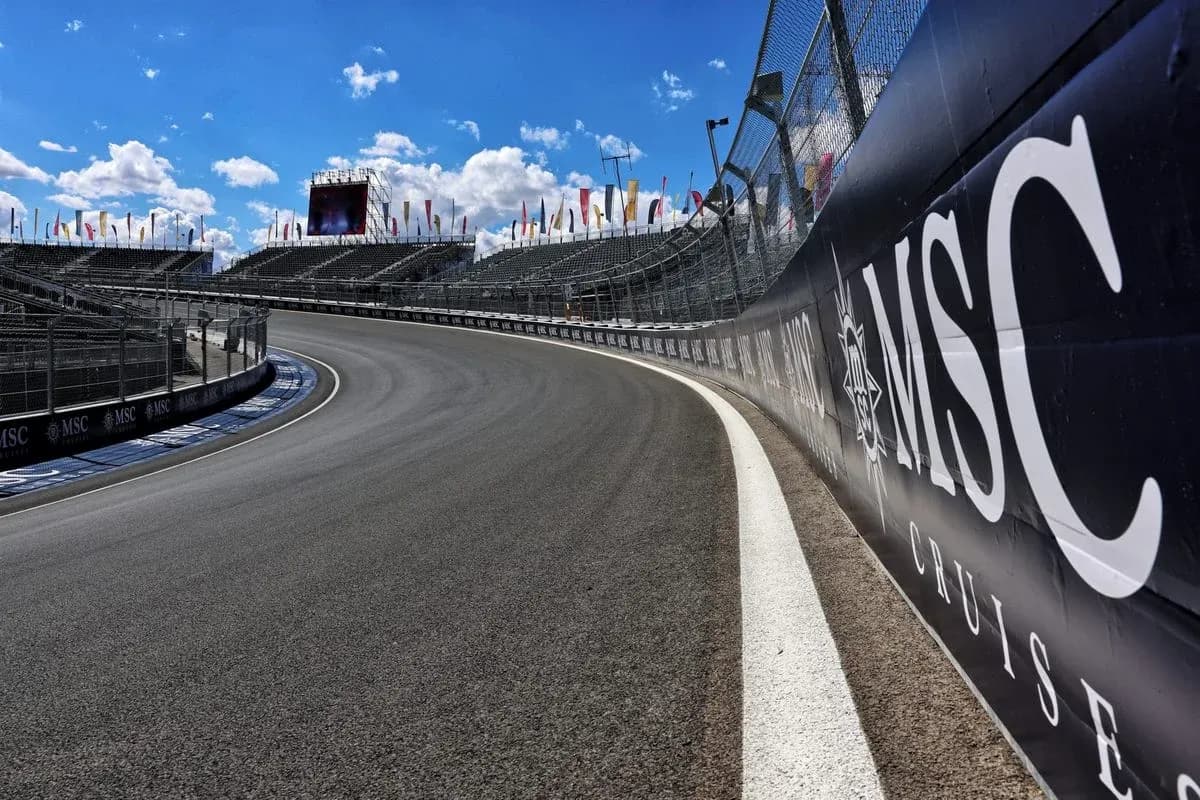
The 550-metre-long banked turn sits like a colossus at the far end of the lap, framed by steep grandstands and a huge hospitality complex on the inside. Stand trackside and it feels like an amphitheatre: steep concrete, high banking, and the sense that 20 cars will be thrown into the bowl at once.
Teams, drivers and Pirelli have all flagged it as one of the most technically demanding corners of the season. The loads on the tyres, the changing lines, the commitment on entry – this is not a corner to tiptoe through.
The big question now is how many ways there are to attack it. If multiple racing lines emerge, La Monumental won’t just be a visual centrepiece. It will be the overtaking heart of the Madring.
Turn 5/6: the sting in the tail of the high-speed run
La Monumental may grab the headlines, but the real trouble spot could lurk much earlier in the lap.
Turn 5/6 – a chicane at the end of the fastest section of the circuit – is already leaving its mark. Literally. F3 testing has painted black arcs of rubber across the asphalt, and those tyre marks are still there.
From Turn 3, the track sweeps and builds speed, funneling the cars into a tightening, awkward chicane. The kerbs demand respect; attack them too hard and the car will bounce, slide or worse. Yet the real danger sits a few metres further on.
The exit barrier is angled into a pinch point. Get the chicane slightly wrong, run a fraction wide, and the car is heading straight towards concrete with nowhere to go. It’s the kind of corner that punishes misjudgment, not just with lost time, but with broken suspension and red flags.
Turn 17, a heavy-braking right-hander that follows a quick left kink, will also test drivers’ nerve and car stability. But Turn 5/6 feels like the place where qualifying laps could end abruptly and races could swing in an instant.
A smooth, fast surface – with teeth at the edges
For a street-based venue, the Madring’s surface is a surprise. It’s silky.
Track walks have revealed almost no serious bumps, no awkward patches, no sudden steps that would force teams to crank up the ride heights. The fresh asphalt should let engineers chase aggressive setups without the fear of bottoming out over hidden ridges.
That doesn’t mean it’s forgiving.
In many areas, walls form the natural track limits. Miss your braking point or misjudge a line and there is no vast run-off to save you, just concrete. Where there is space, painted kerbs push the cars back from the barriers, and the FIA has laid down its now-familiar ribbed paint strips – the same visual cues used in Jeddah, Miami and Austin – to help drivers judge the white lines at speed.
The grip evolution over the weekend could be dramatic. Smooth new tarmac, a fresh layout and a packed schedule usually mean one thing: a track that changes lap by lap.
A paddock on a different scale
Away from the racing line, the Madring has already disorientated the paddock.
The team garages sit inside the IFEMA exhibition complex, and the result is unlike any other F1 layout. Instead of a neat, continuous row of garages, the line is split in two by a 150-metre gap between Williams and Racing Bulls, with the media and TV pen dropped right into the middle.
Behind the garages, the picture becomes even more unusual. Some teams operate from air-conditioned halls within the buildings, others – including McLaren and Mercedes – are stationed outside in the heat with their trucks and engineering offices. The hospitality units live in their own separate zone altogether.
The scale is such that a simple walk between Williams and Racing Bulls, normally neighbours in a traditional paddock, now takes more than two minutes. It’s a logistical maze, and everyone – from mechanics to media – is still working out the shortcuts.
“Bonkers big” has become the phrase of the week. No one is arguing.
A marathon pitlane and a brutal time loss
The quirks of the IFEMA complex don’t stop at the garages. They stretch into the pitlane as well.
Because the pit building runs so far along the exhibition space, the pitlane is enormous. From the first speed limiter line to the second, the official distance is 562 metres – one of the longest in modern F1.
Then comes the exit.
Rather than rejoining at Turn 1, the pitlane feeds the cars back out at Turn 3. Drivers will accelerate hard along a narrow lane, skimming a right-hand concrete barrier before they blend into the racing line. It’s tight, fast and will demand absolute concentration, especially in traffic or in changing conditions.
Pirelli estimates the time loss for a stop at around 25 seconds. That’s significant. Teams will think twice before diving in unless they absolutely have to, which could push strategy towards longer stints and bolder tyre gambles.
The Madring is not just another street circuit painted onto a city grid. It’s a hybrid: part purpose-built arena, part urban challenge, wrapped around a paddock that feels like a trade fair gone racing.
Smooth tarmac, a colossal banked corner, a vicious chicane and a pitlane that punishes indecision – this place will ask questions of every team and every driver.
By Sunday night, we’ll know who has the answers.