Lewis Hamilton and the Ferrari F40: A Dream Revived
Lewis Hamilton’s love affair with Ferrari did not begin with a contract, a press release or a fire-up of the latest Formula 1 engine. It began with a shape, a noise and a poster on a bedroom wall.
The Ferrari F40 was the car that made him feel something. Not just admiration, but longing. The raw, unfiltered drama of a scarlet wedge that seemed to vibrate with anger even when standing still. Long before seven world titles and the move to Maranello, the F40 was the machine that defined the myth of Ferrari in Hamilton’s imagination.
Decades later, that childhood dream has acquired a chassis number.
A time capsule on four wheels
The car that now belongs to Hamilton is no ordinary F40. It is a 1991 example with a backstory that sounds almost implausible in an era of speculative classics and over-restored museum pieces.
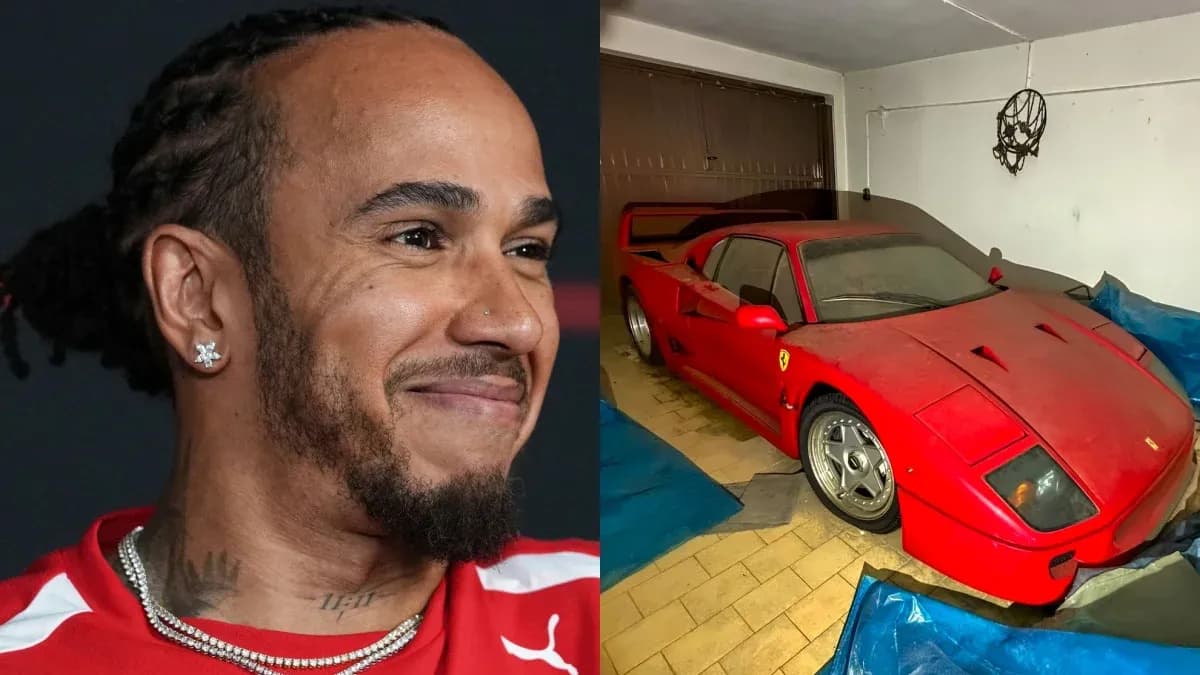
Located by Azimut Automobile Heritage Enhancement in late 2025, the car had effectively been frozen in time. Delivered new, then pushed into a private garage within days, it sat there for roughly 35 years. No track days. No Sunday blasts. No backroad heroics. Just silence.
It still showed delivery mileage. The panels had never been taken off. The car had never been dismantled, modified or restored. According to those who inspected it, not a single screw had been turned since it left Ferrari. Dust, dirt and dead insects told the story of neglect; the bodywork beneath revealed something else entirely.
Thanks to unusually kind storage conditions, the original Rosso paint survived intact. The stance, the finish, the details – all carried the patina of authenticity rather than the gloss of a modern restoration. For collectors, this is the holy grail: a car that has aged, but never been tampered with.
Azimut AHE stepped in and acquired the F40 before it ultimately found its way into Hamilton’s hands. For a driver who had once surrounded himself with a multimillion-dollar car collection, this was the one that truly mattered.
The one car he couldn’t let go
When Hamilton reported for his first official day as a Ferrari driver in January 2025, the symbolism was impossible to miss. Beside him, for the photograph that announced his new era, sat an F40. The past and the present of Ferrari, framed in a single image.
Months later, he revealed that he had sold his entire car collection, saying his attention had shifted toward art. One machine escaped the cull. The F40. In his eyes, it was not just a car; it was a piece of art in its own right.
Owning it was not enough. Hamilton sent the F40 back to Maranello, to the place where it was born, and asked Ferrari’s own engineers and mechanics to wake it up.
They approached it like conservators, not customisers. Major components came out, including the engine, but the brief was clear: make it run, and keep it original. Weeks of painstaking work followed as they coaxed life back into a car that had not turned a wheel in anger for decades, all while preserving the details that made it so remarkable in the first place.
No wild upgrades. No modernisation. Just a factory bringing one of its purest creations back into the world.
Back on the streets of Maranello
The result has now been seen where it belongs: on the streets around Maranello, with Hamilton at the wheel.
There is no glamour to the road he is on. A narrow two-way stretch, lined with everyday traffic, hardly the place to unleash a twin-turbo V8. Yet the scene says more than any staged photo shoot.
Hamilton eases the F40 through the flow, the car’s low nose and towering rear wing slicing through the ordinary. A motorcyclist pulls alongside, offers a quick greeting. The recognition is instant and unforced. Hamilton answers, then rolls on.
People begin to notice. Phones rise. Cars slow. Heads turn. The sound – that hard-edged, unmistakable rasp of a 2.9‑liter twin-turbocharged V8 – cuts through the noise of scooters and hatchbacks. The F40 doesn’t need to show its claimed 201 mph top speed to dominate the street. Its presence is enough.
He cannot explore its enormous performance here, not with traffic hemming him in and pedestrians stopping to stare. But that was never really the point. On this road, on this day, the car is a moving reminder of why Ferrari still stirs something deeper than simple brand loyalty.
Enzo’s last word
Introduced in 1987 to mark Ferrari’s 40th anniversary, the F40 carried a unique weight from the start. It became the final road car approved during Enzo Ferrari’s lifetime, the last machine to pass under his gaze before his death in 1988.
Beneath its slatted engine cover sits that 2.9‑liter twin-turbo V8, delivering 478 horsepower through a five-speed manual gearbox. No driving modes. No hybrid boost. Just a brutal, analogue connection between driver, engine and tarmac.
For Hamilton, now wearing Ferrari red, it is more than nostalgia. It is a link between the team he leads on track and the legend that drew him in as a boy. A car that once lived as a forgotten relic in a dark garage now moves through the light of Maranello, driven by the man tasked with writing Ferrari’s next great chapter.
The F40 has come back to life. The question now is how far Hamilton can push the modern prancing horse that first captured his imagination in that same unmistakable shade of red.