George Russell's Strategy for Engine Penalty
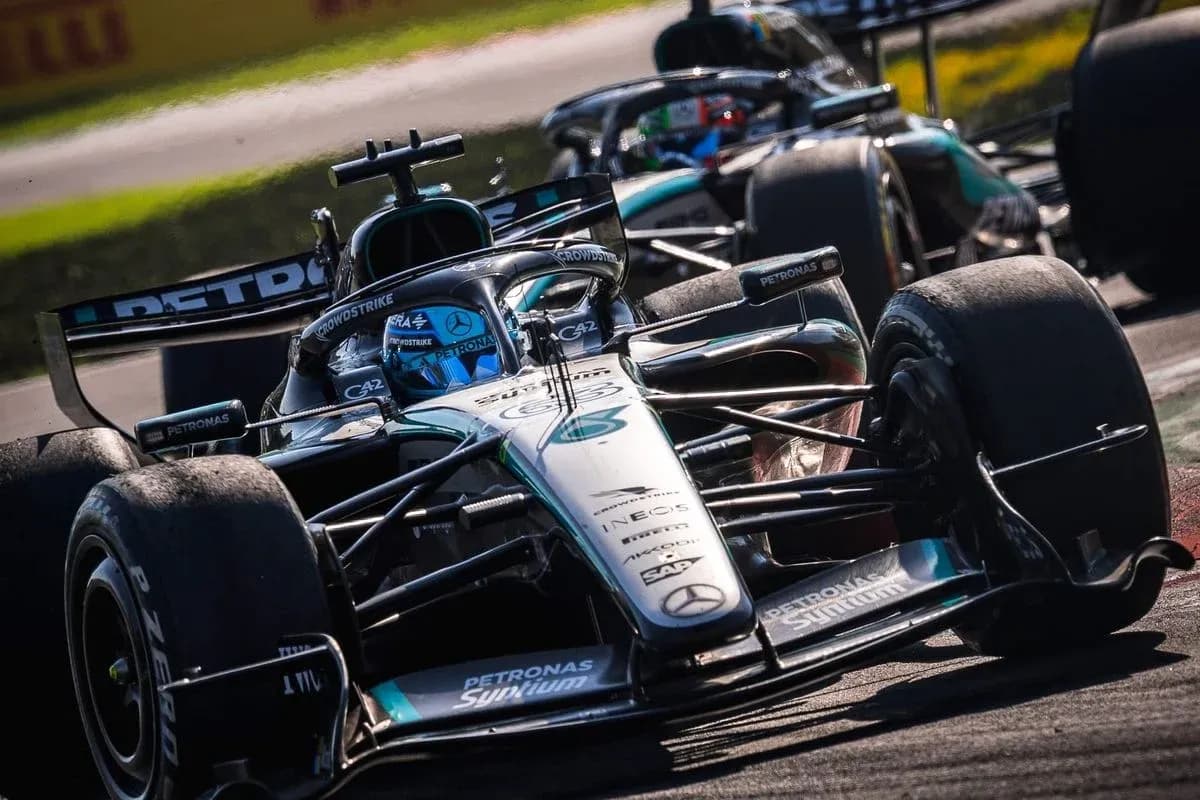
George Russell is prepared to wait for his punishment.
The Mercedes driver, already on the limit of his power unit allocation, will delay taking his inevitable Formula 1 engine penalty until the team’s upgraded ADUO-specification power unit is ready – a move that may not come until around the United States Grand Prix.
Strategy over short-term gain
Mercedes has been wrestling with early-season reliability issues that forced both Russell and team-mate Kimi Antonelli to burn through their permitted components just to keep their title push on track. Antonelli bit the bullet at Monza, taking extra power unit elements that dropped him to 19th on the grid. He still tore through the field to win.
On paper, Russell’s obvious moment to follow suit was Baku. Long straights, overtaking chances, slipstream battles – the kind of circuit where a fast car and fresh engine can turn a grid drop into a recovery drive.
But Mercedes has changed course.
The team wants Russell’s penalty to coincide with the introduction of its new ADUO-upgraded power unit, rather than wasting a grid drop on an older spec and then repeating the pain when the improved version arrives.
Speaking at the Spanish Grand Prix, Russell made it clear there was never really a debate inside the camp.
“We were always going to take my penalty with the ADUO upgrade,” he said. “Otherwise, if I took it there, I'd have to take it again. So it makes zero sense for me.”
Locked out by the limits
Russell’s situation is tight. He has already maxed out his allocation of key power unit components: internal combustion engine, turbocharger, energy store (battery), and control electronics. Any fresh parts in those areas before the ADUO upgrade is ready would trigger grid penalties.
Then, when the ADUO-improved components arrive, he would face another grid drop to switch onto them.
Mercedes is determined to avoid that double hit. The team’s plan is simple: take one big penalty, bolt on the new spec, and run it to the end of the season.
The complication is timing.
Initially, the expectation inside the paddock was that Mercedes would roll out its ADUO step for the next wave of flyaway races in Azerbaijan, Malaysia, and Singapore. That would have allowed Russell to serve his penalty earlier and enjoy the benefits over more rounds.
Now the picture has shifted. The upgraded power unit – understood to include an improved turbo – is increasingly likely to debut during the triple-header of the United States, Mexico, and Brazil, starting in Austin on October 23-25.
Until that spec is signed off, Russell remains on a knife-edge with no margin left in his allocation.
Antonelli’s different route
Antonelli’s path is more flexible.
At Monza, Mercedes did not give the championship leader a full new power unit. Instead, the team limited his changes to the internal combustion engine, battery, and control electronics. That decision now gives him room to manoeuvre.
He can still take a new turbo, MGU-K, exhaust and ancillaries without triggering a penalty. When Mercedes introduces the ADUO upgrade, he will have access to the improved hardware as well, but with more freedom in how and when he fits the remaining elements.
It is a contrast in positions within the same garage: Antonelli with some breathing space, Russell boxed in by the rules and forced to play the long game.
Knock-on effect for customers
Any step Mercedes makes with its works power unit cannot stay in-house. Under F1 regulations, any improvement in specification must also be made available to its customer teams.
There is a catch. At the first event where the upgrade appears, each customer operation receives only a single unit. That means they, too, will face strategic calls over which driver gets the new spec first and when to absorb any penalties.
For Russell, the equation is harsher. One penalty, at the right time, for the best possible engine Mercedes can give him. No second chances.
If the upgraded unit delivers what the team expects, the decision to wait could define the back end of his season. If it doesn’t, he will have carried an old-spec engine deeper into the year, gambling on an upgrade that never truly bites.
Mercedes has not yet nailed down the exact race for the ADUO debut. But when the new power unit finally appears, Russell’s reset will come with it – and so will the verdict on whether this slow, calculated approach was worth the risk.