BRM P351: The Lost Le Mans Prototype Returns to Racing
British Racing Motors has always occupied a particular corner of motorsport folklore. Long before Formula 1 became the corporate behemoth it is today, Raymond Mays and Peter Berthon were piecing together Britain’s first F1 team in 1949, trying to drag a post-war nation onto the global stage. By 1962, they’d done it: Graham Hill, a snarling V8, and both the Constructors’ and Drivers’ titles.
But BRM never wanted to be just a Formula 1 team. It wanted to build racing cars, full stop.
The Prototype That Never Got Its Story
Out of that ambition came one of the most intriguing what-ifs in endurance racing: the BRM P351. A single, carbon-composite Group C prototype, drawn up to take on the World Sportscar Championship in 1992 and, above all, the 24 Hours of Le Mans.
On paper, it had everything. A carbon-composite monocoque. A naturally aspirated 3.5-litre V12, designed in-house. The kind of technical purity that defined the era.
On track, it barely had time to breathe.
At Le Mans, the P351’s race ended early with transmission failure, its campaign cut short before it could build a reputation. Yet in those brief flashes of speed, it hinted at what might have been. It clocked 216 mph (348 kph) down the Mulsanne Straight, running with the heavy hitters from Peugeot and Toyota. For a moment, BRM’s green-and-white return to top-level endurance racing looked like it might be more than a romantic throwback.
It wasn’t. The car faded from the spotlight, seen again at circuits like Silverstone but never allowed to become the contender it was supposed to be.
From V12 Purist to Roofless Outlier
The original concept didn’t last long. As the 1990s moved on and regulations shifted, the P351 was reshaped into something else entirely. Out went the BRM-built V12. In came a Nissan twin-turbo V6. The roof disappeared too, and the car resurfaced under Pacific Racing, rebadged as the BRM P301.
Same chassis lineage, different soul.
For many, that might have been the end of the story: a promising prototype diluted, repurposed, and then quietly retired. Instead, the car found its way back home.
A Ghost Returns to Silverstone
In late 2024, the racer returned to BRM’s possession. That alone would have been a neat historical footnote. BRM chose something far bolder.
They decided to take it back to where it started.
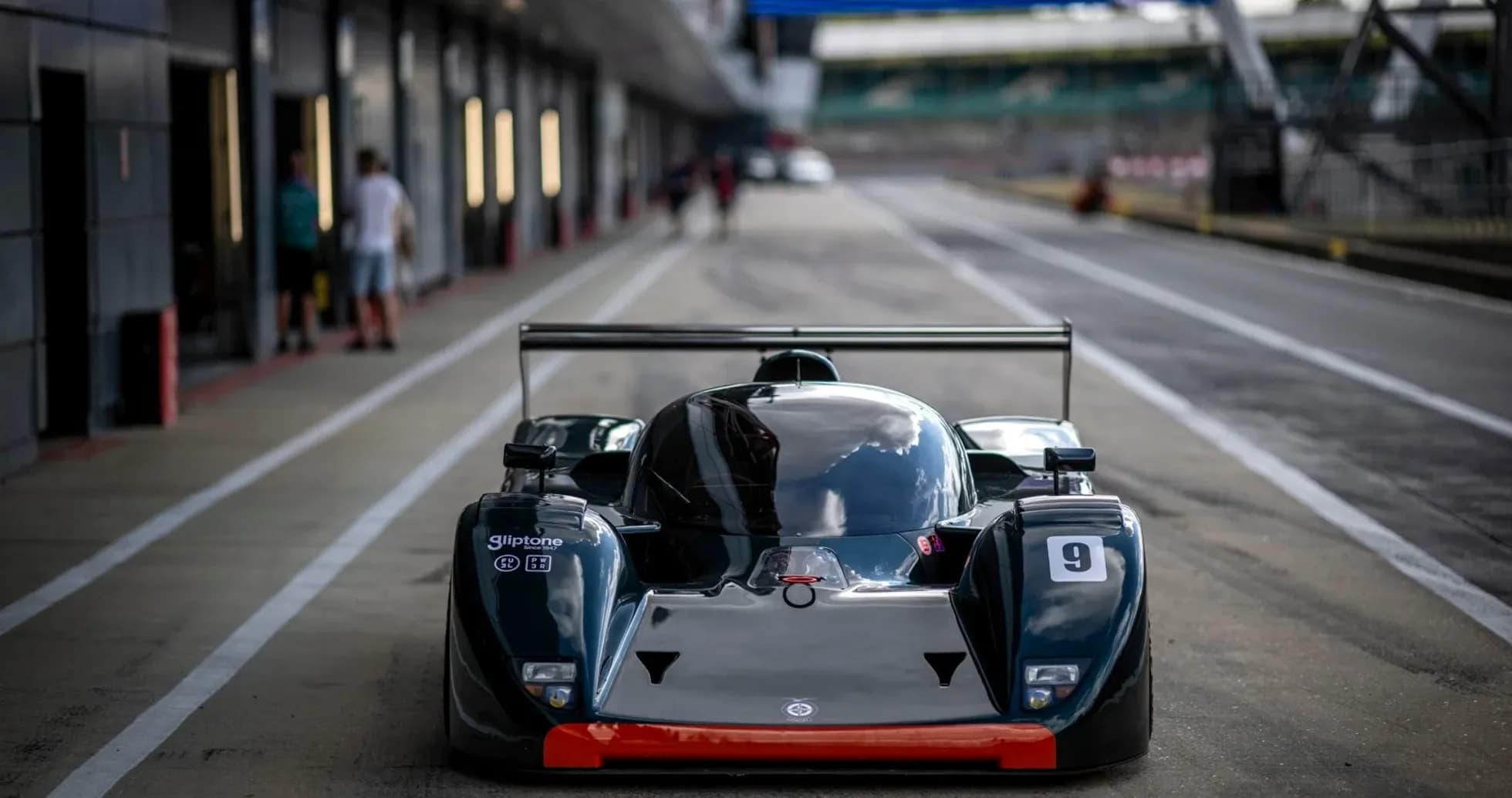
The car has now been fully restored to its original P351 specification and was unveiled this past weekend at Silverstone, the same circuit where so much of Britain’s racing identity has been forged. No half measures, no museum-piece compromise. This is the P351 as it was meant to be seen in 1992.
The carbon-composite monocoque remains the spine of the car, but under the bodywork, almost everything critical has been reworked. The original 3.5-litre naturally aspirated V12 is back in place, paired with a completely rebuilt transmission. Dawson Racing has led that revival, rebuilding the powertrain so it can do more than just fire up for a demonstration run.
The P351 is not being restored to sit still.
Built to Race, Again
BRM has made its intention clear: this is a racing car, not a static exhibit. The V12 now runs on sustainable fuel, a modern twist that allows a 1990s Group C machine to line up credibly in today’s landscape.
The exact championships and events where it will compete have not yet been named, but the plan is simple – the P351 is going back into live competition. Not a parade lap, not a nostalgia festival headliner. Real racing.
The closed cockpit has also returned, a key part of its original identity. BRM rebuilt the roof using surviving period documents and old photographs, reverse-engineering the shape from fragments of history. It’s the kind of detail work that separates a cosmetic refresh from a serious restoration.
A number of major partners have backed the project. Motul, Goodyear, and SKF Automotive are among the companies that have supported the rebuild, a sign that this is more than a small, sentimental exercise.
A Second Chance at the Story It Never Had
The BRM P351 was built to write itself into endurance racing history and instead became a footnote. Now it has a second chance, carrying its own past and the sport’s future in the same carbon shell, its V12 breathing cleaner fuel but chasing the same old thrill.
Soon, somewhere, it will roll out of a garage, the pit lane light will flick green, and the car that never truly got to race will finally find out what its story is supposed to be.