2026 Spanish Grand Prix Review: A Dazzling Setting but Dull Racing
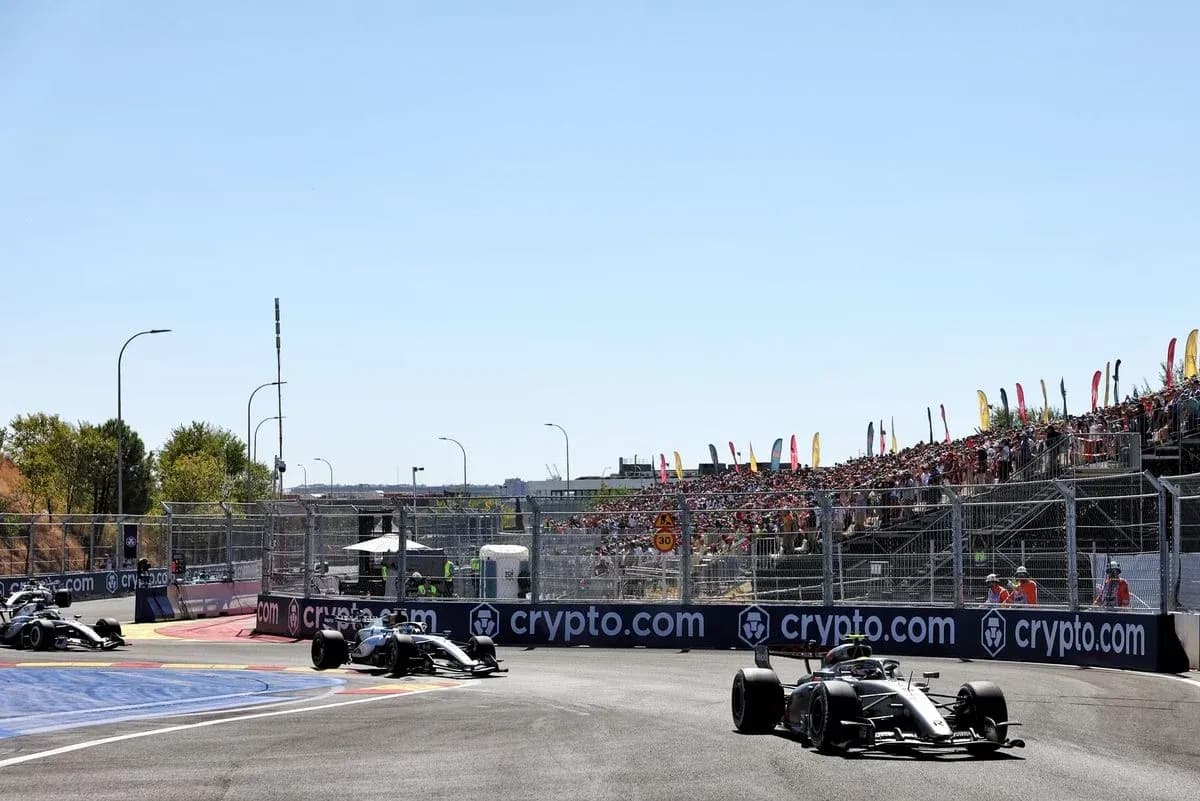
The 2026 Spanish Grand Prix was sold as a glimpse of Formula 1’s future. What it delivered on Sunday at the Madring was a slow, glossy parade.
The setting dazzled. The racing did not.
Built part on permanent circuit, part on public roads looping in and out of the IFEMA conference centre in north-east Madrid, the Madring arrived with the promise of a fresh canvas. Architect Jarno Zaffelli had spoken of its “flow” and its unique character, hoping to prove that a street circuit “that is not boring” could be done.
The drivers broadly agreed on one thing: the place is spectacular. The layout, though, left them cold.
Atmosphere electric, race anaemic
Fernando Alonso, Carlos Sainz, Lewis Hamilton, Arvid Lindblad – across the grid, the verdict on Madrid as a host city was glowing. The paddock buzzed, the grandstands were full, the off-track show worked.
On track, the story flipped.
Lindblad admitted it “wasn’t the most exciting race”. Audi’s Gabriel Bortoleto went even harder when asked if it was as dull to drive as it looked to some viewers.
“Yeah, I almost fell asleep as well,” he said.
Haas driver Esteban Ocon pointed to the tyres as a major culprit. With little degradation or graining on Sunday, strategy froze and so did the running order.
“It was like 120% from as soon as you pitted to the end,” he said. “And because the graining didn’t happen, that’s where we ended up. If we had a race on Friday, it would have been much better.”
The cars were being pushed. The race never caught fire.
A layout that shuts the door
If the tyres dulled the contest, the layout suffocated it.
Max Verstappen’s trip across the run-off at the opening chicane on lap one captured the problem: tight, fiddly, and with almost no room to pass. The Turn 5-6 chicane drew particular ire for being too narrow, and the string of left-handers after the banked La Monumental corner gave drivers little to work with.
Lando Norris did not sugar-coat it in the press conference.
“I don’t know how someone looks at this design and goes, mint!” he said.
Visibility was another recurring theme. Several drivers complained of blind entries and restricted sightlines, with Sainz grouping Madrid with Jeddah and Baku in terms of safety concerns.
“Same as in Jeddah and Baku, it’s poor,” he said. “But it seems like the FIA is happy to go in this direction moving forward in terms of new circuits, which obviously, as drivers, we are raising our… not concerns – but our point of wanting to keep improving safety.
“We’re going to go towards these circuits because going at 260km/h, 270km/h on esses that you cannot see through is definitely eye-opening and definitely makes you question how safe everything is.”
Alonso, usually one to relish a technical challenge, punctured the hype around La Monumental. For all the talk of its banking, he felt the modern cars had reduced it to a non-event.
“It is sad, you know, in a way, with this generation of cars to come to a very nice circuit like this one, with challenges here and there, like Monumental corner, Turn 12, and the driver input is just nothing.
“Michael [Clayton, press officer] can drive in Turn 12 because you go flat with no deployment,” he said.
A showpiece corner, tamed by the machinery.
Drivers move from criticism to solutions
The complaints weren’t just grumbling. Several drivers arrived with clear ideas on how to fix it.
George Russell honed in on what he saw as the central flaw.
“I guess the one small frustration in the design is just the lack of clear overtaking opportunities,” he said. “On every track, at the end of a long straight, you need a clear opportunity to overtake, and the longest straight here goes into that tight roundabout section. So that’s probably the only thing we wish was different.”
Norris went straight to the point.
“They should get rid of [Turns] 18-19 – useless.”
His vision: cut the fiddly final section and turn it into a genuine overtaking zone.
He suggested a “straight line from [Turn] 17 straight to 20, have a much wider entry like Austin Turn 1 or Turn 10 in Austin.
“A big hairpin, you create much better opportunities for everyone and you’ll be able to enjoy the race. There’s some simple changes and maybe some trickier ones like Turn 5, 6, 7.”
Valtteri Bottas, now with Cadillac, echoed Russell’s assessment of the main straight.
He described it as “quite easy” to defend after the longest flat-out run, a damning verdict for any modern F1 circuit. His bigger gripe, though, lay deeper in the lap.
“What I’m not a big fan of is the sector two and three, how blind it is, especially people on the slow laps. Sometimes it’s a bit sketchy, unnecessarily blind in places. But that was the first time we went to Saudi, it was the same issue and then they widened some of the walls, so I don’t know – maybe there’s some room for improvement.”
The message was clear: the template exists to improve this kind of layout. The walls can move. The sightlines can open up.
Turn 5 in the firing line
If one corner became the symbol of Madring’s problems, it was Turn 5 and its chicane.
On paper, it should have been a prime overtaking spot: heavy braking, a slow complex, a chance for late lunges. In reality, the bumpy entry, high kerbs and narrow track killed most ambition.
Williams driver Alex Albon did not hide his frustration.
“I think we need to revisit this track a little bit… because I think, I don’t know if you watched the F3 and F2 races, but it was all drivers going side by side in the chicane and then complaining that one of them didn’t let them back past, so that corner in particular is the corner that I think needs the most work.”
Bortoleto went further, questioning why that sort of chicane exists at all with today’s machinery.
“I just don’t see how… Like even if they slow down the corner, what are they going to do, you know… especially with the big cars we have nowadays; if it was 1990s cars, maybe you could put something, but it’s not like this anymore.”
Verstappen, meanwhile, turned his attention back to the headline feature: the banking.
“Yeah, I mean, it’s cool, the banking,” he said, “but I think they should have done it the other way around, though. Initially more banking and then just flatten it out.”
The star attraction, in his eyes, was a half-measure.
A bigger question: are street circuits the problem?
Beneath the detailed criticism lies a broader unease. Maybe it is not just Madrid. Maybe it is the concept.
Verstappen did not hide his bias.
“I’m not a fan of street circuits, so that will never change. I will always prefer to drive on a track like Spa.
“What they have done, the way they have built everything up, I think they have done a really good job, but I’m not a fan of street circuits.”
Alonso, racing in front of his home fans, landed in a similar place.
“I still prefer normal circuits. You know, in general, you push the limits of the car… On a street circuit, you are always 95% because the track is always surprising you.”
The modern F1 car is long, wide and heavy. On tight city streets hemmed in by concrete, the margin for error shrinks, the drivers back off a fraction, and overtaking windows close. The Madring, with its blind sweeps and tight chicanes, only sharpened that tension.
What matters now is that the criticism is already forcing a response. Changes for the next Spanish Grand Prix are on the table. Corners will be redrawn, walls may move, the final sector could be reimagined.
The drivers have made it clear what they think. The real test is whether Madrid listens – and whether Formula 1’s new urban showpiece can turn from procession to prize fight before the sport moves on.