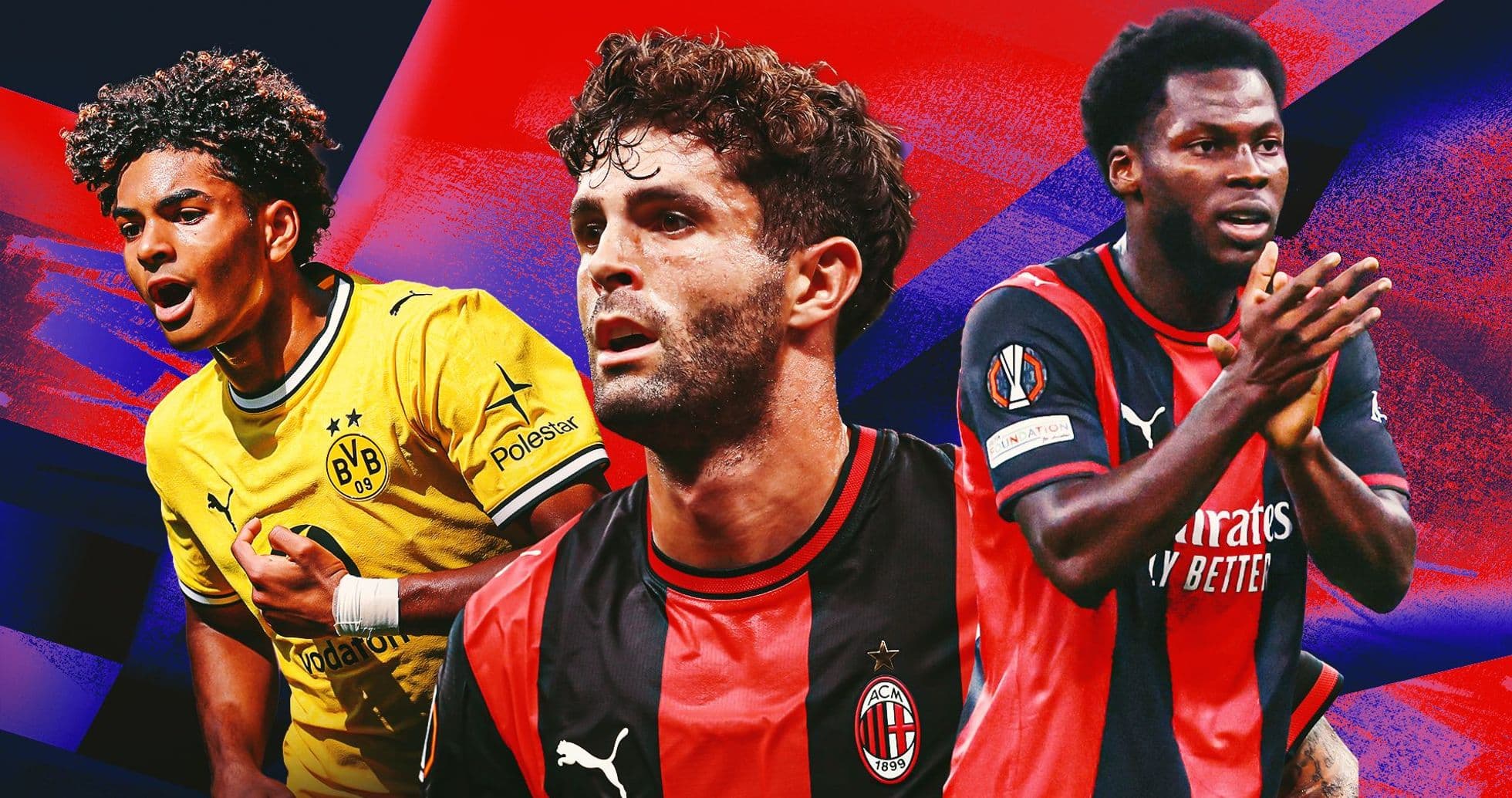
Sullivan Leads a New Era for USMNT
Say hello to the new face of American promise.
Sixteen-year-old Sullivan has been on the radar for years, whispered about in academies and message boards, a name filed under “one to watch.” Now he’s stepped out of the shadows and into a USMNT camp many hope will be the first of dozens.
This isn’t a marketing exercise. It’s not a reward for viral clips. Mauricio Pochettino doesn’t run a popularity contest; he builds teams around players who produce. Sullivan is producing.
He’s scoring. He’s setting up goals. He’s doing it at 16.
“He deserves all of the praise that he is getting,” Pochettino said. “I think it’s because he’s performing well. He’s giving assists, scoring goals, and he’s 16.”
The coach’s words carried admiration, but also a warning label. This is still a kid, still a work in progress, still someone who “needs to show, improve, evolve, and be more mature.”
So this camp is not a coronation. It’s a test.
Sullivan may walk in and look like he’s been here for years. He may struggle. He might drift through sessions, overwhelmed by the pace, or he might grab the ball and demand to be the story. For Pochettino, that’s not the point. What matters is that he’s here, that he feels the weight of the crest, that he has room to try and, if necessary, to fail.
Stack enough of these chances together and a 16-year-old becomes a 20-year-old ready for 2030, hardened by experiences like this one. The door has been opened. Now it’s on Sullivan to decide how far he walks through it, under a spotlight that has followed him for years and will only burn brighter from here.
Pulisic’s absence, and a narrative that won’t move
The most familiar name is missing for a very familiar reason.
Christian Pulisic has only just returned from injury and made his first appearance of the season. Dragging him across the Atlantic for four matches in two weeks would have been reckless, a short-term risk with no long-term upside. From a medical and sporting standpoint, leaving him out makes sense.
It still stings.
Pulisic remains at the center of the conversation around a disappointing World Cup, and his absence means those narratives sit untouched, like a book left open on the same page. He can’t rewrite them in a handful of friendlies three-and-a-half years before the next tournament, but he could at least have started that process, shown the “more determination and more passion” some fans loudly demand.
He won’t get that chance this fall. For a player with a point to prove, that’s a cruel kind of limbo. The reset he wants will have to wait.
Pochettino, though, is already looking beyond that World Cup hangover.
“I think now is a completely different approach than was in the past,” he said. “The World Cup is in four years. We need to work with different objective and goals, and for different reasons, that roster is the roster that is the best roster that we can design for this camp.”
This isn’t a nostalgia tour. It’s the first draft of a new cycle.
Musah’s long road back
Yunus Musah knows how quickly a rising career can stall.
Once seen as a pillar of the future, he slipped out of the national team picture for more than a year and a half. His club career didn’t help. He stagnated at Milan, then found little joy on loan at Atalanta. Minutes were scarce, confidence even scarcer.
Now he’s back at Milan and finally contributing. The difference is visible. He looks like a player who believes in himself again, and Pochettino has noticed.
“Yunus is still young,” the coach said. “He wasn’t involved in the last World Cup, but now, after seeing from the beginning the season that he is performing in the way that we expect… that is why we call again. It’s really open, like for rest of the players.”
Musah is only 23, but in this group he’s almost a veteran. He arrives with scars and perspective, a reminder that growth rarely follows a straight line. His path has bent and twisted, but it has led him back to where he always wanted to be: in the USMNT midfield, fighting for his place.
This camp is his second chance. There won’t be endless ones.
World Cup veterans on notice
Of the 28 players called in, 13 were part of this summer’s World Cup squad. The core is still here: Tyler Adams, Chris Richards, Antonee Robinson, Sergiño Dest, Matt Freese. The spine of the team remains recognizable.
The absences are just as telling.
Pulisic, Weston McKennie and Folarin Balogun are all out with injuries. Tim Ream, at 38, sits on the edge of this cycle, his international future uncertain even as he insists he’s still available.
Then there’s the group that didn’t make it, the players who filled out the World Cup roster but now find themselves on the outside looking in: Matt Turner, Max Arfsten, Mark McKenzie, Joe Scally, Cristian Roldan, Brenden Aaronson, Tim Weah, Alejandro Zendejas. All of them have worn the shirt on the biggest stage. None of them got the call this time.
Pochettino has been clear: this is not exile.
“The door is open for everyone,” he said. “Now it’s a new start. It’s a new cycle. It’s not what happened one year ago, one year and a half ago, what happened in the World Cup. To be honest, it’s a fresh start. It’s a roster that we consider is the best for that period.”
Still, the message is sharp. When you expand the player pool, the battle begins in the middle of the roster, not at the top. Players 15 through 26 on that World Cup list are suddenly fighting for their international lives. That fight has already started, and this camp’s invite list is the first scoreboard.
Albert, the mystery with sky-high upside
Then there’s Albert, the most intriguing outlier in the group.
If he plays 93 minutes in this camp, he’ll have logged more senior minutes for his country than for his club. That alone would be remarkable. Pochettino’s decision to bring him in anyway says even more.
It’s easy to justify Sullivan, Neil Pierre and Adri Mehmeti. They’ve already turned potential into production, forcing their way into the conversation with what they’ve done on the pitch. Albert hasn’t had that chance yet.
What he does have is a badge on his chest that carries its own weight: Dortmund. At 17, he’s been in and around the first team of one of Europe’s best talent factories. That doesn’t happen by accident. Dortmund rarely misjudge young talent, and when they invest time in a teenager, it usually means there’s something special there.
So Albert arrives as the least experienced player in the squad, but possibly the one with the highest ceiling. Pochettino wants to see him up close, to measure his temperament, his touch, his response when the level jumps.
For Albert, this is a classroom disguised as a camp. Learn now, grow now, and the payoff could be huge — for club and country.
A new cycle always starts like this: with questions, with experiments, with risk. The names on this roster tell their own story. The USMNT is betting big on youth, on second chances, and on potential that hasn’t yet fully surfaced.
Soon enough, the games will reveal who was worth the gamble.