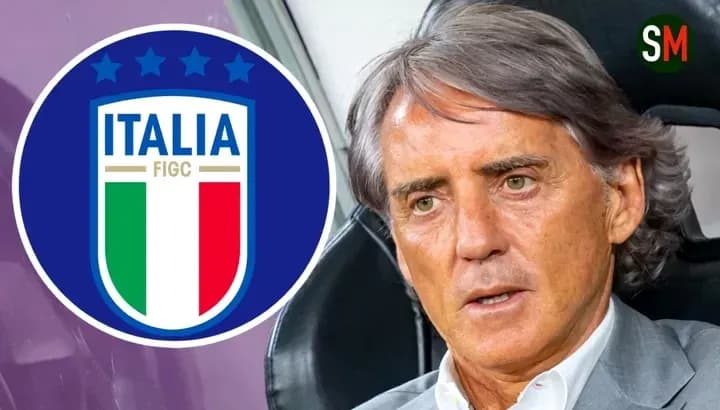
Roberto Mancini's Bold Italy Squad Reset for Nations League
Roberto Mancini did not ease his way back into the Italy job. He kicked the door open with a 34-man squad that looks far more like a reset than a reunion.
Re-appointed at the end of July after Gennaro Gattuso’s departure and the embarrassment of missing a third straight World Cup, the 61-year-old has wasted no time drawing a line under the recent past. His first act: a Nations League squad that keeps only a thin thread of continuity with his Euro 2020 triumph.
A new Italy, with only a faint echo of 2021
Just six survivors from that Wembley night remain: Gianluigi Donnarumma, Alessandro Bastoni, Giovanni Di Lorenzo, Nicolo Barella, Bryan Cristante and Giacomo Raspadori. The core that once carried Italy to the top of Europe has, for now, been stripped back to a skeleton.
The message is blunt. Reputation no longer guarantees a seat on the plane.
Italy open their League A Group 1 campaign with a demanding run across the September and October window: Belgium at home, France away, and a double-header with Turkey. Mancini has chosen this moment, against heavyweight opposition, to accelerate change rather than shelter behind familiar faces.
Big names out, bold calls in
The omissions are as striking as the inclusions.
Chelsea’s Marco Palestra, recently sidelined by injury, misses out despite making his debut in March and already owning two caps. Tottenham’s Destiny Udogie, absent from the national team since June 2025, is also left at home. So is Liverpool’s Federico Chiesa, a hero of Euro 2020 who has not played for the Azzurri since Euro 2024 despite a call-up earlier this year.
They are not alone. Juventus trio Manuel Locatelli, Federico Gatti and Andrea Cambiaso are all cut. Napoli pair Leonardo Spinazzola and Alessandro Buongiorno, central figures in recent cycles, are out as well. Mateo Retegui, now at Al-Qadsiah and once seen as a potential long-term solution up front, also finds no place in this squad.
These are not marginal figures. They are players who, in another era, would have been inked into a Nations League list. Mancini has chosen the eraser.
Nine debutants and a different kind of gamble
In their place, nine new names step into the light.
Brentford right-back Michael Kayode earns a first call-up, a sign that Mancini still believes in energetic, attacking full-backs as a cornerstone of his system. Behind him, 18-year-old Bologna goalkeeper Massimo Pessina joins the senior setup for the first time, a nod to the future even with Donnarumma entrenched as number one.
Roma’s Daniele Ghilardi, Monza’s Eddy Kouadio, Cagliari’s Alessandro Romano, Sporting Lisbon’s Issa Doumbia, Sassuolo’s Sebastiano Esposito, Napoli’s Antonio Vergara and Nurnberg’s Mohamed Ali Zoma complete a debutant group that stretches across Serie A, abroad, and the full breadth of Italy’s emerging talent pool.
This is not a token sprinkling of youth. It is a wave.
Young stars kept in the frame
Among the younger faces already blooded, Borussia Dortmund forward Samuele Inacio keeps his place. Born to a Brazilian father but committed to the Azzurri, he represents exactly the kind of modern, flexible profile Mancini likes to build around.
Honest Ahanor, just 18 and currently on loan at Crystal Palace from Chelsea, is also retained. Their inclusion shows that this is not a one-off experiment but the continuation of a deliberate shift towards a more dynamic, internationally seasoned generation.
Alongside them stand the new leaders of this Italy. Arsenal’s Riccardo Calafiori, Inter’s Federico Dimarco and Nicolo Barella, Tottenham midfielder Sandro Tonali and Como forward Moise Kean all make the cut, forming the spine around which Mancini intends to rebuild.
This is the blend: established European performers, Premier League-hardened talent, and raw prospects thrown into the deep end.
A brutal schedule to test a revolution
The calendar offers no soft launch.
Italy will assemble at Coverciano next Monday, with Mancini given only a handful of sessions to weld this reshaped group into something coherent. On September 25, they open at the Stadio Olimpico against Belgium, a fixture that rarely allows for half-measures or half-fit ideas.
Three days later comes a trip to Bursa to face Turkey, a side that has grown increasingly awkward and aggressive on home soil. Then, on October 2, Italy travel to Saint-Denis to meet 2026 World Cup semi-finalists France, a benchmark game for any side with serious ambitions.
The break closes on October 5 at the Stadio Renato Dall’Ara, where Turkey await again. Four games, three countries, one month. Very little room for doubt.
Mancini has chosen to embrace the risk. He has cut deep, trusted youth, and challenged his new Italy to grow up fast on one of the toughest stages in European football.
Now the question is simple: will this be the birth of a new Azzurri cycle, or the first hard lesson of a revolution launched at full speed?