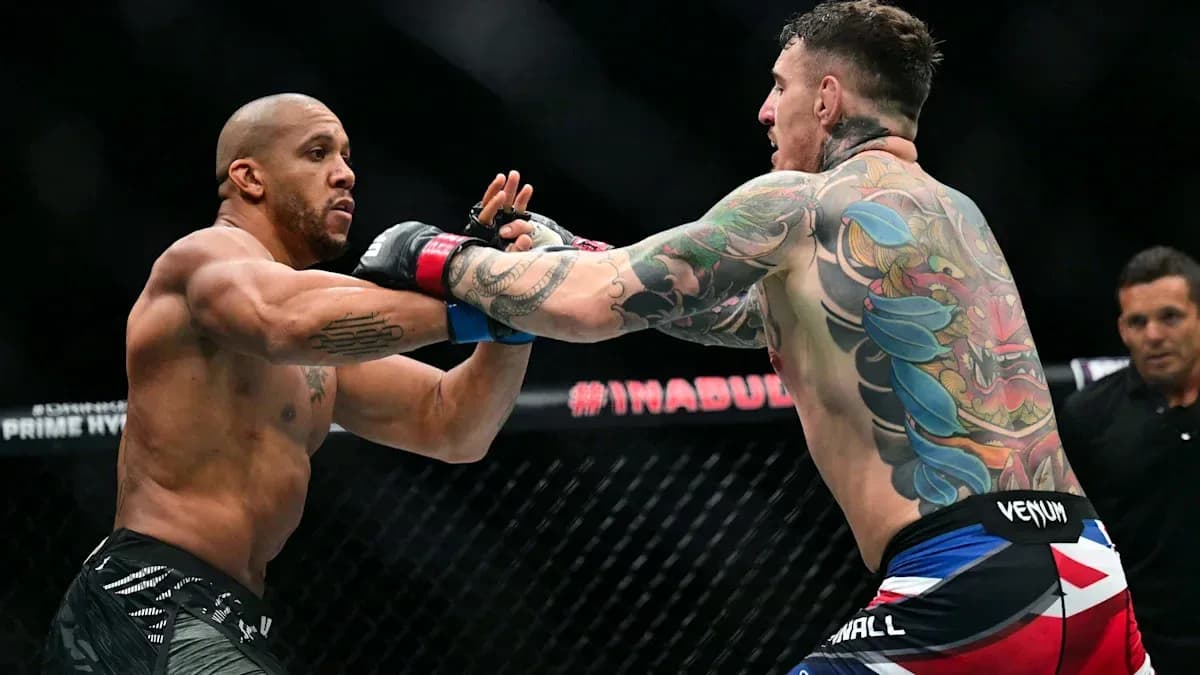
Noche UFC 4: Fighters Chart Their Paths Forward
Mexico’s Independence Day has quietly become one of the UFC’s most reliable stages. Four years running now, the promotion has wrapped the date in violence and drama, and Noche UFC 4 followed the script: not a card stuffed with finishes, but one that pushed careers in sharp, decisive directions.
From a gritty main event comeback to a former champion clawing his way back toward relevance, the winners on the main card all left with something more than a paycheck. They left with clear next steps.
Jean Silva vs. Yair Rodriguez: Unfinished Business
Jean Silva had to walk through fire to get there.
For a round and a half, Jose Delgado gave him nothing easy. The fellow Dana White’s Contender Series product found success early, forcing Silva to adjust, forcing him to suffer. But once “Lord” settled into the rhythm, the fight flipped. The Brazilian dragged it into his kind of chaos, took the back and locked in the rear-naked choke at 2:57 of Round 3.
Win No. 18. Finish No. 16. A reminder that even when he starts slow, he rarely needs the judges.
There’s only one matchup that makes sense now: Yair Rodriguez.
They were already booked for this very card before Rodriguez withdrew with an injury. Stylistically, it’s dynamite. Silva’s aggression and finishing instincts against Rodriguez’s wild, angular striking and championship pedigree. It’s a fight that was good enough to headline Noche UFC 4 before it fell apart. It’s still good enough now, maybe even better with Silva coming off a comeback submission on this stage.
Run it back on paper. Then let them settle it for real.
Brandon Moreno vs. Kyoji Horiguchi: A Superfight, Even Late
Brandon Moreno’s relationship with Glendale is starting to feel personal.
He won his first flyweight title there at UFC 263. At Noche UFC 4, he went back into the furnace and edged Joseph Morales over 15 tense minutes. It wasn’t vintage Moreno, but it was very much “The Assassin Baby” in a nutshell: pressure, volume, and just enough craft in the small moments to sway two of the three scorecards.
A split decision, but a crucial one. Moreno now sits at 24-10-2, with a 13-7-2 mark in the UFC, and he remains one of the most battle-tested names at 125 pounds.
Where does that road lead? To Kyoji Horiguchi.
Horiguchi, the former two-division Rizin champion and Bellator titleholder, is coming off a loss to Manel Kape and needs a statement. Moreno, with his history as a two-time UFC flyweight king, is the exact kind of name that can redefine a late-career push. The matchup feels a couple of years overdue, but that doesn’t strip away its intrigue.
Moreno’s relentless pace and scrambling against Horiguchi’s sharp footwork and veteran timing still sell themselves. It’s not about rebuilding one man or rescuing the other. It’s about answering a question hardcore fans have been asking for years: what happens when their paths finally cross?
Tommy McMillen vs. Losene Keita: Prospects on a Collision Course
Tommy McMillen didn’t get the finish. He got something better.
Against fellow DWCS graduate Marwan Rahiki, the 28-year-old featherweight had to prove he could win a hard, competitive 15-minute fight. Rahiki pushed. McMillen answered. Three rounds later, the undefeated Red Hawk Academy product walked away with a unanimous decision and a 12-0 record, including 3-0 in the UFC.
Then he did what confident prospects do: he asked for a date. Dec. 12.
If the UFC wants to honor that request and test his ceiling at the same time, Losene Keita is the name.
Keita, a former two-division Oktagon MMA champion, just announced himself to the wider fanbase with a first-round knockout at UFC Paris. He’s big for the division, explosive, and already carries the aura of a man who expects to climb quickly.
McMillen vs. Keita feels inevitable. Matching them now only accelerates the process. Two rising featherweights, both with real upside, both with recent momentum. One walks out a contender-in-waiting. The other gets a harsh lesson in how steep the division really is.
Either way, fans win.
Alexa Grasso Back to the Belt
Alexa Grasso had to grind for this one.
Manon Fiorot arrived as one of the division’s most dangerous technicians, and she didn’t fold when the former champion pressed. But over three rounds, Grasso found the answers she needed. Clean boxing combinations, composure in the pocket, and enough control of the key exchanges to bank a unanimous decision.
Now at 18-5-1 overall and 10-5-1 in the UFC, Grasso has quietly rebuilt the case that once made her flyweight queen.
The landscape above her is clear. Valentina Shevchenko is sidelined. Natalia Silva and Cong Wang are set to headline UFC 332 on Oct. 3. Grasso, riding a two-fight win streak and carrying the weight of a former champion, stands as the obvious No. 1 contender.
She doesn’t need a stay-busy fight. She needs a belt in front of her.
Grasso will be watching Silva vs. Wang with sharper focus than anyone else. When that dust settles, she should be next in line, walking back into a title fight with the experience of someone who’s already been there—and the form of someone ready to stay.
Curtis Blaydes vs. Serghei Spivac: A Gatekeeper’s Test
Not every important heavyweight fight is a thriller. Curtis Blaydes vs. Waldo Cortes-Acosta proved that.
Blaydes did what he does: controlled the terms, neutralized danger, and worked his way to a unanimous decision. The bout carried implications for the upper tier of the division, but the action never really matched the stakes.
Still, Blaydes now sits at 20-6 with 1 no contest, and 15-6 with 1 no contest in the UFC. He continues to hover in that familiar space—too good for most, just shy of true title contention. The division’s gatekeeper to the top five.
After a performance like this, a title shot isn’t on the table. But a meaningful, stylistically interesting fight is.
Enter Serghei Spivac.
At 18-7 (9-7 UFC), “The Polar Bear” brings a grappling-heavy, pressure-based style that begs a question: what happens when a strong, mauling heavyweight runs into one of the best takedown artists in the division? They’ve never crossed paths. Now is the time.
Blaydes vs. Spivac won’t be about highlight reels. It will be about hierarchy. Who stays in the conversation, and who gets pushed back into the pack?
David Martinez vs. Mario Bautista: A Contender Emerges
David Martinez didn’t just welcome Dan Ige to bantamweight. He shut the door on him.
“Black Spartan” leaned on precision and volume, piling up strikes and pressure over three rounds to secure a unanimous decision. It wasn’t a firefight, and the crowd let that be known, but the result was undeniable: Martinez extended his win streak to 11 and moved to 15-1 overall, 4-0 in the UFC.
At some point, the numbers demand a step up. That point is now.
Mario Bautista is the right kind of problem.
With an 18-3 record and a 12-3 mark in the UFC, Bautista is coming off back-to-back wins, including a rematch victory over Cory Sandhagen at UFC 329. He’s battle-tested, dangerous, and firmly lodged near the top of the bantamweight ladder.
Match him with Martinez and you don’t just get a good fight—you get clarity. The winner doesn’t just earn another ranking. He moves into the conversation as a legitimate title threat in the sport’s deepest division.
On a night built to celebrate a country, Noche UFC 4 did something else: it quietly redrew the map for six fighters’ futures. The next time their names appear on a card, the stakes will be higher. The room will be louder. And the questions they’ve earned will finally demand answers.