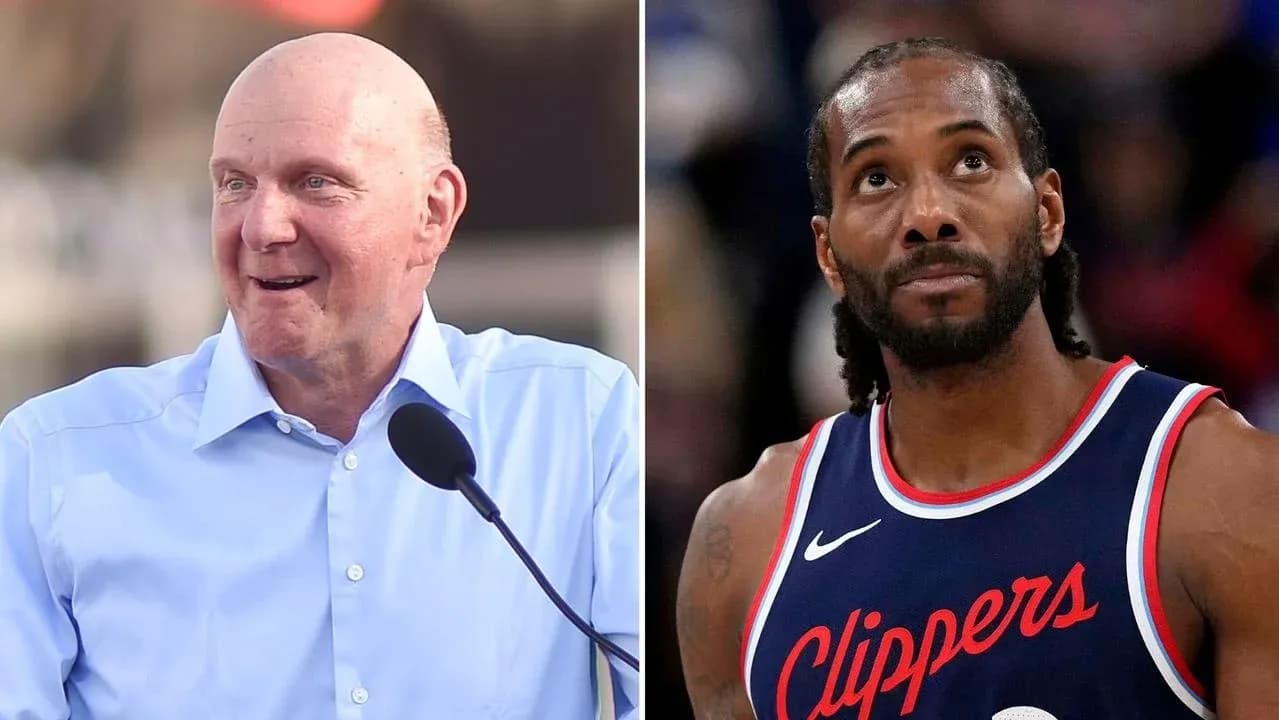
NBA Punishes LA Clippers and Kawhi Leonard Severely
The NBA has dropped a hammer on the LA Clippers and Kawhi Leonard, ending a year-long investigation with one of the most severe punishment packages the league has handed down in the salary cap era.
Five first-round draft picks gone. A $30 million fine. A one-year ban for owner Steve Ballmer. Heavy suspensions for top executives. A financial penalty for Leonard himself. And a five-year ban from league business for his uncle and former representative, Dennis Robertson.
This wasn’t a slap on the wrist. It was a statement.
A Pattern, Not a One-Off
In its announcement, the league accused the Clippers — described pointedly as a “prior offender” of salary cap circumvention rules — of orchestrating a broad scheme to boost Leonard’s off-court income through companies tied to the franchise.
The investigation, led with a summary report by Wachtell Lipton, outlined how the team:
- Initiated off-court income opportunities between Leonard and four companies doing business with the club: Aspiration Partners, Boingo Wireless, Daktronics, and Lockton Insurance
- Facilitated endorsement deals between those companies and Leonard
- Induced those companies to sign on by dangling team business in return
- Paid personal expenses for Leonard and his representatives
- Failed to report improper solicitations for off-court income made on Leonard’s behalf through Robertson
The league concluded that this wasn’t accidental or isolated. It called it “a pattern of misconduct and multiple significant rules violations.”
The pressure, the NBA said, didn’t come only from the team’s side.
According to the league, Leonard — “through the conduct of Mr. Robertson on his behalf” — violated circumvention rules by pressing the Clippers to help secure off-court money, accepting those opportunities, and not reimbursing personal expenses the team covered.
The Penalties: Picks, Power, and Reputations Hit
The cost is staggering.
The Clippers must forfeit five first-round picks, one in each of the 2029, 2030, 2031, 2032, and 2033 NBA Drafts. For a franchise that has already mortgaged much of its future in pursuit of a title window built around Leonard, that is a generational blow.
The organization is fined $30 million.
Ballmer, one of the league’s most visible and energetic owners, is suspended from all league and team activities for one year. The NBA found he “knowingly” sought to help Leonard obtain off-court income, approved a business deal that served as a precondition for Aspiration’s endorsement agreement with Leonard, and failed to ensure his organization followed the rules.
President of Business Operations Gillian Zucker receives a one-year suspension without pay. The league calls her “primarily and directly culpable” for the improper endorsement structures and says she provided “false and misleading statements” to investigators.
President of Basketball Operations Lawrence Frank is suspended without pay for six months for his role in the endorsement arrangements and for approving impermissible expenses tied to Leonard and his family.
For the next five years, the Clippers will operate under a compliance and monitoring program overseen by the league office.
Leonard is ordered to pay the NBA $700,000.
Robertson, the uncle who has long been a powerful figure in Leonard’s career, is banned from conducting business or engaging with NBA teams and their affiliates on behalf of any player, employee, or other league or team personnel for five years.
This is not just about one season. It reshapes the franchise’s long-term planning, its leadership structure, and the public perception of how it tried to build around its star.
Leonard Accepts Responsibility, Denies Intent
Leonard responded with a carefully calibrated statement that tried to walk a narrow line: accepting responsibility for what happened around him while distancing himself from any deliberate attempt to cheat the system.
“Integrity and respect for this game are fundamental to who I am. I accept full responsibility for lapses in judgment by people within my inner circle and regret the distraction this situation has caused the fans and my family,” Leonard said through his agent.
He insisted he entered both his Clippers contract and the sponsorship agreements “in good faith,” saying he had “no knowledge of any intent on anyone’s part to circumvent the salary cap.”
“For 15 years, my priority has been giving everything to my family, the game, and those I share the court with,” Leonard added. “As I return to Toronto, I am focused on what I can control, closing this chapter, and moving forward with a clean slate.“
The message was clear: he would pay the price the league set, but he would not accept the idea that he knowingly joined a cap-circumvention plan.
Clippers Come Out Swinging
If Leonard’s tone leaned toward contrition and closure, the Clippers’ statement did the opposite. The franchise went directly at the league’s process and motives.
“We vehemently reject the NBA’s findings, which are the result of a heavily biased investigation seeking to justify a predetermined narrative rather than facts and evidence,” the team said.
The Clippers claimed a gap between what the league told them behind closed doors and what it announced publicly, arguing that the NBA failed to live up to the standard of fairness and accuracy Commissioner Adam Silver set at the outset.
“For the past year, we cooperated fully and in good faith and we will now fight just as hard to demonstrate our innocence,” the statement continued.
The organization vowed to “vigorously challenge these findings and penalties through every avenue available” and said it looks forward to “an ethical and impartial arbitration process.”
The stage is set for a bruising legal and political battle between a high-profile franchise and the league office, even as the competitive consequences of the ruling begin to sink in.
A Franchise Reeling, A League Drawing a Line
Strip away the legal language and the corporate spin, and the message from the NBA is blunt: star recruitment and retention have limits. Off-court money tied to team business, when used as a tool to sweeten a contract beyond the cap, crosses a line the league is now willing to defend with historic force.
For the Clippers, who moved into a new era with a new arena and once-grand ambitions, the fallout cuts deep. Draft capital gone for half a decade. Top executives sidelined. An owner barred from the building. A superstar paying a financial price and trying to move on as he returns to Toronto.
The Clippers say this is a witch hunt. The NBA says it’s justice.
The next question is not who is louder in their defense, but how this ruling reshapes the way teams court and keep their stars in a league where every edge is chased — and, as of today, some are punished with unprecedented severity.