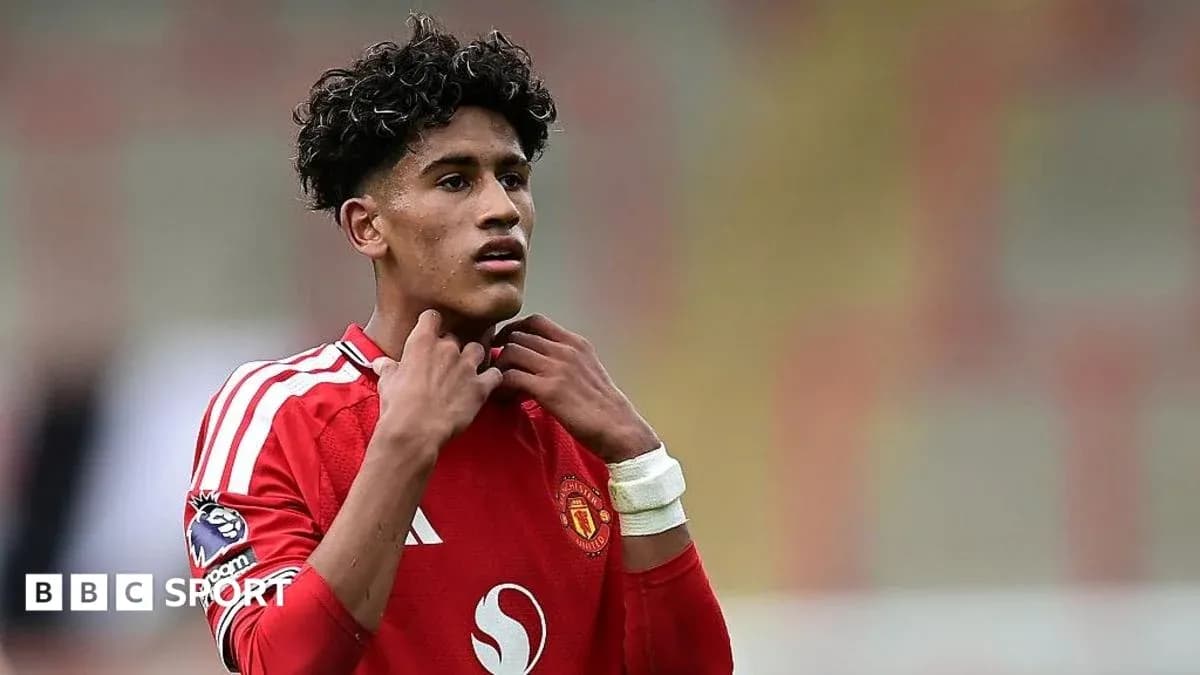
Manchester United's JJ Gabriel Faces Departure Amidst Rising Concerns
On a night that was supposed to celebrate Manchester United’s next great prodigy, Old Trafford is instead bracing for a loss that would cut deep into the club’s identity.
JJ Gabriel, the 15-year-old forward many inside United regard as the brightest talent of his generation, wants to leave. The club are stunned. And scrambling.
Only a week ago, the story felt very different. Gabriel had just scored a hat-trick on his Uefa Youth League debut at Leigh, a ruthless performance that looked like the final audition before history. The plan, or at least the expectation, was simple: he would become United’s youngest ever player with a Carabao Cup appearance against Brighton in the third round.
Now that script has been ripped up.
A wonderkid on the brink
Inside Carrington, senior figures know exactly what is at stake. Chief executive Omar Berrada and director of football Jason Wilcox are directly involved in talks, trying to convince Gabriel to reverse course and commit his future to the club.
It feels, to many around the situation, like a long shot.
Those close to the player believe promises over his development and pathway have not been kept. Confidence in his own ability and ultimate ceiling is not in doubt; confidence in United’s handling of him is. Trust has eroded at precisely the moment Europe’s elite have started circling.
Real Madrid, Barcelona and Paris St-Germain are all monitoring the situation. They are not watching out of curiosity. They are watching because Gabriel’s potential has been obvious for some time.
Last season, while still only 14 when the campaign began, he tore through the Premier League Under-18 competition. He scored 23 goals there, added three more in the FA Youth Cup and dragged United to the final of both the Premier League Under-18 Cup and the FA Youth Cup. By the end of it, he had been named Premier League Under-18 Player of the Year and United’s own Under-18 Player of the Year.
Those awards reflected more than numbers. Gabriel plays with balance, pace and close control that unsettle defenders far older than him, and he hits the ball with a power that belies his age. This season, coaches have also seen a greater appetite to press and fight for possession.
Inside the club, one United source recently described him simply as “the best 15-year-old in Europe”.
United Under-21s coach Adam Lawrence, speaking after Gabriel’s Youth League hat-trick against Sabah FK, cut to the heart of the challenge.
“The first thing in my job is not to ruin him,” he said. “When you have a talented player like JJ, you obviously don’t want to stifle their freedom and their creativity.”
That kind of talent never stays a secret. Real, Barcelona and PSG specialise in identifying exactly this profile: elite youth players who can be moulded early. Gabriel fits that category perfectly.
Promises, pathways and a growing rift
United’s first reaction to the noise around Gabriel’s future was to play for calm. Privately, they insisted they would try to persuade him that staying at Old Trafford remained the best option for his career. They also pointed to a key detail: his registration with the club runs until the end of the season.
That offers some protection in the domestic market. It does not necessarily protect them from Europe.
Gabriel holds a European Union passport. His mother is of Greek-Cypriot heritage and his father, who won two caps for the Republic of Ireland, gives him a dual-nationality route that complicates United’s position.
There is precedent. In 2016, the Court of Arbitration for Sport dismissed an appeal by Argentine club Velez Sarsfield, who had tried to stop a 16-year-old moving to Manchester City. The player held both Argentine and Italian nationality, and CAS ruled that as an EU national he was entitled to move to a club within the European Union, even though he was coming from outside it.
Then there is the case of Louie Barry. West Brom lost the 16-year-old to Barcelona in 2019 and received no compensation after Fifa ruled the club had not formally offered him a scholarship. West Brom had claimed €130,000 in training compensation. Barry left Barcelona for Aston Villa for just under £1m six months later.
United know what the nightmare scenario looks like. Gabriel turns 16 on 6 October. If he walks away then and the legal landscape goes against them, they could end up with no compensation for a player whose current market value, even before a senior appearance, would already be measured in millions.
This is not the first time a gifted teenager has clashed with a club over their route to first-team football. Jadon Sancho was 17 when he stopped training with Manchester City to force a £10m move to Borussia Dortmund, convinced he would play more in Germany than under Pep Guardiola. Morgan Rogers, Barry’s team-mate in the West Brom side that reached the FA Youth Cup semi-final in 2019, left for City within three months, completing the move on his 17th birthday.
United sources believe that during meetings last summer, when Gabriel agreed to commit his short-term future, the club outlined a career path that has not materialised. The player did begin to appear in senior training sessions, first under Ruben Amorim and then Michael Carrick. Talk of a senior debut in last season’s FA Cup gathered pace.
Then Darren Fletcher, by that stage interim senior manager after Amorim’s dismissal while still overseeing the Under-18s, applied the brakes. Fletcher felt a first-team appearance would have come too soon.
Pre-season frustration and a Champions League flashpoint
The expectation inside the academy was that Gabriel would get his first taste of senior football this pre-season. On paper, the schedule offered chances. In reality, his involvement was minimal.
He did not travel to Helsinki for the meeting with Wrexham on 18 July, with his absence attributed to the timing of his return for pre-season training. After that, he was named in every squad. He played just once: an eight-minute cameo against Atletico Madrid in Stockholm.
The frustration did not end there. Gabriel travelled to Trondheim for the friendly against Rosenborg on 24 July. Carrick used 11 substitutes. Gabriel was one of only two United players who stayed on the bench. Five of those who did get on the pitch have since left the club, either permanently or on loan.
It was also noted internally that 18-year-old Tynan Thompson, who had only just arrived from Tottenham, was handed a 45-minute senior debut against Leeds United at Croke Park. Gabriel travelled to Dublin for that game as well. Again, he did not play.
Even so, the sense persisted that his moment would come early this season, most likely in the EFL Cup. The third-round draw, delivering a home tie with Brighton, seemed to set up the perfect stage: Old Trafford, rotated XI, a crowd ready to embrace a new academy star.
The Champions League added another possible route. On paper, Sabah FK, the Azerbaijani champions, looked like the softest home fixture United might face in the group stage. When Carrick’s side went 3-0 up by half-time and he had used all five substitutes by the 72nd minute, the question was obvious: where was Gabriel?
He was not among the substitutes used. As with Max Dowman at Arsenal last season, Uefa’s registration rules created a barrier. At 15, Gabriel could only play if he was named on United’s A list for the competition.
He was not. United filled their allocation of 25 players. One of those slots went to Manuel Ugarte, the midfielder sidelined with a knee injury until at least January. Thompson, the teenager given his Leeds debut, was also on the list.
Why Gabriel missed out is not entirely clear. Some coaches at United have suggested he is not yet at the physical level required to handle senior football. Those close to the player reject that outright. They look at Arsenal giving Dowman his chance at 15, at Bayern Munich handing Lennart Karl a debut at 17, and ask why United are so hesitant with a player they themselves call the best of his age group.
That question now hangs over Old Trafford with real weight. If United cannot convince JJ Gabriel that his future belongs in Manchester, the club that built its modern mythology on the promise of youth could watch Europe’s aristocrats walk away with their next generational talent.