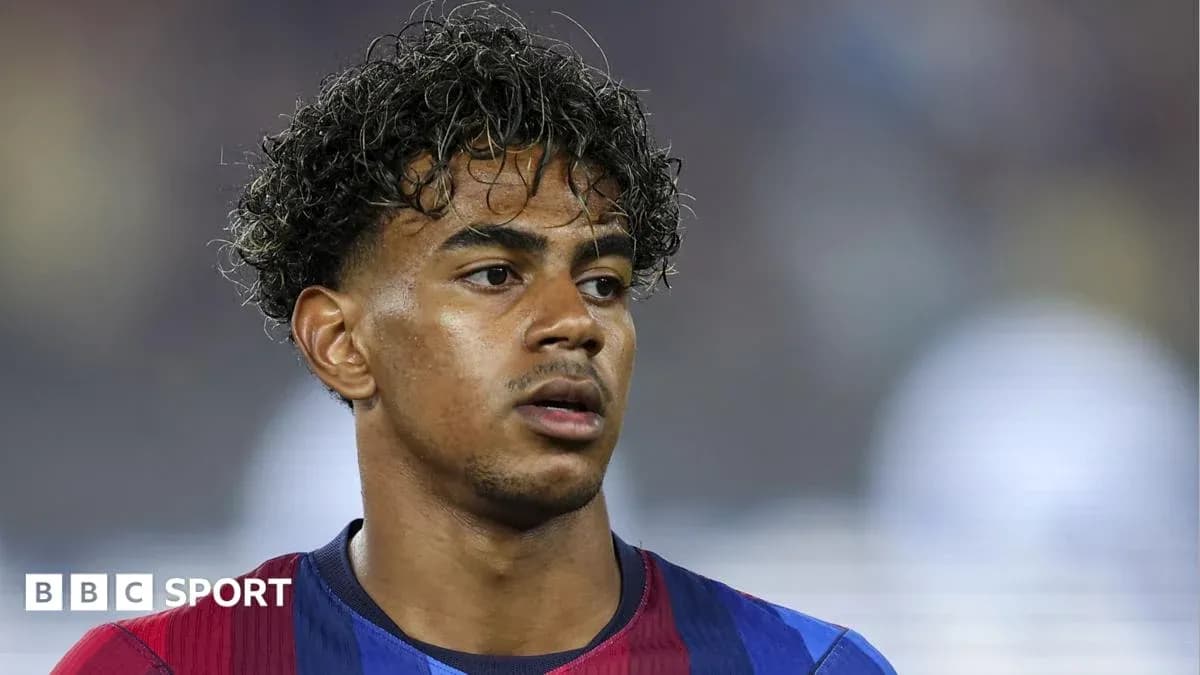
Lamine Yamal on Racism in Football: A Thousand Times
Lamine Yamal is 19 years old, a World Cup winner and one of the brightest talents in European football. And yet, as he explains it, racism has been a constant soundtrack to his rise.
In a candid interview with broadcaster Movistar, the Barcelona winger said he has experienced racism “a thousand times”, describing a reality that stretches far beyond the occasional headline-grabbing incident.
“People are indirectly racist toward you, but maybe don't realise it,” he said. “There are a lot of comments or looks that are racist and they don't even notice.”
These are not abstract complaints. They come from a player who has already stood at the centre of some of Spanish football’s ugliest recent episodes.
The Spanish Observatory on Racism and Xenophobia, a government agency, reported earlier this year that Lamine Yamal and Real Madrid winger Vinicius Jr were the most frequent targets of online racist abuse in Spain during the final quarter of 2025. Two of the country’s most electrifying attacking talents, routinely reduced to the colour of their skin.
The abuse has not been confined to social media. During El Clasico at the Bernabeu in October 2024, Lamine Yamal was among several Barcelona players subjected to racist insults from sections of the crowd. On the pitch, he was a symbol of Barça’s new generation. Off it, he became another case file in a pattern Spanish football still struggles to eradicate.
What strikes most in his words is not anger, but clarity.
“If someone calls me Black, it's not going to bother me at all, ultimately I'm Black, I'm not any other colour,” he said. “Another thing is whether it's good or bad, whether they're saying it to offend me.”
That distinction cuts to the heart of a debate that football, and society around it, often tries to blur. Identity is not the problem. Intention is. The way a word is loaded, the tone in which it is spat, the context in which it is used — that is where violence lives.
Lamine Yamal has grown up inside that tension. He speaks of “comments or looks” that carry a sting, the small, constant frictions that many players of colour recognise instantly but rarely describe so openly. It is the everyday racism, the kind that hides behind jokes, ignorance or “it was just banter”.
His response is disarmingly pragmatic, almost cold in its logic.
“If I'm playing a match and they paid for a ticket to see me, I'm not going to get angry just because they disrespected me,” he said.
There is defiance in that line. A refusal to hand power to the abuser. A reminder that, even as insults rain down, the player on the pitch is the one people have paid to watch.
But it also hints at something else: a young star who has already learned to normalise what should never be normal, to absorb and carry on because the game does not stop and the ball will not wait.
This is the paradox at the top of modern football. The sport markets diversity, celebrates its global icons and packages their stories for worldwide audiences. Yet some of those same players, like Lamine Yamal and Vinicius Jr, become lightning rods for racist hate, both inside stadiums and in the digital echo chamber beyond them.
Lamine Yamal has already lifted the World Cup with Spain, already shouldered the pressure of El Clasico, already become a face of Barcelona’s future. To do all that while dealing with what he calls “a thousand” racist moments is a damning measure of the environment around him.
The winger’s words do not solve that problem. They do something else. They strip away excuses, expose the everyday reality and leave Spanish football — and those who run it — with a simple question: how many more “thousand times” will it take before the game finally treats its brightest talents as more than targets?