Ireland's Squad Decision Amid Controversy Over Playing Israel
The naming of an Ireland squad has rarely carried a weight like this.
On Thursday, when Heimir Hallgrímsson reads out the list for the games against Israel, the usual debates about form, fitness and surprise inclusions will feel strangely hollow. The real scrutiny will fall on the names that are there – and on what it means for each of them to accept the call.
Normally, the equation is simple. Playing for your country is the pinnacle, the dream that outlives every club contract and every transfer window. This time, that instinct collides with something far darker. A decision that should rest with institutions and governing bodies has been pushed down onto individual players, who now carry the burden of choosing whether to line out against a nation accused of genocide.
That is the product of the FAI board’s retreat. By refusing to take a definitive stand, it has handed an impossible moral calculation to young men whose job is to play football, not to navigate the ethics of international law. It is an abdication, and a cowardly one.
The old line that “politics has no place in sport” collapses under even the lightest inspection. Politics saturates sport: in who gets to host tournaments, in which flags fly, in which anthems ring out, in who is excluded and who is embraced. To pretend otherwise is to close your eyes and call it principle.
Those reaching for historical precedents are missing the scale of this moment. The article’s author argues that in their lifetime, there has never been a genocide so openly underwritten by western powers as Israel’s assault on Palestine. Some contest the legal definition, pointing to processes at international courts that will take years to conclude. The counterpoint is blunt: you do not wait for the final judgment when the evidence of systematic, State-backed terror is already in front of you. You act on what you know.
When institutions face decisions of real moral substance, responsibility sits squarely with those in charge. Genocide is recognised as the gravest of international crimes. Against that backdrop, the idea of playing a football match against a State viewed by many as guilty of such an atrocity should not be a grey area. It should be unthinkable.
Last November, the FAI appeared to understand that. The board formally requested that Uefa ban Israel from competition. Implicit in that move was a clear belief: no association, no group of players, should be asked to fulfil a fixture against Israel while its military campaign continued. The FAI drew praise for that stance. It seemed, briefly, like an organisation willing to put principle ahead of qualification paths, broadcast deals or prize money.
That was then. The moment Ireland were drawn to play Israel, that principle was quietly boxed up and stored away.
The reversal does not exist in isolation. It sits in a broader Irish pattern of institutions blinking when confronted with hard choices on Palestine. The Government’s prolonged stalling on the Occupied Territories Bill has set a limp example. In sport, the FAI is not alone. The GAA has attracted fierce criticism for maintaining its commercial relationship with Allianz, despite accusations – rejected by the company – of complicity in genocide. Across the board, the moral high ground has been surrendered piece by piece.
Yet it is Irish football that offers Israel something more tangible: the normalisation of fixtures, the image of business as usual. Two dates, two games, two nights when the spectacle goes ahead and the message to the watching world is that nothing, ultimately, was serious enough to stop the show.
The matches will be played. That much is now clear. The scorelines on September 27th and October 4th are almost incidental. Once the ball is kicked and the final whistle blows, there will be only one side that can truly claim a victory from the occasion, and it will not be Ireland.
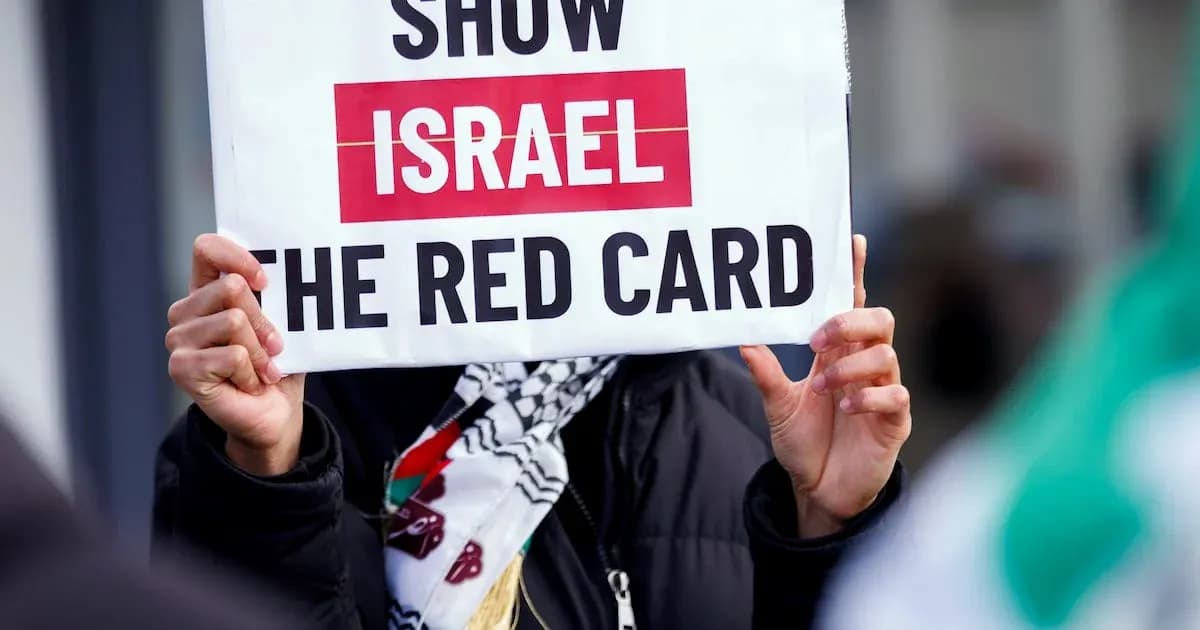
Protesters have marched, spoken, written, and lobbied. They have tried to force the issue onto the agenda, to insist that human rights and justice cannot be brushed aside for the sake of rankings and revenue. The board has held its line. In the narrow, internal sense, it has “won” the argument. In the wider moral frame, the day belongs to Israel.
The Government does not escape this indictment. Its record since the start of the current war has fallen short of the standard it likes to project on the international stage. That failure offers cover to others. The FAI has taken full advantage of that cover.
When asked about the games proceeding, Taoiseach Micheál Martin did not dwell on the ethics of playing Israel. He spoke instead about the team’s form, about a “rejuvenation” and a “journey ahead for the Irish team,” and wished them well. The comments were not just tone-deaf; they were wildly out of step with the gravity of the situation, as if the only journey that mattered was on a football pitch.
Now the countdown is almost over. In a matter of days, Ireland will step onto the field with points and prize money on the line, while tens of thousands of civilians – including more than 25,000 children, according to the article – remain at the heart of the accusation that Israel’s campaign amounts to genocide.
In that light, the word “principle” starts to look cheap. Easy to invoke, easier still to discard when the draw is made and the fixture list lands. The question that will linger long after these games are played is simple and uncomfortable: what, in Irish football, is actually non‑negotiable anymore?