Iraola's Journey: From Bournemouth to Liverpool's Coaching Hot Seat
Only a year ago, Liverpool opened the season like a champion side that knew exactly who and what it was. Five wins from five under Arne Slot, the title defence seemingly locked onto its tracks. That surge began with a victory over Bournemouth, then led by Andoni Iraola, on the opening night.
No one at Anfield that evening imagined the Spaniard in the away dugout would be the man walking out as Liverpool head coach 12 months later.
Football does not bother with neat storylines. It rips them up and writes new ones.
From Bournemouth’s touchline to Liverpool’s hot seat
Iraola arrives at this weekend’s reunion still unbeaten in the Premier League with Liverpool, but already six points worse off than Slot’s side at the same stage. The numbers say “slower start”. The mood around the club says something different.
The 44-year-old walks back into Bournemouth not as the architect of their high-pressing survival act, but as the man trying to reshape Liverpool after a bruising, joyless campaign. Those inside the club insist almost everyone wanted last season over and done with. Even if Slot had stayed, they say, the atmosphere was always going to feel lighter.
Now comes a strange homecoming. Iraola will step into the away dressing room at the Vitality Stadium, a room Bournemouth have had to expand and upgrade to meet Europa League regulations. Smaller than the home quarters, but no longer the cramped, unforgiving box he once knew. Fitting, perhaps, for a coach who has traded the south coast seaside for the quieter sands of Formby.
He has slipped into the area much as he has slipped into the job: quietly. He lives where Jurgen Klopp and Brendan Rodgers once did, has been seen occasionally in Liverpool’s city centre and, as a keen cyclist, has already taken to the coastal routes. But his real habitat is not the promenade. It is the training pitch at Kirkby.
Six days a week and no “light days”
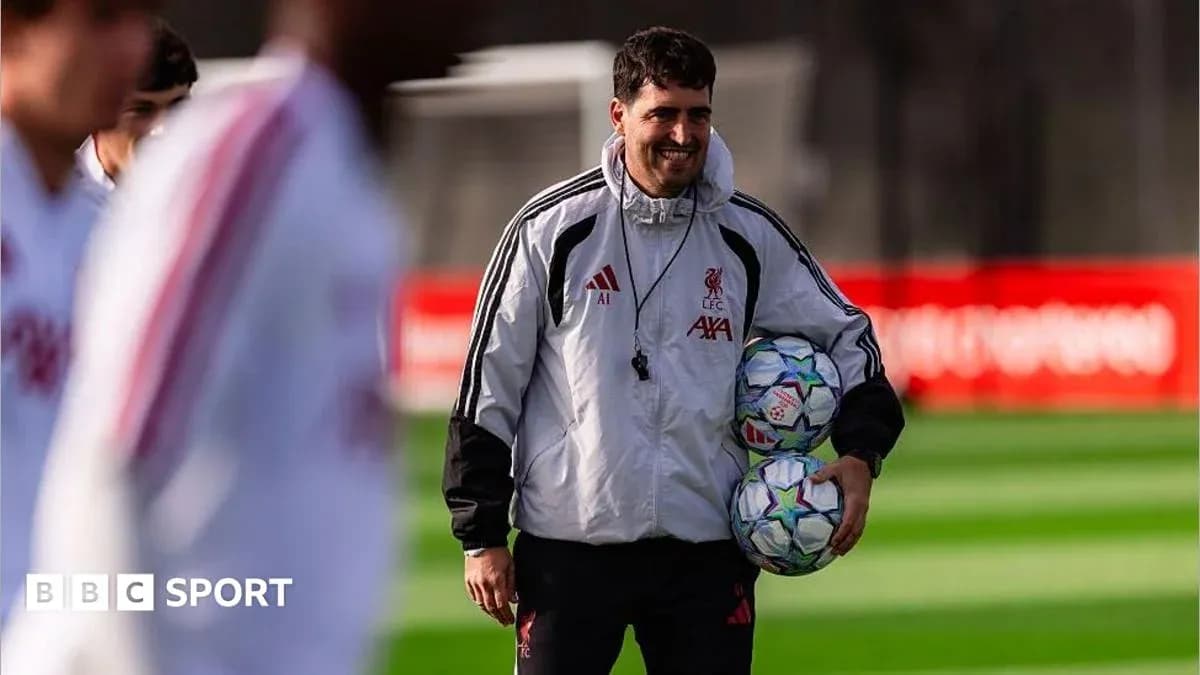
At the AXA Training Centre, Iraola is a constant, almost old-fashioned presence. Those at Liverpool call him a “six days a week” coach. He is often first out on the grass, marking cones and laying out sessions himself.
“It’s really intense. There’s a lot of hard work and no sort of light days. Everyone’s putting in 100%,” said forward Lewis Koumas. The line could double as a mission statement.
Intensity is the word that keeps coming back. It was the word that caused a small storm in pre-season, when Iraola told LFC TV that Liverpool had “run out of steam” after half an hour against Monaco and did not yet have the energy to play with his desired tempo. He meant it as an honest admission of where they were in their physical build-up, not a public jab at his players. The reaction reminded him of something every Liverpool manager learns quickly: every syllable can ricochet around social media and be twisted into something else.
He has adjusted. In front of the media he comes across calm, measured, open to debate. Inside the building he keeps a lower profile than some of his predecessors. His own office is rarely used. Instead, he spends most of his time in the coaches’ room with Tommy Elphick, Shaun Cooper and long-time lieutenant Pablo de la Torre.
De la Torre followed him from Rayo Vallecano to Bournemouth in 2023 and is again central to the project. His job is clear: make sure Liverpool’s players can physically sustain the demands Iraola places on them.
Learning Liverpool’s grind in real time
For all his good work at Bournemouth, Iraola is learning a new sport within the same game at Liverpool: elite management under a relentlessly congested schedule.
This season, the club expects to play at least 49 matches. A decent cup run or two and that number creeps into the 60s. That changes everything. Training loads. Recovery. Rotation. Risk.
Iraola listens. The medical and fitness teams at Kirkby have a strong voice in planning, and he has shown a willingness to bend his ideas around the reality of the calendar. Training times move with the fixture list. Late afternoon and early evening sessions have become more common as he tailors preparation to kick-off slots. Under Slot, Liverpool largely trained at the same time each day. Iraola prefers the schedule to move.
There have been long conversations with the academy too. Rob Page, who coaches Liverpool Under-21s, talks of a clear alignment.
“We have an understanding of how the first team play and key principles, like how we press, how he [Iraola] wants his number 10 to press, how he wants his number eight to press, how he wants his centre-backs to press – we mirror that absolutely,” said Page.
That clarity feeds into selection. Iraola tends to name his team on the morning of a game, keeping players on their toes but inside a framework they recognise. Post-match, the detailed debrief waits until the following day. Emotions cool, analysis sharpens.
A young squad built to run – and asked to
Liverpool’s squad under Iraola is one of the youngest in the league. The average age in the Premier League this season is 25.3, with only five teams fielding younger line-ups. That is not an accident. One of the main reasons Liverpool went for Iraola was his track record in developing young talent.
The Carabao Cup tie against Tottenham underlined the point. Rio Ngumoha, 18, Trey Nyoni, 19, and Koumas, 20, all started. All three are expected to have bigger roles this season than last. They are being asked not just to fill gaps, but to live the pressing principles that define the first team.
Dominik Szoboszlai has already broken down the structure publicly: a number six, a number eight and a number 10 in midfield. Supporters spent the summer calling for a defensive midfielder, but Iraola’s view is that the system can function if the collective improves. The press must be joined up. The distances must shrink. The legs must last.
So far, the legs have worked hard. Going into this weekend, Liverpool have recorded the most sprints in the Premier League. Yet the schedule has already started to bite. Less than 72 hours after beating Atletico Madrid in the Champions League, they looked flat in a goalless draw against Fulham.
Sunday’s trip to Bournemouth will be their fourth game in 12 days. After the international break, it gets even more brutal: four matches in 10 days, and between 11 October and 7 November, nine games in total. Intensity is a non-negotiable for Iraola, but he knows there will be days when Liverpool have to win with a set-piece or a flash of individual genius rather than a 90-minute storm.
Adapting as much as he is changing
From the outside, a new coach at Liverpool often looks like a revolution. Inside the club, the changes are more measured. The head coach role is tightly structured. Processes are in place. Iraola has not ripped any of that up. He is fitting himself into it.
It is as much about him adapting to Liverpool as Liverpool adapting to him.
He has already shown a pragmatic streak. He understands that a side expected to challenge cannot live off being “hard to beat” alone, even if that represents progress after 12 league defeats last season. The unbeaten Premier League run that stretches back to January across his two clubs matters. So does the fact that, as vice-captain Alisson pointed out last week, draws are not good enough for Liverpool.
The standards are ruthless. The room for excuses is thin.
A Basque smile and a familiar stage
On Thursday night, Iraola will have allowed himself a private smile. Bournemouth, the club he left for Liverpool, won on their Europa League debut against Real Sociedad in the Basque region where he grew up. A neat twist of geography and history, even if his focus lies elsewhere.
Maybe on the flight down from Liverpool on Saturday, he will finally have a moment to breathe and look back. From the Basque Country to Rayo, from Bournemouth to Anfield, from the home dressing room at the Vitality to the away one.
Liverpool under Iraola have not exploded out of the blocks as they did under Slot last year. They have, however, stopped losing. They have run, and run, and run. They have started to look like a team that refuses to be easy prey.
Now comes a different kind of test. A familiar ground. A fanbase that once sang his name. A club that helped earn him this shot.
He is unbeaten in the Premier League since January. Extend that run with a win back on the south coast, and Liverpool head into the international break not just intact, but with the sense that this new era is finally beginning to gather speed.