Humanoid Robot Football Carnival in Nanning: A New Era
In the humid late-summer air of Nanning, the future of football walked out onto the pitch on Thursday — on metal legs.
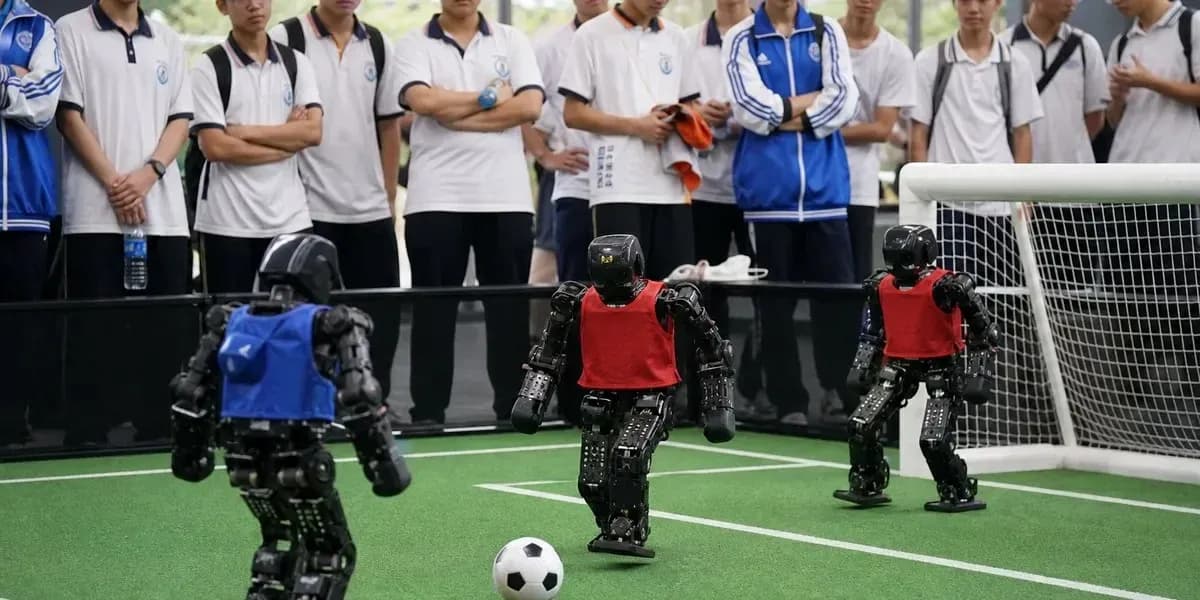
China’s first humanoid robot football carnival for secondary school students kicked off in the capital of the Guangxi Zhuang Autonomous Region, turning a slice of the 23rd China-ASEAN Expo into a laboratory for the game’s next revolution. More than 40 schoolchildren from 10 educational institutions have swapped shin pads and studs for code and sensors, coaching teams of machines rather than teammates.
Three-a-side, no joysticks
The format is familiar at first glance: three-on-three football, small-sided, fast, and congested. The twist is absolute. Once the whistle goes, no one touches a controller.
Every team fields Booster K1 humanoid robots, operating fully autonomously through artificial intelligence. The students’ work is done before kick-off — in the lines of code that dictate how their robots see the ball, read space, and decide whether to press, pass, or shoot. After that, it’s up to the algorithms.
No touchline rants. No last-minute tactical tweaks. Just robots making split-second decisions in real time, their movements a direct reflection of how well their young programmers have taught them to think.
For Guangxi, organizers say this is a landmark: the largest and highest-level humanoid robot football event ever staged in the region for secondary school students. For the kids, it is something more personal — a chance to see their classroom theories tested under the lights.
A new kind of football classroom
Around the pitch, the carnival feels less like a conventional tournament and more like a cross between a science fair and a cup final. There are cheers, of course, as a robot swivels and finishes a move its creators mapped out on laptops weeks ago. There are also quiet huddles over screens, as students pore over data from the previous match, looking for the bug that cost them a goal.
The football is the headline act, but it sits inside a wider program designed to stretch young minds beyond the touchline. Alongside the matches, the schedule includes scientific events, interactive demonstrations, and China-ASEAN exchanges, all built around artificial intelligence and its role in daily life.
Parents and children move between exhibits and the pitch, drifting from technical displays to hands-on activities. A robot miscontrols a pass, draws a groan, then a laugh. A few minutes later, in a nearby zone, another machine demonstrates delicate precision in a different field. The message is clear: the same intelligence that misjudges a bounce today might guide something far more complex tomorrow.
Football at the heart of an AI showcase
The timing is no accident. The carnival runs in parallel with the China-ASEAN Expo, held in Nanning from September 17 to 21, where one of the three major exhibition zones this year is devoted entirely to artificial intelligence and cooperation in the field.
Under the theme “CAFTA 3.0 Opportunities, Better Life,” the expo frames AI not as a distant abstraction but as a tool already reshaping work, play, and education across the region. On that stage, robot football is more than a novelty. It is a vivid, accessible way to show how code, hardware, and imagination can combine into something that moves, reacts, and competes.
The Booster K1 units become unlikely ambassadors — not just for technology, but for a generation of students learning to treat AI as a language they must speak fluently if they want to thrive.
As the carnival unfolds, every three-on-three duel carries a quiet question: when these teenagers leave the schoolyard behind, will they still be writing game plans for robots on a pitch, or will they be scripting how intelligent machines shape the rest of our lives?