Gabriel: Manchester United's Next Superstar at a Crossroads
Manchester United have spent the past decade searching for the next homegrown superstar. Now that one finally appears to have arrived, they are fighting to stop him walking out of the door before he’s even old enough to drive.
Gabriel, the 15-year-old forward lighting up United’s academy, is being courted by Real Madrid, Barcelona, Paris Saint-Germain and Bayern Munich. Four of Europe’s heavyweights, all circling the same teenager. United’s answer is blunt: they do not intend to sell. Behind the scenes, senior figures are scrambling to change his mind.
For Sir Jim Ratcliffe, still in the infancy of his reign as the public face of United’s football operation, this is a test with real consequences. He has already felt the heat from supporters over unpopular calls. Lose a player many inside Carrington regard as a once-in-a-generation talent, and the protests will only grow louder.
A loophole, a birthday and a ticking clock
Gabriel is under contract until next summer, but the situation is far from straightforward. He is not a full-time scholar, and not part of the club’s full-time model. That matters.
When he turns 16 on October 16, he could, in theory, leave for an EU club if he holds a European passport.
United are now digging into that detail. His father, Joe O’Cearuill, is a former professional who represented Ireland twice. His mother is of Greek Cypriot heritage. Under post-Brexit regulations, a dual national can move from England to a club in the European Union before turning 18.
That loophole is exactly what the European giants are trying to exploit. United, who beat Manchester City to Gabriel last year, suddenly face a far more complicated battle. This time, it feels like his head might already have been turned.
The evidence? He was due to train with the first team on Saturday. He didn’t show. He has not been seen at Carrington this week.
A debut that won’t happen – and history on hold
Michael Carrick had planned to include Gabriel in his squad for Wednesday’s Carabao Cup third-round tie against Brighton at Old Trafford. Had he stepped onto the pitch, Gabriel would have become the youngest player ever to feature for United’s senior side.
That appearance is now off the table.
For a club whose academy has not produced a true global star since Marcus Rashford, Gabriel has been the great hope. He joined at 11, a two-footed forward with sharp feet, sharp instincts and the agility to slalom out of the tightest spaces. Give him a glimpse of goal and he finishes with cold precision.
Comparisons with Lionel Messi are unhelpful, but the Neymar parallels are easier to understand. Gabriel’s style is flamboyant, slippery, daring. He even wears the same model of Nike boots as the Brazilian, having signed a lucrative contract extension with the brand in March 2025.
The numbers underline the hype. Last season, he broke into United’s Under-18s at 14 – another club record – and scored 20 goals in 21 league games. That haul earned him the inaugural Premier League U18s Player of the Year award and United’s Jimmy Murphy Young Player of the Year, again as the youngest ever recipient.
In August, he stepped up to the U21s and announced himself with a goal and two assists in a 5-0 demolition of Ipswich. A week later, he scored again as United battered Leicester City 4-1.
This is not a normal 15-year-old. This is a player operating years ahead of schedule.
Dowman, Nwaneri and the pull of the fast lane
So why the impatience? Look around Europe.
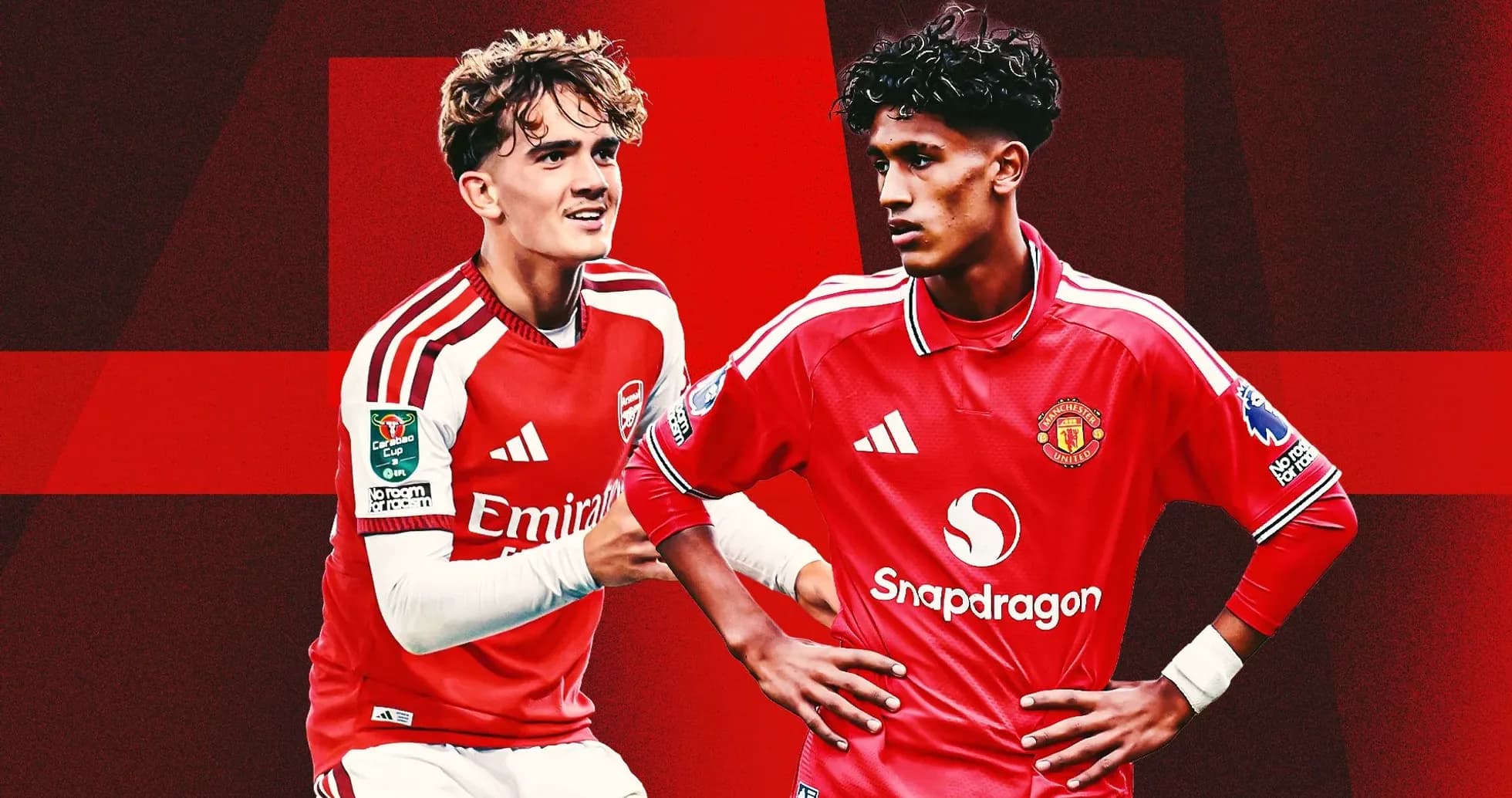
In north London, Arsenal have shown exactly what can happen when a club leans into the “if you’re good enough, you’re old enough” mantra. Ethan Nwaneri became the youngest Premier League player in history at 15 years and 181 days when he came on against Brentford in September 2022. His progress has stuttered at times, with loans to Marseille and Borussia Dortmund, but he already has over 50 appearances for Arsenal at 19.
Now it’s Max Dowman’s turn. The teenager became the Premier League’s second-youngest player when Mikel Arteta brought him on against Leeds United in August 2025. In March, Dowman broke James Vaughan’s record as the league’s youngest goalscorer, dancing through Everton’s defence at 16 years and 139 days.
By May, he was the youngest title-winner in Premier League history. This week, he joined Wayne Rooney in a tiny club: only the second 16-year-old to score a brace for a Premier League team in a major competition, as Arsenal beat Ipswich 4-2 in the Carabao Cup.
Fourteen senior appearances already, and a manager who has publicly spoken about him in the same breath as Messi. Arteta is not just throwing him in; he is picking his moments, shielding and showcasing Dowman in equal measure.
“You don’t see that in this league,” Arteta said after the Ipswich game, stressing the physical and mental demands of English football and the need to “make sure every time we throw him in, he’s in the right context with the right preparation.”
Gabriel sees all of this. Of course he does.
Talent vs timing – and a fragile frame
Here is the crucial difference. Dowman looks built for the Premier League. Gabriel does not. Not yet.
United’s prodigy is slight, often the smallest player on the pitch. His courage and determination close some of that gap, but they do not erase it. Thrusting him into the first team too early could backfire spectacularly, especially if he explodes onto the scene.
Imagine the scenario. Gabriel comes in, dazzles, scores. The clamour becomes deafening. Carrick would face pressure to pick him every week, loading a teenage body with an adult’s workload.
Arteta can rotate Dowman because Arsenal are stacked. They win games with or without him. Their “second XI” is still good enough to dominate most opponents. United do not have that luxury. Performances swing wildly. Results wobble. Every selection is a statement.
If Carrick were to bring Gabriel in and then take him out, he would be accused of stifling a generational talent. If Gabriel played and struggled, the narrative would flip: overhyped, overrated, another academy myth.
That is why Carrick’s caution has impressed those who know the path from academy to first team.
A graduate’s warning
Danny Simpson, who emerged from United’s academy in the latter days of Sir Alex Ferguson’s empire, understands the difference between breaking through in a dominant team and one still searching for itself.
Speaking to GOAL via Free Bets, he pointed to Dowman’s environment at Arsenal.
He recalled how, in his own early days, he could come on for 10 minutes when United were already 2-0 or 3-0 up, surrounded by a “second XI” strong enough to win the league. That is the cushion Dowman now enjoys: a side “flying in confidence, full of top, top talent, winning games.”
At United, Simpson argued, the picture is very different. Every point is fought for. Every mistake is magnified. That is no place to throw in a skinny 15-year-old and expect him to carry the mood of a stadium.
Simpson believes Carrick is handling the situation correctly, pointing to the careful integration of Shea Lacey as a template. Let Gabriel train with the seniors. Let him feel the level. Let the timing be right.
His message is simple: Gabriel’s time will come, if he stays.
Yamal, La Liga and the lure of Spain
Of course, patience is a hard sell when your peers are already living the dream.
Gabriel only has to glance at Barcelona and Lamine Yamal to see what early elevation can look like. Yamal made his senior debut at 15 years, nine months and 16 days, slight of frame but lightning-quick in thought and movement. He survived the physical battles by outthinking defenders, not outmuscling them.
La Liga helped. Spain’s top flight is less about relentless transitions and more about structure, possession and angles. It is a kinder place for a young technician to grow. In the Premier League, where time on the ball is a luxury and contact is constant, Yamal’s rise might have been far more complicated.
Gabriel could look at that and think Barcelona or Real Madrid offer a fast-track to superstardom. On the surface, it makes sense. But timing is everything.
When Yamal broke through, Barcelona were surging towards the La Liga title under Xavi but licking their wounds after a Champions League group-stage exit. Raphinha, Ousmane Dembele and Ferran Torres were not at today’s levels. There was space in the hierarchy. Yamal took it.
Now, that landscape has changed. Barcelona can call on Yamal, a peak Raphinha, Anthony Gordon, Karim Adeyemi and Gabriel Jesus in attack. At Real Madrid, Jose Mourinho has Kylian Mbappe, Vinicius Junior, Jude Bellingham and Yan Diomande, among others.
At either club, Gabriel would still be waiting, just in a different language and a different climate.
The path of least resistance – and the danger of entitlement
Strip away the noise and one truth remains: Gabriel has a clearer route to regular senior football at United than at any of the superclubs chasing him. That does not mean it will be immediate. It does mean it is realistic.
If he insists on having everything now, he risks losing everything later.
United, for their part, cannot allow themselves to be held hostage by a teenager who is still 18 months away from sitting his GCSEs. Talent does not change that fact. Carrick and the academy staff have nurtured him carefully to this point. They will continue to do so, if he chooses to listen. If not, there is little sense in chaining him to a club he no longer believes in.
A prolonged saga would only distract from United’s attempts to recover from a poor start to the season. Whether pushed by advisers or driven by his own ambition, Gabriel is making decisions from a position of power he has not yet truly earned.
That sense of entitlement is not new at Old Trafford. Former manager Ruben Amorim, heavily criticised and ultimately sacked in January, warned about it before his exit.
“There is a feeling of entitlement we have in our club,” he said. Difficult moments, he argued, can be good for young players. They do not always need applause. They need to stay, fight, overcome.
Amorim failed in many areas, but on that point, he struck a nerve.
Bigger than one boy
United’s history is built on homegrown greatness forged in hardship, not handed out as a birthright. George Best, Sir Bobby Charlton, Ryan Giggs, David Beckham, Paul Scholes, Gary Neville – none of them were given anything on a silver platter. They met the highest standards on and off the pitch.
That is the bar Gabriel must reach if he wants to belong in that lineage.
Right now, his attitude will decide as much as his ability. If he believes he is bigger than the club, he will never become the player he could be at Old Trafford. If he walks away to build a brand elsewhere, United will move on. They always do.
The question is not whether Gabriel can change United. It is whether he is willing to let United change him.