Gabriel at Manchester United: A Crossroads for Future Talent
Manchester United are fighting to keep hold of a boy who hasn’t even turned 16 yet, but already has four of Europe’s giants circling.
Real Madrid, Barcelona, Paris Saint-Germain and Bayern Munich all want Gabriel. United, for now, are refusing to even contemplate his exit. Senior figures at the club are working overtime to change his mind.
The stakes are brutal. INEOS chairman Sir Jim Ratcliffe has already felt the anger of the fanbase over a series of unpopular calls in his short reign as the public face of United’s football operations. Letting a once-in-a-generation academy talent slip away would ignite a new level of fury.
Gabriel is under contract until next summer. Crucially, he is not a full-time scholar or part of United’s full-time model, and that leaves a dangerous loophole. When he turns 16 on October 16, he could walk away for nothing, as long as he holds a European passport.
United are scrambling to understand exactly how vulnerable they are. His father, Joe O’Cearuill, is a former professional who played twice for Ireland. His mother is of Greek Cypriot heritage. Under post-Brexit rules, a dual-national teenager can leave England for a club in the European Union before turning 18. That rule, written in political ink, now hangs over Old Trafford like a storm cloud.
A No-Show and a Growing Fear
United already know what it’s like to fend off predators. They kept Gabriel away from Manchester City’s clutches last year. This time, the fight feels different. Harder. Colder.
It may already be too late.
Gabriel was scheduled to take part in first-team training on Saturday. He didn’t turn up. He hasn’t been seen at Carrington all week. For a club that had mapped out his next steps carefully, that silence is deafening.
Michael Carrick had planned to name him in the squad for Wednesday night’s Carabao Cup third-round tie against Brighton at Old Trafford. Had he stepped on the pitch, Gabriel would have become the youngest player ever to feature for United’s senior side. That historic cameo is off the table. His involvement has been ruled out.
This is no longer just about development. It’s a power struggle.
A Beacon in a Dull Era
United’s academy has not produced a genuine global superstar since Marcus Rashford burst through. Gabriel has carried that burden of hope since he arrived as an 11-year-old.
He’s a two-footed forward, slippery in tight spaces, light on his feet, and ruthless when the goal opens up. He glides out of pressure, then finishes with a cold precision that belies his age.
Comparisons with Lionel Messi do him no favours, but you can see echoes of Neymar in the way he moves, feints, and tempts defenders into lunges they regret. He even wears the same model of Nike boots as the Brazilian, having signed a lucrative contract extension with the sportswear giant in March 2025. The hype machine is already running at full speed.
Last season, at just 14, he broke into United’s Under-18s. Another record. He scored 20 goals in 21 league games, tearing up a level where most players are three or four years older. That haul earned him the inaugural Premier League U18s Player of the Year award, and he became the youngest ever winner of United’s Jimmy Murphy Young Player of the Year prize.
In August, he stepped up again, this time to the U21s. On his debut against Ipswich he produced two assists and a delicate chipped finish in a 5-0 rout. Seven days later, he scored again as United thrashed Leicester City 4-1.
These are not normal numbers. This is not a normal trajectory.
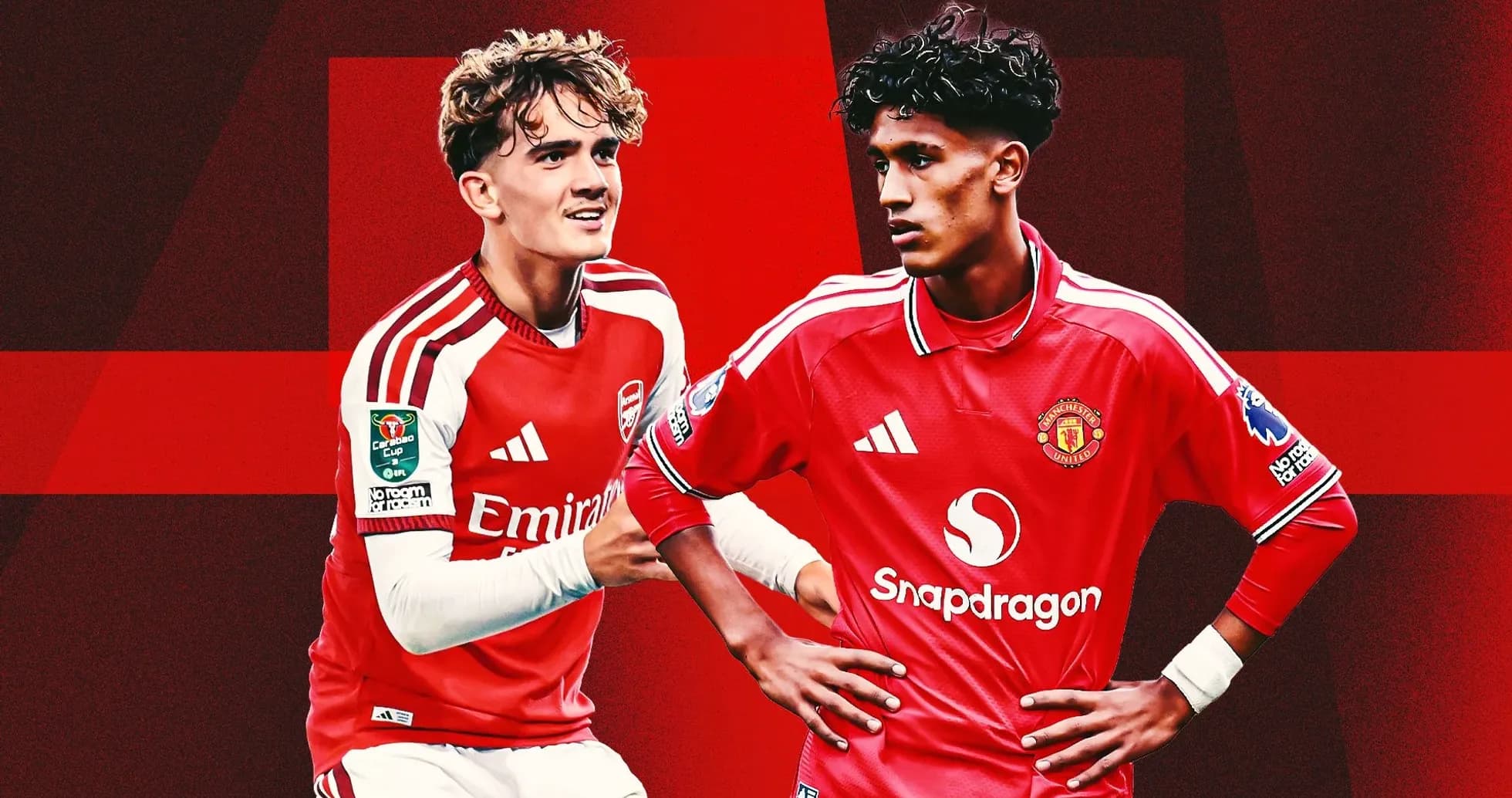
It’s no surprise there’s a growing clamour for Carrick to throw him in, particularly with United crying out for inspiration in the final third and with Max Dowman lighting up Arsenal.
The Dowman Effect
The Premier League has seen this movie before. In September 2022, Ethan Nwaneri became the youngest player ever to appear in the competition, coming on for Arsenal against Brentford at 15 years and 181 days. His rise has not been linear – loans to Marseille and Borussia Dortmund have slowed the hysteria – but he now has over 50 appearances for Arsenal at just 19. The path is still bright.
Arsenal have doubled down on the “if you’re good enough, you’re old enough” mantra with Dowman. He became the league’s second-youngest player when Mikel Arteta threw him on against Leeds United in August 2025. In March, he broke James Vaughan’s record as the youngest Premier League goal-scorer with a stunning solo goal against Everton at 16 years and 139 days.
By May, he was the youngest title-winner in league history. This week, he joined Wayne Rooney in an exclusive club as only the second 16-year-old to score a brace for a Premier League side in a major competition, driving Arsenal to a 4-2 Carabao Cup win over Ipswich.
Dowman already has 14 senior appearances. His mix of flair and physical strength means Arteta simply cannot ignore him. Arteta himself has mentioned Dowman in the same breath as Messi, but he’s drip-feeding the teenager’s minutes, choosing his moments carefully.
“We have to look after him. He's 16 years old. You don't see that in this league,” Arteta said after the Ipswich game, stressing the unique physical and mental demands of English football. His message was clear: talent needs protection, not indulgence.
Gabriel, by contrast, does not yet match Dowman physically. He’s slight, often the smallest player on the pitch. His courage and determination help bridge that gap, but they don’t erase it. Throwing him into Premier League combat too early could backfire badly – especially if he explodes straight away.
If he shines, the pressure to play him every week will be immense. United do not have Arsenal’s luxury of depth and consistency. Arteta can rotate Dowman in and out of a winning machine. Carrick is trying to stabilise a side that lurches from one performance level to another.
If Gabriel starts strongly and is then rested, Carrick will be accused of being too cautious while the team struggles. If the teenager comes in and fails to impose himself, he’ll be branded overrated before he’s old enough to drive. It’s a brutal, unforgiving spotlight.
Carrick’s Caution and the View from Within
Carrick’s restraint has impressed those who know the academy grind. Danny Simpson, a United youth product who came through at the tail end of the Sir Alex Ferguson era, understands the difference between bedding in a youngster in a dominant side and exposing one in a fragile team.
Speaking to GOAL courtesy of Free Bets, Simpson drew a sharp contrast with Dowman’s situation.
He pointed out that when he broke through, United were “great”. He could come on for 10 minutes at 2-0 or 3-0 up, often surrounded by a “second XI who could win the Premier League”. Dowman, he argued, is stepping into a team “flying in confidence, full of top, top talent, winning games,” with even the back-up players “just as good”.
“It’s easy to come on and have an impact and play well,” Simpson said. United right now, he added, are “a bit different”. The environment is far less forgiving.
Simpson accepts the excitement around Gabriel but backs Carrick to time it right. He referenced Shea Lacey as an example of a careful approach, describing Lacey as a “top talent” and urging patience: let Gabriel train with the first team, be around the group, and trust that his time will come.
That is the club’s stance. The problem is that the modern teenager doesn’t just see his own dressing room. He sees the whole of Europe.
Yamal, La Liga and the Lure of the Fast Track
Even if Gabriel accepts that his physical profile makes his case different to Dowman’s, he only needs to look to Spain to feel that itch of impatience intensify.
Lamine Yamal was similarly skinny when he made his Barcelona debut in 2023 at 15 years, nine months and 16 days. He was a target for heavy challenges, but his speed and sharp football brain allowed him to outwit older, stronger opponents.
La Liga’s rhythm helps players like Yamal. The league is less physically relentless than the Premier League, with more emphasis on tactical structure and possession than on end-to-end transitions. It’s a more forgiving environment for pure technicians to blossom. In England’s chaos, where time on the ball is a luxury, Yamal’s rise might have taken longer.
Gabriel may believe Barcelona or Real Madrid can fast-track him to superstardom. The temptation is obvious. The logic is not.
When Yamal broke through, Barcelona were on their way to the La Liga title under Xavi but had crashed out of the Champions League in the group stage. Raphinha, Ousmane Dembele and Ferran Torres were not at the level they are now. There was room for disruption. Yamal could kick down a door that was already ajar.
Today, Barcelona’s frontline options are far more stacked: Yamal himself, a peak Raphinha, Anthony Gordon, Karim Adeyemi and Gabriel Jesus. At Real Madrid, Jose Mourinho has Kylian Mbappe, Vinicius Junior, Jude Bellingham and Yan Diomande in his dressing room. Those squads are not short of star power.
Where, exactly, does a 16-year-old Gabriel fit into that hierarchy?
Wherever he goes, he will have to wait. The difference is that at United, the path to a regular role is clearer. The first team is crying out for a homegrown hero. At Madrid or Barcelona, he would be one more jewel in a glittering collection.
Entitlement, Identity and a Harsh Lesson
This is where the conversation moves beyond tactics and into identity. United cannot afford to be held to ransom by a child who is still 18 months away from sitting his GCSEs, no matter how gifted he is.
Carrick and the youth staff have handled Gabriel carefully so far. They’ve given him a platform, protected him, and mapped a route to the top. If he recalibrates and stays, that work will continue. If he insists on forcing a move, there is a limit to how far the club can bend.
Any prolonged saga will only distract from United’s attempt to recover from a poor start to the season. Whether Gabriel is being pushed by people around him or simply intoxicated by the attention, his current stance smacks of a false sense of privilege.
The club’s history tells a different story. George Best, Sir Bobby Charlton, Ryan Giggs, David Beckham, Paul Scholes, Gary Neville – none of them were handed anything. They clawed their way to the top. Standards on and off the pitch were non-negotiable.
Former manager Ruben Amorim, for all his failings during a short and ill-fated tenure, touched a nerve when he spoke about entitlement at United shortly before his sacking in January.
“There is a feeling of entitlement we have in our club,” he said. Difficult moments, he argued, are not always a bad thing for young players. “We don't always need accolades in everything. We are not helping. Nowadays, they [players] speak and go against the club because they feel entitled. Let's stay. Let's fight. Let's overcome. That is the way we can solve things.”
He lost his job, but he was right about that.
With his current mindset, Gabriel is not going to transform United’s fortunes. The most important lesson for any academy prospect is brutally simple: no one is bigger than the club.
If that truth doesn’t land, United may be better served letting him chase his personal brand elsewhere – and backing the next kid in line to understand what it really means to wear that red shirt.