Dane Sweeny Achieves Career-Defining Win at US Open
Dane Sweeny had already banked more than a million dollars in career prize money before he walked out on court in New York. By the time he walked off, he had something far more valuable: the defining win of his career so far.
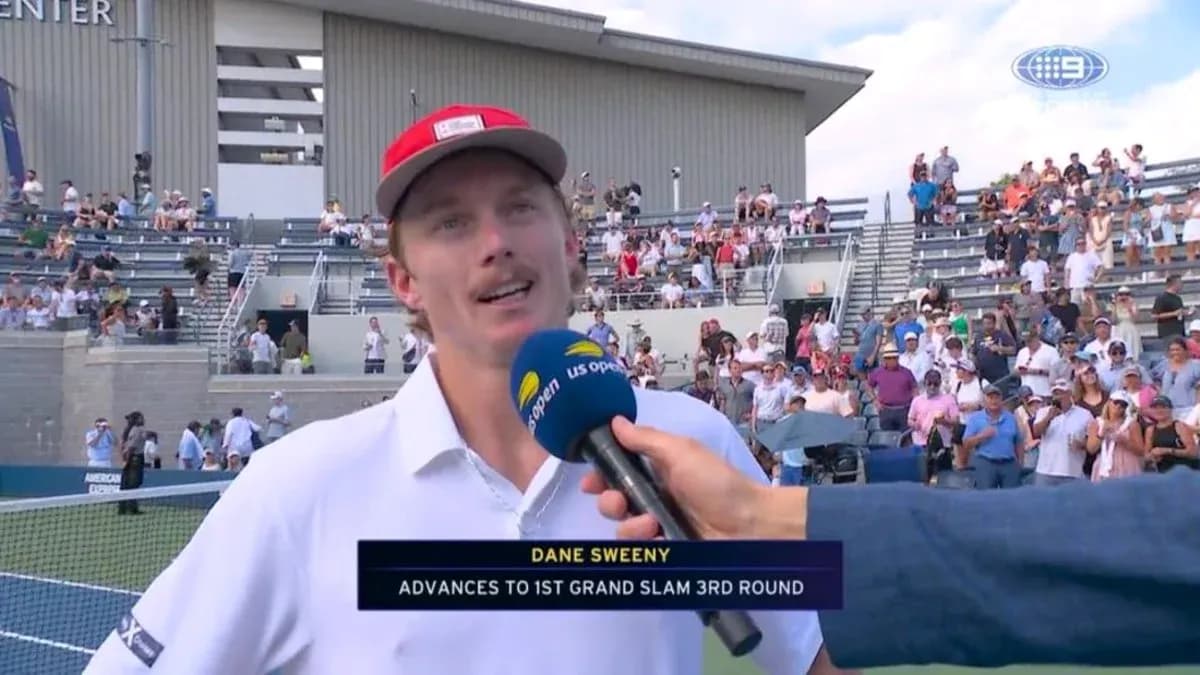
The 25-year-old from Penrith stunned 13th seed Lorenzo Musetti at the US Open, a victory he himself called “the biggest win of his life”, and one that propels him into the third round of a major for the first time. The cheque attached to it is hefty too – at least $402,000, more than doubling his earnings for the year – but the journey that led him here makes the number feel almost secondary.
Not long ago, Sweeny stepped away from the sport entirely. Results had dried up, belief with them. For two months he walked away, unsure if the grind of the tour was worth the emotional toll. Then he came back.
“Tennis can change at the flip of a coin, you’ve just got to keep persevering, and that’s what I did,” he said after the match, still trying to process what he’d just achieved. “I wasn’t getting results for a long while, but the law of probability, I knew it was going to swing in my favour if I just kept going, and I did. Now I’m here. Best decision I ever made to come back after that two months.”
On Louis Armstrong, his voice cracked as the scale of it all hit him.
“I don’t know, I’m so grateful to be able to compete in grand slams, I put a lot of work in,” he told the crowd. “Tennis [is] such a rollercoaster, I’m so incredibly grateful to play in front of this crowd, and to soak up the win... it’s awesome.”
Musetti was clearly hampered during the contest, but Sweeny still had to hold his nerve and his level. He did both. Point after point, game after game, he kept pressing, kept believing. When the final ball sailed out, the reaction said everything: part disbelief, part release, all joy.
While Sweeny was writing his own chapter, another Australian story on the grounds took a different turn.
Tristan Schoolkate, backing up barely 24 hours after a straight-sets win over Italian qualifier Andrea Guerrieri, ran into the brick wall of the fifth seed, Italian No.5 seed Flavio Cobolli. Schoolkate had hoped that quick first-round win meant he’d conserved enough energy for a long second-round fight. He certainly gave one.
He chased, he scrapped, he hung on. But at 5-5 in the fourth set, with the match on a knife’s edge, the pressure finally broke his resistance. Schoolkate took the opening point of the game, then watched two forced errors undo his work, including a forehand that missed the line by a hair. Cobolli seized his moment with two clean winners to grab the decisive break.
Serving for the match, Cobolli didn’t blink. He earned two match points and needed only one, slamming a booming serve out wide to close it out. No rabbit out of the hat for the Perth player this time. The handshake at the net told its own story: warm, genuine, a nod from a seed who knew he’d been pushed.
Elsewhere, Alexei Popyrin found himself locked in a trench war with Alejandro Tabilo. Popyrin flew out of the blocks, taking the first set 6-2, but the match flipped into a dogfight. Tabilo edged the next two sets in tiebreaks by near-identical scorelines, absorbing the Australian’s power and answering with ruthless efficiency on serve.
By the fourth set they were still on serve, the tension climbing with every hold. Popyrin had already fired down 22 aces and was landing 70 per cent of his first serves, yet he’d won only 72 per cent of those points. Tabilo, by contrast, was cruising behind his first delivery, winning 85 per cent of points when it landed. The numbers told the story: Popyrin’s serve was a weapon, but Tabilo’s was a shield that barely cracked.
It felt like a match destined to go the distance, one more five-set scrap to test Australian legs and lungs deep into the New York night.
On a day when one Aussie fell short, another pushed a seed to the brink, and a third tore up the script entirely, Sweeny’s surge stood out. From walking away from the sport to walking into the third round of the US Open, he’s turned a career crossroads into a launchpad.
The question now is simple: with belief finally matching his talent, how far can this run go?