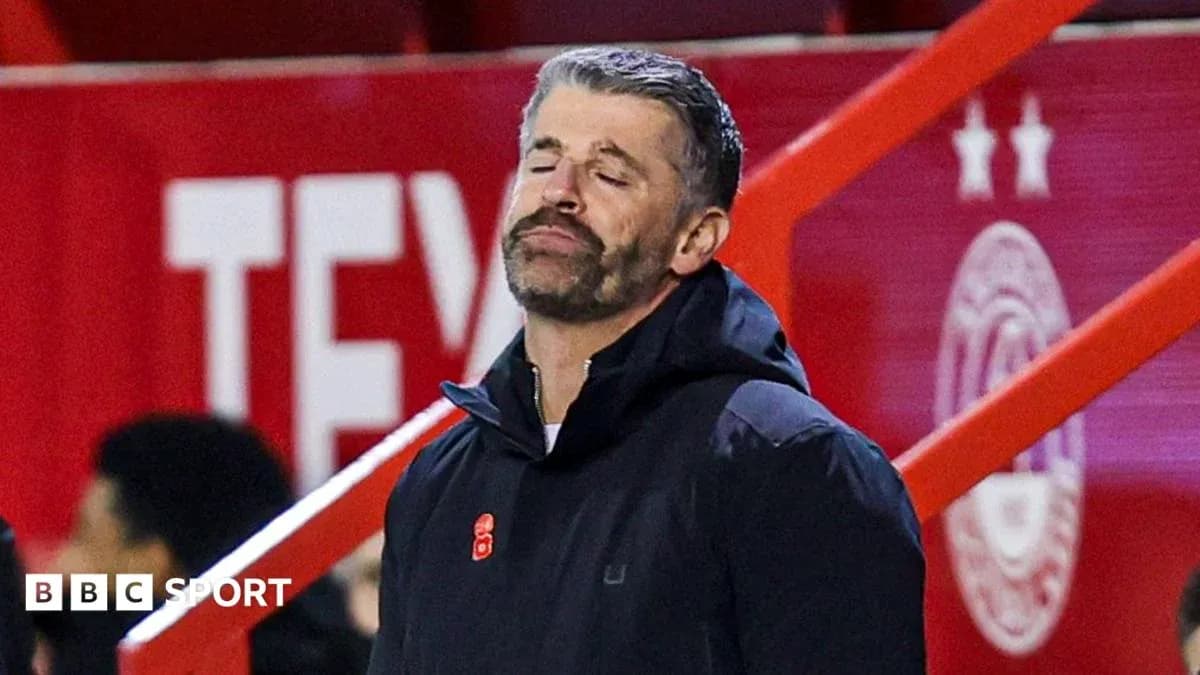
Stephen Robinson Sacked as Aberdeen Manager After Disappointing Start
Stephen Robinson’s time at Aberdeen is over before it ever truly began.
Eight months after walking into Pittodrie on a long-term deal meant to bring stability, the 51-year-old has been sacked, undone by three wins in 12 Premiership matches, a team drained of belief and a support that had clearly had enough.
Saturday’s 4-0 collapse at home to Hibernian was the breaking point. Aberdeen’s fourth straight defeat in all competitions, it left the Dons second bottom and looking every inch a club in freefall. The reaction was instant and unforgiving.
Club legend Willie Miller called the result “utterly embarrassing” and said Robinson looked “a man lost”. The words landed heavily. They also reflected what thousands inside Pittodrie had already decided.
Brian Kerr and Stephen Craigan have gone with him. Stuart Duff steps up as interim manager, handed a dressing room that has forgotten how to defend, how to score, and how to convince anyone that it belongs in the top half of the table, never mind anywhere near trophies.
A rebuild that never settled
Robinson did not arrive as an unknown quantity. The former Northern Ireland international had taken charge of Oldham Athletic, Motherwell, Morecambe and St Mirren, and came north on the back of three straight top-six finishes and a League Cup win with the Paisley club.
Aberdeen prised him away from St Mirren in March, giving him a contract through to the summer of 2029. He became the sixth permanent manager under chairman Dave Cormack since November 2019, a statistic that already hinted at a deeper instability.
Initially, Robinson did what was asked. He steadied Aberdeen last season, steering them away from relegation danger with the squad he inherited. Then came the summer. Then came the gamble.
Fifteen players out. Fifteen players in. A full-scale overhaul, backed by the board and led, in Miller’s eyes, by Robinson himself.
“You are looking at 15 players out and 15 players in, so it is a huge turnaround of players,” Miller said. “Was that all Stephen Robinson? I would imagine probably yes but I don't know because I am not privy to that information.”
The scale of change demanded a clear plan and a settled structure. Aberdeen never found either.
Robinson veered between a back four and a back five, searching for solidity, trying to plug holes that only seemed to widen. Across the league campaign, those tactical shifts produced just two clean sheets. At the other end, Aberdeen became the joint lowest scorers in the Premiership. It is a brutal combination.
Across 28 games in all competitions, Robinson leaves with 11 wins, five draws and 12 defeats. On paper, it is not a catastrophic record. On the pitch, and in the stands, it felt far worse.
New faces, same old problems
For all the churn, only a handful of the new recruits have truly established themselves. Goalkeeper Marius Muller and full-back Nesta Guinness-Walker are the only summer signings to have started every league game. Top scorer Kevin Nisbet, the club captain, is the only other player to match that ever-present record.
Even that relationship has soured. When Nisbet was substituted during the Hibs defeat, sections of the home crowd cheered. It was a raw, telling moment: frustration boiling over, not just with the manager, but with the squad he had assembled and the performances they were serving up.
Miller did not spare the players.
“The players aren't up to scratch, not up to playing at this level and dealing with high-ish expectations,” he said. “I'm not talking about trophies, I'm talking about being in the top six and they're nowhere near that.”
The criticism stings because it feels accurate. Aberdeen, a club that only recently lifted the Scottish Cup and has spent years talking about closing the gap to the top, now look like a side fighting simply to stay in the division.
Former defender and manager Alex McLeish turned the spotlight on recruitment.
“The board have really worked hard over the years to try and get Aberdeen back to a kind of level, won a cup a couple of years ago. I don't blame the board for anything at all,” he said.
“Recruitment is absolutely key and if you've bought a bunch of players and then they're not performing then that is a real worry. There's a few players in there that are already at a good level but can the others jump on that wagon and get Aberdeen rolling again because it's a very difficult time for them.”
McLeish’s caution was clear. “I'm not going to criticise the players because I'm not really sure what level they're at. You have to be a fairly good level to be in the Aberdeen team and to get back to that kind of level is going to be tough.”
Rinse, repeat, regress
Cormack’s ambition for Aberdeen has never been in doubt. His success rate with managers most certainly has.
Since he took control at Pittodrie, the club’s dugout has been a revolving door. Each new appointment has arrived with talk of long-term vision. Each departure has dragged the club a little further away from where it insists it wants to be.
“The phrase rinse and repeat may apply to hair washing, but these days it also applies to Aberdeen's recruitment of managers,” came one pointed assessment.
Aside from last season’s Scottish Cup win, the broader direction has been downward. The constant chopping and changing has not just failed to solve the problem; it has become part of it.
Robinson’s own arrival felt symptomatic of that cycle. He followed a lengthy search to replace Jimmy Thelin that left Aberdeen looking increasingly anxious. When the announcement finally came, the Red Army did not exactly rejoice. Many saw it as a move driven by panic, not conviction.
From there, the relationship never truly warmed. Results stuttered, performances sagged, and Robinson’s public demeanour told its own story. He looked worn down, his post-match interviews in recent weeks heavy with frustration and resignation. A man, as Miller put it, “lost”.
He has now paid the price, but the problems he leaves behind are not his alone.
A slide that must be stopped
The next Aberdeen manager will inherit a squad short on confidence, short on goals and short on time. The league table is unforgiving, and the fixture list offers no comfort.
After the international break, Aberdeen travel to Kilmarnock on 21 November. Three days later, they go to Rangers. Dundee visit Pittodrie on 28 November. It is a run that will quickly expose any lingering fragility.
The responsibility for the next move lies with recently appointed chief executive Adrian Bevington and sporting director Lutz Pfannenstiel. Much has been made of their networks, their contacts, their ability to open doors Aberdeen could not previously reach.
They will need every bit of that reach now.
This cannot be another short-lived experiment, another name added to the list of managers who came, talked about projects and left with reputations bruised. The next appointment must stop an alarming slide that is beginning to resemble something more serious than a bad spell of form.
Aberdeen have been here before, too often. The question now is stark: do they finally break the rinse-and-repeat cycle, or does this season end with a club of Aberdeen’s stature staring into the darkest of relegation battles?