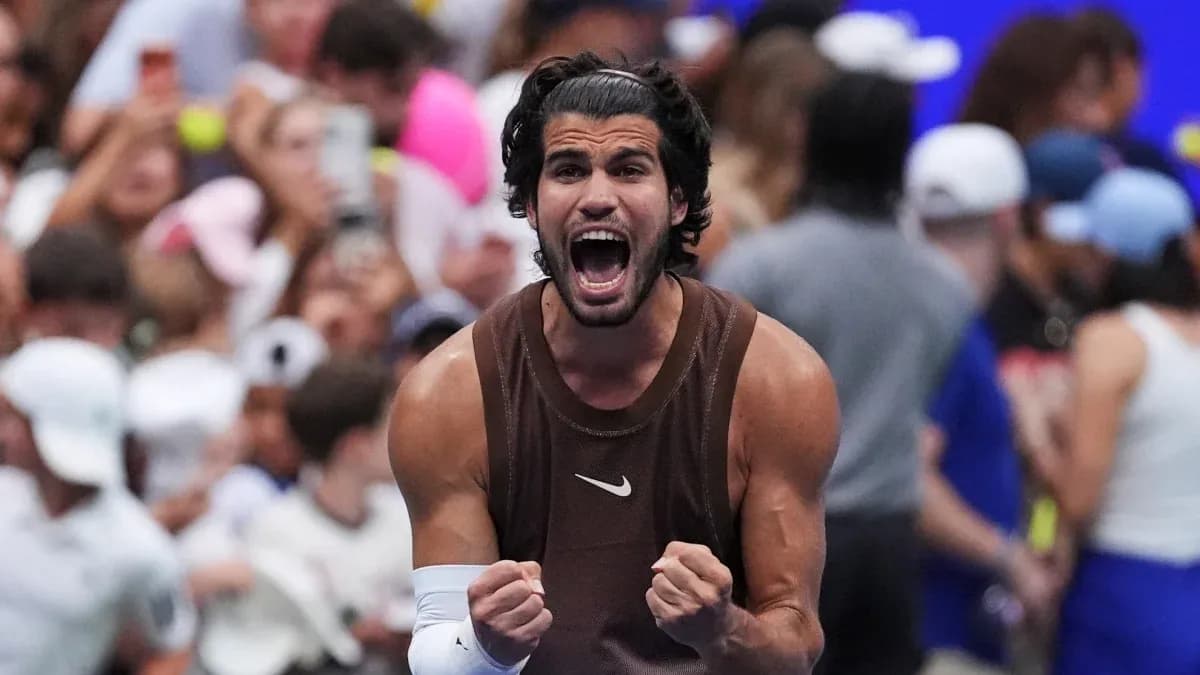
Carlos Alcaraz Steps Back from Grand Slam Revenue Campaign
Carlos Alcaraz has walked back into the US Open looking every inch a title threat again. But while his forehand is back on the big stage, his role in one of tennis’ most powerful player movements has quietly shifted to the sidelines.
According to The Times, Alcaraz’s long-time representative Albert Molina told the group behind the Grand Slam revenue campaign shortly before the tournament that the Spaniard would no longer be involved. For a movement built on the clout of its biggest names, that is no minor detail.
A star steps away from the fight
The campaign, launched in March 2025, had become the sharp edge of a growing player pushback. It gathered some of the game’s heaviest hitters — Aryna Sabalenka, Jannik Sinner, Coco Gauff among them — around a clear set of demands: a larger slice of Grand Slam revenue, stronger welfare protections, and a bigger voice in how the sport is run.
The headline target was bold: lifting the players’ share of Grand Slam revenue to 22% by 2030. As the 2026 season wore on, the frustration stopped simmering and started boiling over in public.
Sinner framed it in blunt terms.
“It’s more about respect, you know?” he said. “Because I think we give much more than what we are getting back.”
Players cut back their pre-tournament media duties at Roland Garros in a pointed gesture, tying that symbolic reduction to what they believed was an unfair percentage of Grand Slam income flowing their way. The message was simple: if the sport would not listen, its stars would make themselves harder to access.
The pressure worked, at least in part. Wimbledon pushed its prize fund up to £64.2 million. The US Open responded with a 20% jump in total player compensation to $108 million and introduced a $2 million Player Support Program. The four majors also signed off on a Grand Slam Player Council, a formal platform for player input.
On paper, the campaign still moves. But without Alcaraz, it loses one of its most magnetic figures — a 21-year-old multiple major champion whose presence helped sell the idea of unity at the very top of the sport.
His withdrawal does not mean he suddenly opposes the goals. It does mean his priorities, at least publicly, have shifted.
From revenue to survival: Alcaraz recalibrates
The turning point came not in a boardroom but in a treatment room.
A wrist injury cost Alcaraz almost five months of his season and forced him out of both Roland Garros and Wimbledon. For a player who had seemed to thrive on a relentless schedule, the enforced pause cut deep. It also appears to have reset his view of what a modern career can realistically endure.
Back in New York, his words are no longer about revenue percentages or governance structures. They are about survival in a calendar that grinds even the most gifted down.
“In the future, I’m going to take some breaks, some long breaks,” Alcaraz said. “Maybe not four months, but one month, two months, missing some tournaments, because it’s impossible to play them all.”
That is a stark admission from a player who not long ago looked determined to chase everything, everywhere. The lesson from those lost months is clear: if he wants to keep lifting the biggest trophies, something has to give.
Questions answered in New York
On court, though, the doubts have evaporated quickly.
Four and a half months away from the tour raised legitimate questions. How sharp would he be? How quickly could he hit his top level? The US Open has supplied emphatic answers.
Alcaraz has marched into the quarterfinals, brushing aside Roman Safiullin, Jaime Faria, Wu Yibing and Tommy Paul. The Paul match, in particular, underlined the gulf.
“It felt like he’s playing at a completely different level than me,” Paul admitted.
Alcaraz has sounded just as sure of himself as his tennis looks.
“So it probably doesn’t matter that I was out for four months and a half,” he said. “Every time that I come here, I play my best.”
New York has always suited his swagger, but this run carries a different weight. It is not just a comeback; it is a proof of concept that he can step away, heal, and still dominate when it counts.
A new kind of power play
That, in its own way, is another form of player power.
Alcaraz may have stepped back from the Grand Slam revenue campaign, but his stance on scheduling cuts to the heart of the same debate: how much can the sport ask of its stars, and at what cost?
He is still in the hunt for the biggest titles. He is still one of the faces of tennis’ future. The difference is that he is no longer pretending he can, or should, play everything.
For a generation watching him redefine the limits on court, his decision to impose limits off it might prove just as influential.