Bournemouth's Historic European Win Against Real Sociedad
“From -17 to Europe,” declared the banner in the away end at Anoeta, a strip of fabric that told Bournemouth’s story better than any glossy brochure ever could.
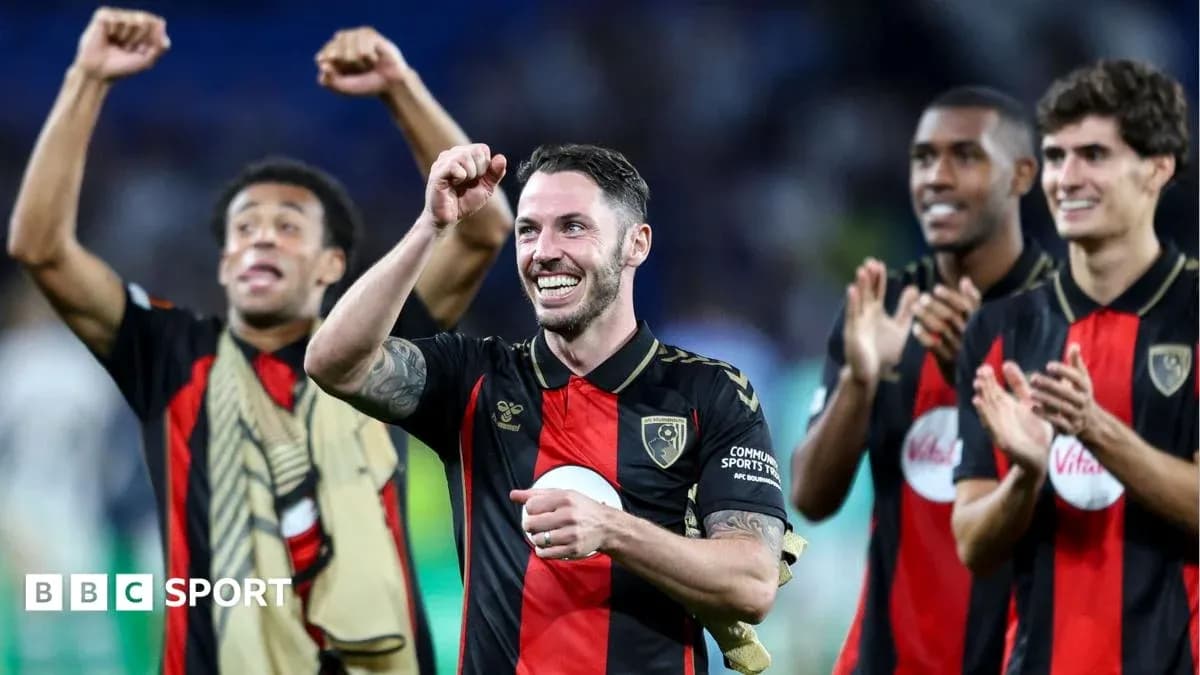
On a cool night in San Sebastián, the club that once started a season 17 points adrift at the foot of the Football League walked out for its first European game in 127 years – and then beat Real Sociedad 2-1 in their own backyard. Not just turned up. Won. Properly.
“This is a brilliant win in our first European game. It’s brilliant for the club and the 2,000 fans from Bournemouth,” Marco Rose told TNT Sports, his voice cutting through the noise of a travelling support that still looked like it was trying to believe what it had just seen.
For some, this all feels like the natural next step. Eleven years in the Premier League has created a generation of Bournemouth fans who have grown up with top-flight football as standard, not luxury. To them, Europe is the logical extension of a well-run, ambitious club.
For the rest, it remains utterly surreal.
Eighteen years ago, Bournemouth were on the brink. Administration brought a 10-point deduction and relegation to League Two. To even be allowed to start the 2008-09 season, they had to accept a 17-point penalty and sign away their right to appeal because they had not met the terms for exiting administration. Survival, not silverware, was the only objective.
Back then, the idea of a £100m-rated midfielder gliding around a European tie, picking out a Brazil winger to head home a winner, belonged to another universe. Yet here was Alex Scott, owning the San Sebastián pitch with the swagger that has top Premier League clubs circling, and Rayan showing exactly why Bournemouth will not blink at talk of a £130m release clause.
This was not just a romantic night. It was a serious European away performance.
Up against a Real Sociedad side led by World Cup winner Mikel Oyarzabal and fresh from a Copa del Rey triumph over Atletico Madrid, Bournemouth took the first half by the throat. Rose’s team pressed high, hunted in packs and suffocated the Basque side. Time and again they won the ball back in advanced areas, then had the composure and craft to turn those regains into chances, even against a set defence.
Sociedad looked rattled. Anoeta, so often a cauldron, was restless.
The response was inevitable. There is steel in this Real Sociedad team, and they emerged after the break with a different edge. The intensity that Bournemouth had poured into the opening 45 minutes began to show in tired legs. The press lost half a yard, the duels became more even, the spaces a little larger.
The pressure rose. Bournemouth’s resolve did not crack.
This is not a club renowned for shutting games down. Leads had slipped away in each of their first four Premier League fixtures this season, and as Sociedad poured forward, those scars must have itched. Crosses came in, second balls bounced dangerously, and the volume inside Anoeta climbed.
Djordje Petrovic stood firm. The Bournemouth goalkeeper’s sharp reflexes underpinned the resistance, his interventions buying his defenders breath and his team precious seconds. Every block, every clearance in the final stages felt heavier than the last.
“It was very intense and tough,” Rose admitted to TNT Sports. “Brilliant first half in everything. The way we won balls and the possession high up. In the second half, we needed to suffer because we were not so sharp.”
They suffered, and they survived. That is how famous away wins in Europe are made.
On BBC Radio Solent, former Bournemouth full-back Charlie Daniels captured the mood. “It is a big occasion. A big moment for the club, and they should be applauded for it,” he said, a man who knows exactly how long this road has been.
The path to nights like this runs straight back to January 2009 and the appointment of Eddie Howe. Given a team apparently destined for the drop, Howe somehow steered Bournemouth to safety, finishing nine points clear despite that brutal 17-point deduction. Six and a half years later, back for a second spell, he had dragged the club all the way to the Premier League.
So it felt fitting that, on this latest landmark evening, the side was led out by a survivor of those early days. Adam Smith first arrived at Bournemouth on loan in 2010-11, returned permanently in 2014 and has barely left the team-sheet since. Close to 400 league appearances later, he walked his team out into Europe.
“Adam has been with the club for so long,” Daniels said. “Dedicated himself to the club, and it’s such a proud moment, not only for him, but for his family, his team-mates and old team-mates to see how he’s grown – not only as a player but as a man as well. To lead out the Cherries on this historical night is fantastic.”
History followed him onto the pitch. At 35 years and 141 days, Smith became the oldest English outfielder to make his debut in major European competition since Ipswich’s Reginald Pickett in 1962. A statistic, yes, but also a symbol: the old guard finally tasting a stage that once felt unreachable.
Smith, more than most, will understand what this night means. Bournemouth’s recent years have not been smooth – relegation from the Premier League in 2020, the grind of coming back up, the constant battle to replace key players cherry-picked by Europe’s elite. Every time they build, someone bigger comes calling.
Even qualifying for Europe did not keep Andoni Iraola. The coach who helped shape this latest version of Bournemouth is already gone, returning to the Vitality Stadium on Sunday with Liverpool, another reminder of the food chain that never stops moving.
That pattern will not end because of one night in San Sebastián. Bournemouth will continue to sell, to rebuild, to reinvent. But as long as evenings like this are possible – a banner proclaiming “From -17 to Europe,” a World Cup winner frustrated, a Basque fortress silenced – no one in the away end will be complaining.
They know exactly where they’ve come from. The real question now is how far this journey can still go.