Alexander Zverev: From Near-Miss to World Number One
Alexander Zverev used to be the nearly man. The best player of his generation without a Grand Slam, the talent who always seemed to stop one step short of the summit.
He will finish 2026 as a two-time major champion and the world number one. Not a placeholder. A fully earned, fully scarred, late-blooming number one.
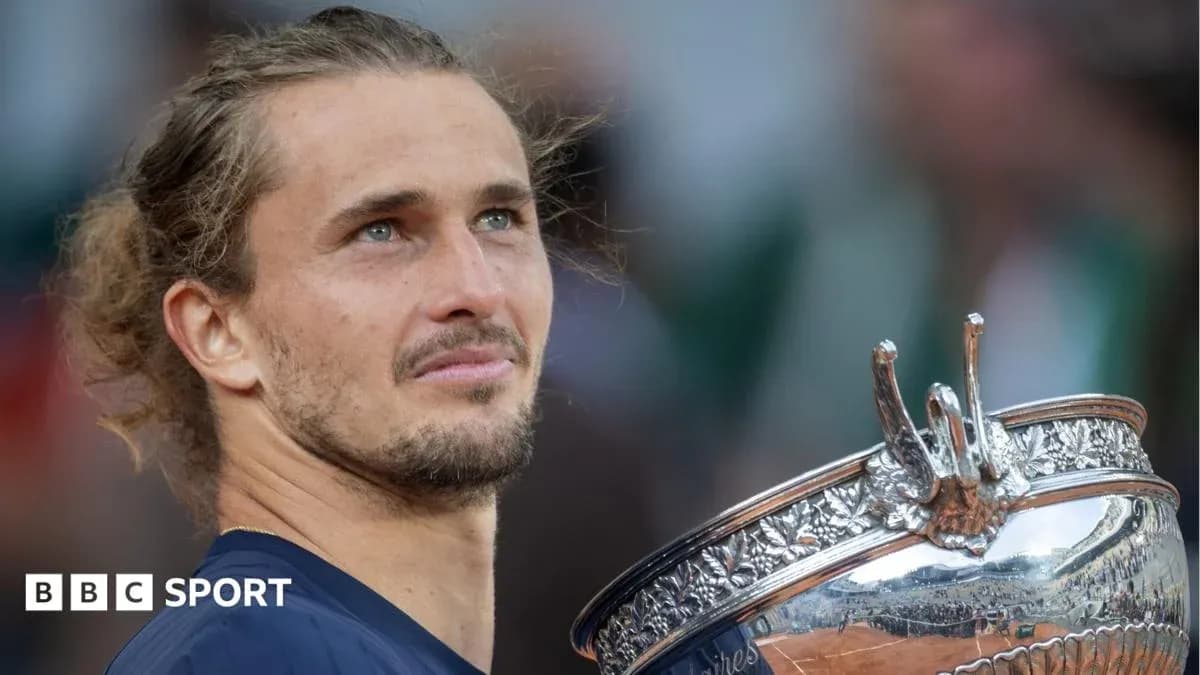
At 29, he has become the oldest man in more than half a century to reach the top of the rankings for the first time, powered there by titles at Roland Garros and the US Open and a run to the Wimbledon final. For a decade he has been a looming presence near the top; this year, he finally kicked the door down.
A career that refused to stay in the shadows
The raw materials were never in doubt. Before this season began, Zverev’s CV already read like that of a man who should have been a multiple major winner: Olympic champion, twice the ATP Finals champion, former world number two, three-time Grand Slam finalist.
But the defining image of his early career was not a trophy lift. It was New York, 2020, and a collapse.
Two sets up on Dominic Thiem in the US Open final, Zverev tightened. The arm, the legs, the mind. He served two double faults in a fifth-set tie-break as Thiem, cramping and barely able to move, somehow walked through the gap. Zverev walked away with a scar.
That inability to reproduce his free-swinging, aggressive ATP Tour tennis on the sport’s biggest stages became a recurring theme. The forehand would roll in instead of rip. The second serve would tremble. The talent remained obvious; the trust in it did not.
He decided 2026 would not be a repeat. He would hit through the ball, live with the errors, chase winners, change patterns in rallies rather than waiting for mistakes.
Ten days in Mallorca
In July 2025, Zverev went to Mallorca for 10 days with Rafael Nadal and Toni Nadal. Not for a photo opportunity. For answers.
"I wanted to see and then hear a new vision of what tennis in their mind looks like – and how my tennis, in their mind, looks like," he said later.
Nadal had faced him for a decade. He knew every hesitation, every tendency. Now, as a retired great watching from the other side of the net, he could strip Zverev’s game down to its essentials and tell him what the rest of the locker room really feared – and what it quietly exploited.
The message was clear: commit. Hit harder. Take the ball earlier. Accept that to win the biggest prizes, you have to live closer to the edge.
The new mindset did not remove the tension. It just changed how he played through it.
In the French Open final against Flavio Cobolli this June, the ghosts briefly reappeared. Zverev cramped. The body seized, the stakes rose, and another major final threatened to slip away.
This time, he didn’t blink.
He tore through the deciding set 6-1, swinging as if the match were being played in February on an outside court, not in June on Court Philippe-Chatrier with a decade of frustration on his shoulders. The long-awaited first major trophy finally landed in his hands.
Family business
Zverev’s climb has always been a family project.
His father, Alex Sr, has been a permanent figure in the player box, a stern, familiar silhouette through the highs and the lows. His older brother Mischa, once the player while Alexander sat courtside as a toddler, now stands alongside their father as part of the coaching team.
The image has flipped. The child who used to watch Mischa practise with Andy Murray is now the star, with Mischa the one studying, advising, reacting.
Zverev often jokes that his relationship with his father works precisely because they keep their distance away from the court.
"They never forced me to do anything," he has said. As parents and former players, they encouraged him to try other sports – football, field hockey – almost hoping tennis might not be the path that demanded their constant involvement.
"They are very smart. They've been through it. They've been tennis players themselves."
The result is a player who has grown up inside the sport yet insists he was never suffocated by it.
Type 1 diabetes and a long road
Diagnosed with type 1 diabetes at the age of four, Zverev has spent his entire life managing a condition that adds another layer of calculation to a sport already obsessed with detail.
Training, matches, travel – all of it has required planning and discipline. The breakthrough at Roland Garros was not just a tennis milestone; it was the payoff for a body and mind kept in line through years of grind and vigilance.
That context matters when assessing the resilience behind his 2026 surge. The world number one ranking did not come from nowhere. It came from a career that has had to be carefully built and rebuilt.
A new force at the majors – with one major problem
Zverev didn’t stop in Paris.
At Wimbledon he produced perhaps the purest tennis of his season, attacking on grass with a confidence that once deserted him in the later rounds of majors. He reached the final, only to run into Jannik Sinner on Centre Court and fall in four sets.
The loss still carried a message. He had gone at Sinner, not waited for the Italian to dictate. The blueprint for future battles with Sinner and Carlos Alcaraz was clear: aggression or nothing.
He will need it. The numbers against Sinner are brutal. Zverev has lost 10 consecutive matches to the Italian, a streak that hangs over their rivalry and over any talk of long-term dominance.
If both Sinner and Alcaraz start 2027 fit and firing, Zverev’s task is obvious: turn this era into a three-way fight at the top, not a brief, solitary spell at number one interrupted by two younger forces.
A career framed by controversy
For all his achievements on court, Zverev’s story cannot be told without the allegations and disciplinary issues that have followed him.
In October 2020, former partner Olga Sharypova accused him of physical violence and controlling behaviour. Zverev denied the accusations from the outset and called them baseless. There were no legal proceedings, but the ATP commissioned a major independent investigation by third-party investigators.
In January 2023, the ATP announced that the inquiry had found "insufficient evidence to substantiate published allegations of abuse".
"Based on a lack of reliable evidence and eyewitness reports, in addition to conflicting statements by Sharypova, Zverev and other interviewees, the investigation was unable to substantiate the allegations of abuse," the statement read.
The case did, however, prompt change. The tour appointed a director of safeguarding and, this year, launched a new safeguarding programme, setting out a global framework to prevent and respond to abuse, including harassment, bullying, domestic violence and other forms of misconduct.
The scrutiny did not end there.
In October 2023, a German court issued Zverev with a penalty order and a €450,000 fine for bodily harm against another ex-partner, Brenda Patea. Zverev denied the allegations and challenged the order, triggering a public trial in Berlin in May 2024.
A week into the proceedings, the court terminated the case before any verdict. It confirmed there had been a settlement between Zverev and Patea.
"The decision is not a verdict and it is not a decision about guilt or innocence," the court said. It added that a key factor was the witness – Zverev’s ex-partner – expressing a wish to end the trial.
On the day the settlement became public, Zverev reached the French Open final. Earlier in the tournament, he had spoken of the trial as a chance to prove his innocence. Asked later if he regretted settling, and losing that opportunity, he was blunt.
"That's what dropping the case is. That is innocence," he said. "They're not going to drop the case if you're guilty at the end of the day. I don't know what translations you have, but that's what it means.
"Done. We move on. I never ever want to hear another question about the subject again. That goes out to everybody."
Patea has not commented publicly on the settlement.
The reaction from the stands has been sharp at times. Zverev was heckled by spectators at the 2025 Australian Open and in Munich over the allegations, a reminder that, for many, the questions have not disappeared.
Temper, lines and limits
Zverev’s disciplinary record on court has also left its mark.
In 2022, he was thrown out of the Mexican Open in Acapulco after an explosive outburst in doubles. Furious at a line call in a deciding tie-break while playing alongside Marcelo Melo, he smashed his racquet into umpire Alessandro Germani’s chair four times, one swing coming perilously close to the official’s foot.
He swore at Germani, accusing him of ruining the match. The images went around the world. The ATP later found him guilty of a "major offence" and handed him an eight-week suspended ban.
Zverev apologised, calling it "difficult to put into words" how much he regretted the incident. The suspension remained just that – suspended. He avoided any further fines for disrespectful or aggressive behaviour, or verbal or physical abuse, in the following 12 months, so the ban was never activated.
The episode added another layer to an already complex public image: a player of immense ability and drive, whose temper and off-court life have repeatedly collided with the sport’s boundaries.
The paradox at number one
So where does that leave men’s tennis as 2026 closes?
At the top of the rankings stands Alexander Zverev, a man whose journey has taken him from child managing type 1 diabetes to world number one, from agonising Grand Slam defeats to major champion in Paris and New York, from prodigy in his brother’s shadow to the face of a new safeguarding era in his sport.
On court, his year has been a statement of intent. Off it, the debate around him remains charged and unresolved in the minds of many fans.
The numbers say he is now the standard-bearer. The question is whether, in an era about to be defined by Sinner and Alcaraz, he can turn this breakthrough season into a lasting reign – or whether 2026 will be remembered as the year he finally reached the summit just as the mountain itself began to change.