Ramla Ali Becomes World Champion in Emotional Victory
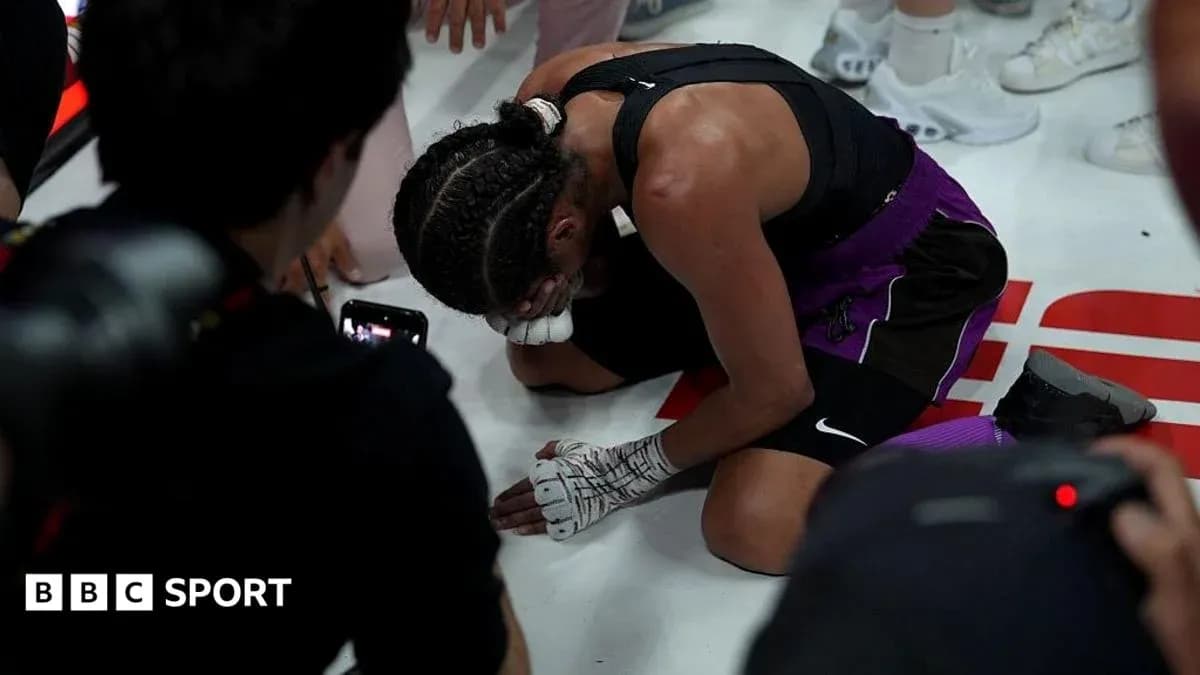
Ramla Ali dropped to her knees in the centre of the ring, tears streaking down her face in Arlington, Texas. At 36, the refugee-turned-Olympian-turned-author had finally become what she had promised herself she would be: a world champion.
A split decision. A split crowd. No split in her conviction.
The Briton outpointed previously unbeaten American Mikiah Kreps to claim the WBO and IBF super-bantamweight titles, the judges scoring it 97-92, 96-93 and 98-91 in her favour. The belts were draped over her shoulders, but her thoughts were somewhere else entirely.
Her father.
He died in May. His name has been stitched through every training camp since. On this night, his memory carried her when her legs threatened to give way.
“In the changing room my coach said, because my dad passed away in May, ‘Do this for him’,” Ali said. “That’s where those emotions came out at the end, because I did it for my dad.”
She could barely speak as the result was read out, overwhelmed by a journey that began when her family fled war-torn Somalia and resettled in London with nothing but survival on their minds. From there she became the first Somali boxer to compete at an Olympic Games, at Tokyo 2020. The first Muslim woman to win an English title as an amateur. A model, an activist, an author. Now, a unified world champion.
“I can’t put into words what this means to me and what this means to all of Somalia,” she said. “I’ve hopefully inspired so many young girls and boys out there to dream big and that’s all I’ve ever wanted to do.”
A knockdown, a storm, and a split decision
For Kreps, the scene could not have been more different. While Ali sobbed with joy, the American stood stunned, convinced the fight had been hers.
The numbers backed up her belief. Kreps outlanded Ali 115 punches to 78. She connected with 91 power shots to Ali’s 70. One judge saw the bout as a rout in her favour, turning in a 98-91 card for the American.
But the fight hinged on moments, not just metrics.
The most decisive came in the third round. Kreps stepped in, and Ali met her with a perfectly timed left hook. The shot snapped Kreps’ head and forced her glove to brush the canvas as she tried to steady herself. The referee ruled a knockdown. Kreps protested, but the replay told the story: the punch had done the damage.
That 10-8 round sat like a stone in the scoring. A single frame that shifted the arithmetic of a tight contest.
Ali could not turn the knockdown into a surge. Kreps regrouped, bit down, and marched forward. From the middle rounds on, the American pressed relentlessly, walking Ali down, making every second feel like a test of will as much as skill.
The pace was suffocating.
“I remember going to the corner every round and I remember saying ‘I’m so tired, I can’t do this’,” Ali admitted. “All my coach responded was ‘think about your dad, do this for your dad’. I think that really pushed me. I really boxed out of my skin, I was so knackered. I did it for him.”
Every break between rounds became a mental fight. Sit down, breathe, stand up, go again. No shortcuts. No hiding place.
“Every time I went to the corner, I kept saying, ‘I’m so tired. I’m so tired,’ because your work rate was just next level,” she said, acknowledging the constant pressure Kreps brought.
The judges saw Ali’s cleaner work, the knockdown, and her ability to answer when the momentum threatened to desert her. Kreps saw something else entirely: a first professional defeat she felt she did not deserve.
From Mercado heartbreak to world champion
Two years earlier, Ali’s first shot at a world title ended brutally. Yamileth Mercado swept her aside, the gulf in experience exposed under the harshest lights. Critics wondered if that was the ceiling. Some suggested that, with a successful modelling career, a growing media profile and her non-profit Sisters Club supporting young women, she did not need to keep walking into punches to prove anything.
The doubts multiplied after she was knocked out in her ninth professional fight in 2023. World champion talk suddenly sounded naïve to some, even reckless.
Ali ignored them.
She rebuilt quietly, away from the magazine covers and film sets. Even as a biopic about her life rolled out, she went back to the grind that only boxers truly understand: lonely runs, endless rounds on the pads, the constant hum of sacrifice.
On this night in Texas, that work finally cashed in.
Two belts. One of the most unlikely world champions in modern boxing. A woman who began life as a refugee baby in Somalia and ended this chapter as the face of a division.
Skye Nicolson on the horizon
The win opens the door to a compelling unification clash. On the undercard, Australia’s Skye Nicolson retained her WBC title with a unanimous decision over Japan’s Miyo Yoshida. Like Ali, Nicolson is signed to Jake Paul’s Most Valuable Promotions, a shared banner that makes a future showdown easy to imagine and even easier to sell.
Ali has spoken for years about becoming a world champion. That box is now ticked, twice over. The next logical step is total unification, and Nicolson stands squarely in that path.
But not tonight.
Tonight belongs to the woman who refused to let a knockout loss define her, who refused to accept that her story was better suited to cinema screens and glossy spreads than to the unforgiving reality of world-level boxing.
She came from a country torn apart by war, settled in London as a refugee, carried a nation to the Olympic Games, and kept walking back into gyms when the world suggested she had already done enough.
Now she walks out as WBO and IBF super-bantamweight champion, the doubters behind her, the division in front of her, and her father’s memory stitched into every step she takes from here.