Alexander Zverev: From Grand Slam Aspirant to World Number One
Alexander Zverev has spent most of his career carrying a label no player wants: the best man never to win a Grand Slam. He ends 2026 with that tag buried, replaced by something far heavier. Two-time major champion. World number one. And, at 29, the oldest player in more than half a century to climb to the top of the rankings for the first time.
His rise has been relentless on the court and deeply complicated off it. That duality now defines him.
A breakthrough long in the making
For years, Zverev’s talent was obvious and his résumé stacked: Olympic champion, two ATP Finals titles, former world number two, three Grand Slam finals. Yet when it mattered most, something always seemed to tighten.
The most brutal scar came in New York in 2020. Two sets up on Dominic Thiem in the US Open final, Zverev froze as the match slipped away. A fifth-set tie-break. Two double faults. Thiem cramping, Zverev unable to pull the trigger. It was the kind of collapse that can live with a player for a lifetime.
The pattern repeated often enough to become a story of its own. The big, fearless game he displayed on the ATP Tour shrank at the majors. The serve, usually a weapon, became a liability. The forehand, tentative. The shoulders, heavy.
Zverev decided this year that the script had to change.
He vowed to hit through the ball, to live with the errors, to accept the risk that comes with true aggression. More pace. More variety. More courage when the air gets thin.
The turning point came far from the spotlight, in Mallorca in July 2025. Ten days with Rafael Nadal and Toni Nadal, not as an opponent but as a student.
“I wanted to see and then hear a new vision of what tennis in their mind looks like – and how my tennis, in their mind, looks like,” Zverev said. Nadal had faced him for a decade. Now he could dissect him from the other side of the net, a rival turned analyst. The message was clear: trust your game, especially when the walls close in.
Paris pain, New York redemption
The new mindset was tested almost immediately.
In June at Roland Garros, Zverev’s body threatened to betray him again. Cramping in the French Open final against Flavio Cobolli stirred memories of old collapses. The tension was thick. This was exactly the kind of moment that had previously unravelled him.
This time he didn’t blink.
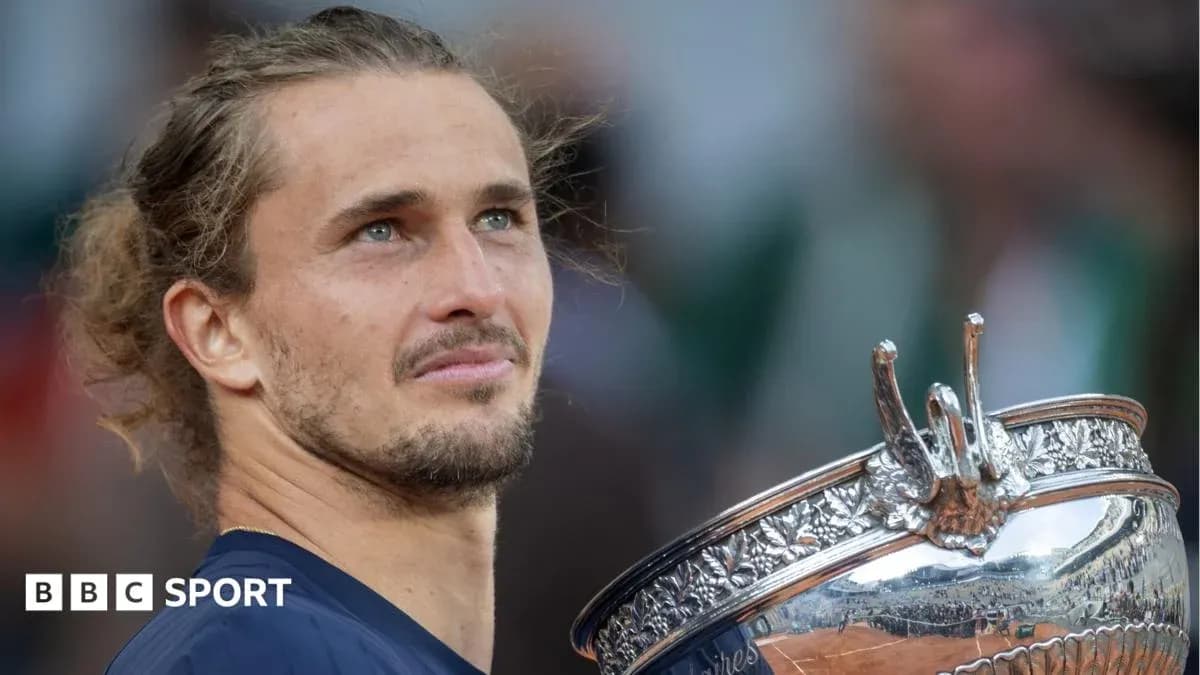
He tore through the deciding set 6-1, hitting out rather than holding back, to finally lift his first major trophy. Years of frustration, of being told he couldn’t finish the job on the biggest stages, dissolved in a single afternoon on Court Philippe-Chatrier.
That win lit the fuse. The US Open followed, not as redemption but as confirmation. The question shifted from whether Zverev could win a Slam to how many he might collect.
A family operation
His success has always felt like a family production.
His father, Alex Zverev Sr, has been a permanent figure in the player box, guiding his son’s career from the start. Mischa Zverev, the older brother who once practised as a junior with Andy Murray while a toddler Alexander watched from the side of the court, now sits alongside their father as part of the coaching team.
The dynamic is unusual. Zverev has said that his relationship with his father works in part because they spend “zero time together” away from the court. The boundaries are stark: family, but also business.
He often recalls how his parents, both former professionals, tried to steer him away from tennis altogether. “They wanted me to play different sports so they didn’t have to coach me,” he has said. Football, field hockey, anything but the tour life they knew too well. It didn’t take.
They understood the grind. They understood the pressure. And they understood that forcing it rarely works.
Grass, rivals and the next frontier
By the time Wimbledon rolled around this year, Zverev was no longer chasing validation. He was chasing history.
He finished runner-up on the lawns of SW19, but the performance felt like a statement. Against Jannik Sinner on Centre Court, Zverev played some of his boldest tennis of the season. He attacked, he took the ball early, he accepted the risk. It wasn’t enough in four sets, yet the intent marked a clear evolution.
He will need that same attitude, and more, if he is to break the hold Sinner and Carlos Alcaraz have tried to establish on the sport’s future. The numbers tell their own story: Zverev has lost 10 straight matches to Sinner. That is not a blip; it is a problem.
If all three men start 2027 healthy, the challenge is obvious. Turn a season dominated by two young stars into a three-man fight for every major. Zverev has the ranking now. What he wants is the era.
A champion under scrutiny
Away from the court, the picture is far darker.
Zverev’s ascent has unfolded against a backdrop of serious allegations and disciplinary flashpoints that have repeatedly dragged him into the headlines for reasons that have nothing to do with his backhand.
In October 2020, former partner Olga Sharypova accused him of physical violence and controlling behaviour. Zverev denied the claims and called them baseless. There were no legal proceedings, but the ATP launched a major independent investigation, handled by third-party investigators.
In January 2023, the ATP announced it had found “insufficient evidence to substantiate published allegations of abuse”. The statement cited a lack of reliable evidence and eyewitness reports, and conflicting accounts from Sharypova, Zverev and other interviewees. The case closed without sanctions, but it did not pass without consequence: the tour appointed a director of safeguarding and, this year, rolled out a new safeguarding programme with a global framework for preventing and responding to abuse, harassment, bullying, domestic violence and other misconduct.
Then came another case in Germany.
In October 2023, a court issued Zverev with a penalty order and a €450,000 fine for bodily harm against another ex-partner, Brenda Patea. He denied the allegations and challenged the order, triggering a public trial in Berlin in May 2024.
A week into the hearing, the proceedings were terminated. The court confirmed there had been a settlement between Zverev and Patea. “The decision is not a verdict and it is not a decision about guilt or innocence,” it said, adding that one decisive factor was the witness’s wish to end the trial.
On the same day the settlement became public, Zverev reached the French Open final. Earlier in the tournament he had spoken of the trial as a chance to prove his innocence. Asked afterwards whether he regretted settling before a verdict, he was emphatic.
“That’s what dropping the case is. That is innocence,” he said. “They’re not going to drop the case if you’re guilty at the end of the day. I don’t know what translations you have, but that’s what it means. Done. We move on. I never ever want to hear another question about the subject again. That goes out to everybody.”
Patea has not commented publicly on the settlement.
The court of public opinion, though, has not been so quick to move on. Zverev has been heckled by spectators, notably at the 2025 Australian Open and in Munich, with fans referencing the allegations during matches. The jeers have become part of the soundtrack of his career.
Anger, lines and a suspended ban
Questions about his conduct are not confined to his private life.
In 2022, Zverev received an eight-week suspended ban from the ATP after a notorious meltdown at the Mexican Open in Acapulco. Furious over a line call during a doubles match alongside Marcelo Melo, he smashed his racquet into the umpire’s chair four times, one swipe coming perilously close to the foot of official Alessandro Germani.
He swore at the umpire, accused him of “destroying the whole match”, and was defaulted from the tournament for unsportsmanlike conduct. The footage ricocheted around the tennis world, raising serious concerns about player behaviour and the protection of officials.
Zverev apologised and said it was “difficult to put into words” how much he regretted the incident. The suspended ban hung over him for a year, to be activated if he committed another major offence related to disrespectful or aggressive behaviour, or verbal or physical abuse. He stayed clear of further sanctions in that period, so the ban was never enforced.
A complicated number one
So here he stands at the end of 2026: French Open champion, US Open champion, Wimbledon finalist, and the game’s new world number one. A player who has reshaped his tennis with the help of one of the sport’s greatest champions, who has finally conquered the mental block that once defined his career.
He is also a figure shadowed by allegations, settlements and disciplinary lines crossed, a man cheered for his forehand and jeered for his past in the same breath.
The numbers say Alexander Zverev is the best player in men’s tennis right now. The question for 2027 is whether his tennis alone will ever be what defines him.