Stefanos Tsitsipas Reacts to Nick Kyrgios’ Cocaine Suspension
Stefanos Tsitsipas did not flinch. Not at the question, not at the name, and certainly not at the scandal.
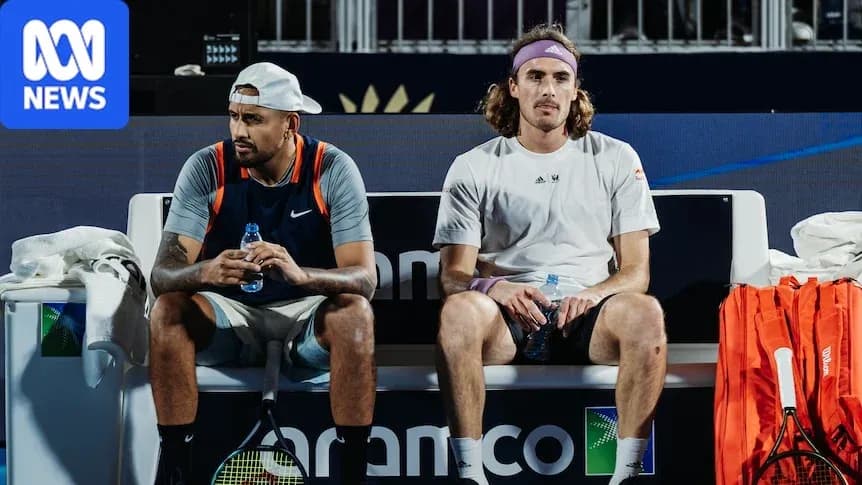
Fresh from knocking out 10th seed Arthur Fils in the first round of the US Open, the former world number three was asked about Nick Kyrgios’ suspension for cocaine use. The Greek star, who has shared one of the most combustible rivalries on tour with the Australian, barely needed a moment.
He said he saw it coming.
“Here we go”
Kyrgios was banned earlier this month after revealing he tested positive for cocaine in June while in Spain for an event. The 29-year-old faces a potential four-year suspension, though a reduced ban is widely anticipated.
For Tsitsipas, the news landed with all the force of a confirmation, not a revelation.
“I mean, to be entirely honest with you, I knew about this before the announcement. Myself, I knew about it,” he said. “So what can I tell you? I will just tell you the truth. I knew about all of this before any announcement was made, and when I saw it on social media, I was, like, ‘Here we go.’ I kind of expected it, to be honest.”
No attempt to soften it. No diplomatic sidestep. Just a blunt admission from a player who has lived close to the Kyrgios storm before.
A rivalry forged in chaos
Their history is anything but mild.
At Wimbledon in 2022, they produced one of the most volatile matches the All England Club has seen in years. Kyrgios, in full agitator mode, reached what would become his only Grand Slam final that fortnight, but the fourth-round clash with Tsitsipas became the flashpoint.
Tsitsipas fired balls directly at Kyrgios, lashed another into the crowd, and later labelled the Australian a “bully”. It was raw, emotional, and deeply personal — a rivalry that seemed to tap into something far beyond a standard Centre Court contest.
Since then, Kyrgios’ tennis has largely been replaced by medical updates. Injuries have stalked him, limiting his appearances and momentum. When the suspension was announced, he spoke publicly of feeling “helpless and alone”, while accepting responsibility by adding that “none of that excuses what I did”.
The admission did little to change Tsitsipas’ reaction.
“I’m not going to try and cover up”
Nor, he insisted, did it surprise him.
“I knew that those were things that were happening away from the tennis courts. I will tell you that,” Tsitsipas said.
He made it clear he would not play the role of apologist.
“I’m not going to try and cover up someone that I know the truth for. I’ll consider myself a nice person with everyone, but these were behaviours that I personally heard on the tour and heard other people in that same environment saying those sort of things to me.
“So when I saw it I was like, ‘well, pretty much expected, to be honest’. I am surprised it came so late, though.”
That last line hangs in the air. Surprise not that a ban arrived, but that it took this long. From a leading figure in the locker room, it is a sharp commentary on both Kyrgios’ choices and the sport’s response.
Tsitsipas moves on at Flushing Meadows with his own ambitions revived and his own reputation on the line every time he steps on court. Kyrgios, meanwhile, faces a very different fight — one that may decide whether his name remains a cautionary tale or becomes a comeback story tennis never quite believed it would see.