Sonal Dinusha's Remarkable Test Series Against India
Sonal Dinusha walked into this series against India with just three Tests behind him and no hiding place in sight. Four innings, four high‑wire entry points, and an Indian spin attack that exposed almost everyone else in Sri Lanka’s top order.
He left it having scored 420 runs, three centuries, and something far more valuable: proof that his game is built for the fire, not the comfort zone.
Learning to live on the good length
In Sri Lanka, spinners don’t have to be clever to be dangerous. Hit that 3‑5m good-length zone often enough and the pitch does the rest. Against India’s varied and relentless spin group, that band became a graveyard for most batters.
Dinusha turned it into a scoring zone.
He took 182 runs off good-length balls from spinners, averaging 91 at a strike rate of 58.89. The series baseline for that length? An average of 26.42 and a strike rate of 45.36. No one from either side scored more runs off that band. Only Niroshan Dickwella, in a much smaller sample, scored faster.
Even Player of the Series Devdutt Padikkal sat behind him in this specific fight, averaging 69.50 and striking at 49.82 off spin overall. Dinusha wasn’t just surviving a good length; he was dictating to it.
The secret lay in where he met the ball. Dinusha’s average interception point against good-length spin was 2.64m from the stumps – comfortably the furthest of any batter in the series. Padikkal, more inclined to play from the crease, sat at 2.02m.
That difference mattered. Only 43.4% of good-length balls to Dinusha were met in the so‑called danger zone between 1.5m and 3.5m from pitching to contact. Among Sri Lankans, nobody did better. Across both teams, only Padikkal, Rishabh Pant and Ravindra Jadeja kept the ball out of that trap more consistently.
Front foot, small frame, big solutions
Against spin, Dinusha committed. Among batters who faced at least ten overs of spin, he had the second-highest share of balls played off the front foot at 73.6%. Only India captain Shubman Gill, at 77.3%, went forward more often.
Gill, tall and rangy, can impose himself with reach alone. Dinusha, listed at just five foot six, had to find another way. He found two.
He came down the track. And he swept. Relentlessly.
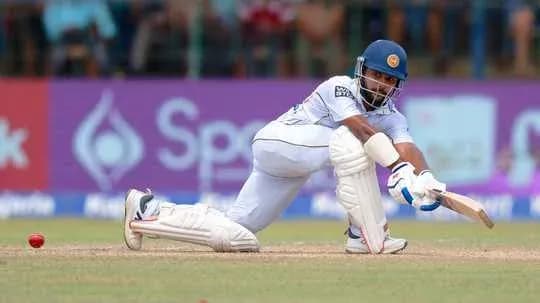
He advanced to 12% of the balls he faced – second only to Pant’s 13.3%. His sweep percentage climbed even higher, to 21.6%, the highest in the series. For a young batter in only his fourth Test to commit that hard to such high‑risk, high‑reward methods against a world-class spin attack said plenty about his nerve.
The volume of sweeps was staggering. Dinusha played 120 of them, including reverse and slog-sweeps, and scored 173 runs. Both figures are the highest ever recorded in a series of any length, eclipsing Joe Root’s famed sweeping masterclass in Sri Lanka in 2021. Against all four of India’s frontline spinners, he scored at better than a run a ball with that shot.
The 4‑5m length – the one that troubled everyone – only sharpened his intent.
That band produced 27 wickets at 21.14 across the series. Dinusha faced 212 balls there and was dismissed once, for 125 runs. He didn’t retreat. He doubled down on his methods, sweeping 53 of those deliveries for 87 runs and stepping down to 32 of them.
Taking on Jadeja at his own game
Doing that against Ravindra Jadeja, with his flat trajectory and hurry-through-the-air pace, bordered on audacious.
Dinusha attempted 34 sweeps against Jadeja, the most by any batter off him in a sub‑continent series. He also advanced down the track to 36 of Jadeja’s deliveries – just two fewer than Michael Clarke managed across five innings during Australia’s 2013 tour of India, a series remembered for its own dance down the pitch.
This was not slogging for effect. It was targeted disruption.
Eighteen of Dinusha’s 30 boundaries against spin came through sweeps and their variants, almost all aimed front of square on the leg side. He mixed in paddle and reverse sweeps, and on four separate occasions opened a new session by launching a slog sweep to the mid‑wicket boundary. Those strokes did more than decorate a scorecard; they forced immediate recalculations in length, line, and field.
Once he had bowlers second‑guessing their length, the rest of his game slipped quietly into gear. Singles and twos flowed. He nudged, pushed, worked the angles, and refused to let the scoreboard stall.
Tellingly, his innings were not built on a flood of boundaries. Only 4.98% of the balls he faced went to the rope – the second‑lowest boundary rate among specialist batters who faced a significant volume in the series, ahead of only Jadeja. This was control, not chaos.
The shot he refused to play
Perhaps the most revealing detail sits not in what he did, but what he refused to do.
Across the series, Sonal Dinusha did not hit a single boundary through the front‑of‑square off side against either pace or spin. The cover drive, often the early-career indulgence of a young stroke‑maker, simply disappeared from his risk profile.
He built three centuries without it.
In a series Sri Lanka did not win, Dinusha’s numbers will live in databases and analytics reports. What will linger longer, though, is the image of a 22‑year‑old repeatedly striding down to Jadeja and sweeping India’s spinners off their preferred length, not with bravado for its own sake, but with a clear, disciplined plan.
For a batter only three Tests old at the start of this examination, that looks less like a purple patch and more like the foundation of a career.