Roger Federer Inducted into Tennis Hall of Fame
NEWPORT, R.I. — The tears arrived before the punchlines could save him.
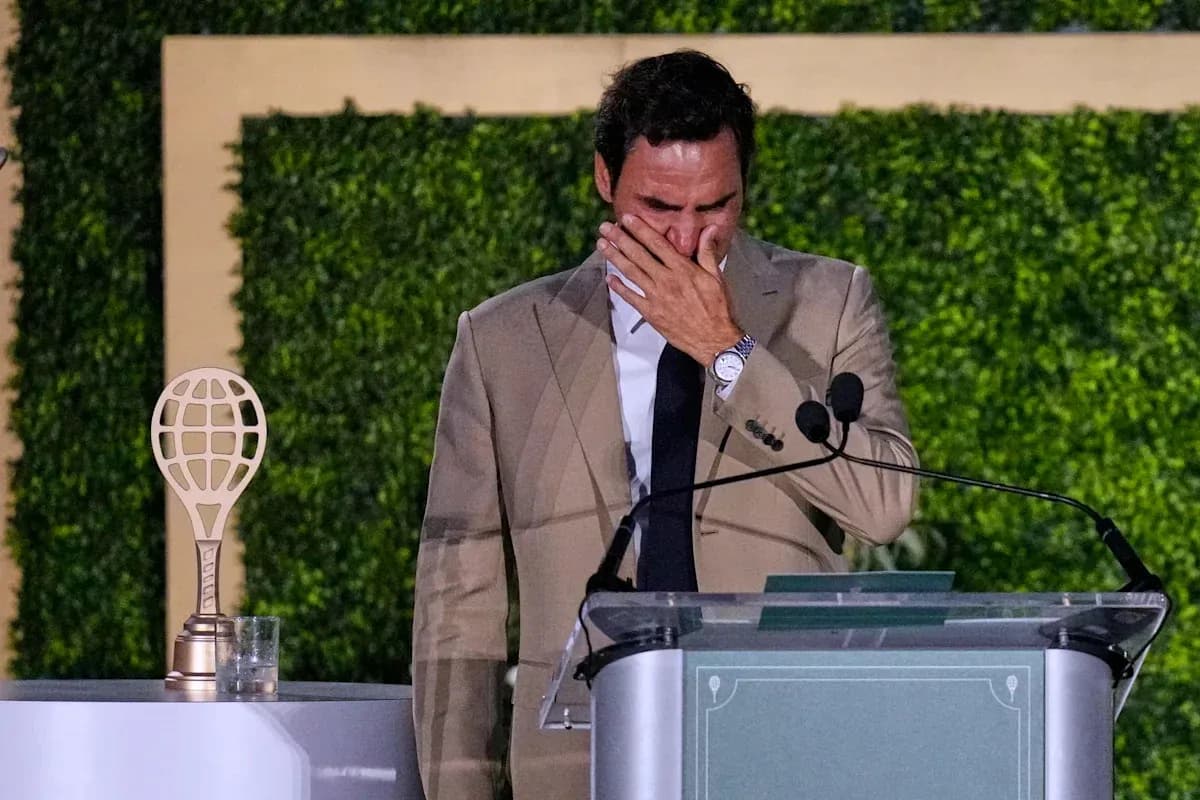
Roger Federer, immaculate in a tan suit on Newport’s grass horseshoe court, walked toward the stage at the International Tennis Hall of Fame on Saturday and quickly understood this would not be like any final he had ever played.
“Oh man,” he began, the first man to win 20 Grand Slam singles titles suddenly sounding less like the “Swiss Maestro” and more like someone overwhelmed by the moment. “This is very high level and a tough act to follow.”
Mirka Federer, who had just introduced her husband, earned one of his first jokes of the night.
“I don’t know if you have been practicing secretly,” he quipped, trying to steady himself as the 272nd Hall of Famer in tennis history.
The humor bought him a few seconds. The emotion kept coming back.
A Maestro Overcome
The Hall staged its first red-carpet show on center court about 90 minutes before the ceremony, and Federer admitted the spectacle had got to him.
He told the crowd he “was a little stressed to be honest,” an admission that would have sounded absurd in his prime, when his fluid movement and one-handed backhand carried him to 237 consecutive weeks as world No. 1 in the ATP rankings.
This was different. This time, the opponent was memory.
Across nearly 30 minutes on the microphone, Federer choked up several times. The first real break in his voice came midway through, when he spoke about his childhood idol, Stefan Edberg. The tears came, but he framed them the way he has framed so many tight moments in his career.
“Happy tears,” he called them.
They didn’t stop there.
He welled up again when he turned to his longtime coach Severin Luthi. The relationship, the years, the shared grind — it all landed at once. Then came the part he knew would be the hardest.
“Now the Mirka part,” he said, then froze, the words stuck behind the emotion. He paused, tried to smile, and then surrendered to it. “Oh gosh, this is such a mess.”
The crowd laughed with him, not at him. Federer tried to lean back on his familiar timing, to counter with another joke.
“I need tissues and sunglasses, everything to protect me right now,” he said, still fighting back more tears.
For two decades he had made the game look effortless, gliding to five straight U.S. Open titles from 2004-08 and reaching 10 consecutive Grand Slam finals, winning eight of them. On this stage, effort was obvious. Vulnerability, too.
Yet, as so often in his career, he found a way to close.
He thanked the ball kids — a small detail, but one that spoke to the way he has always seen the sport — and urged the next generation of players to keep pushing tennis to new heights.
A Career Carved Into History
Federer turned 45 three weeks ago. His résumé remains almost absurd in its breadth: eight Wimbledon titles, six Australian Opens, five U.S. Opens in a row, and the elusive French Open in 2009 to complete the career Grand Slam. Only seven other men have ever done that.
Now his name sits in Newport alongside the legends he once watched on television. The boy who idolized Edberg now shares a hall with him.
“I’m thrilled to have made the journey here,” Federer said. “It’s amazing to see yourself in a place like this. To immerse yourself in the history of the sport means a lot to me.”
As the sun dropped behind the stands and the shadows stretched across the grass, the setting felt almost scripted: a maestro stepping into the archives, still very much alive to what the sport has given him — and what he has given it.
Carillo Joins Tennis Royalty
Federer did not go in alone.
Mary Carillo, the former player turned acclaimed broadcaster, was inducted as a contributor. Already a member of the Sports Broadcasting Hall of Fame, she arrived in Newport with a résumé that has long commanded respect across sports media.
Her presenter, Billie Jean King, left no doubt about Carillo’s place in the game.
“She has earned her spot in sports journalism and she has earned her spot in Newport,” King said.
Carillo, 69, stood before a cluster of Hall of Famers and let the scale of the moment wash over her.
“To walk through these gates here in the company of you people, that was beyond my dreams,” she said.
On a summer evening in Rhode Island, the sport honored two very different careers — one defined by balletic dominance on court, the other by sharp, insightful storytelling off it. Both, in their own ways, have shaped how tennis looks and sounds.
The records and broadcasts will live on. So will the image of Roger Federer, eyes wet, voice cracking, finally letting the game’s history embrace him as tightly as he once held it.