Real Madrid Players Show Mixed Signals on Ceuta Solidarity
At the Martínez Valero on Tuesday night, the story started before a ball was kicked.
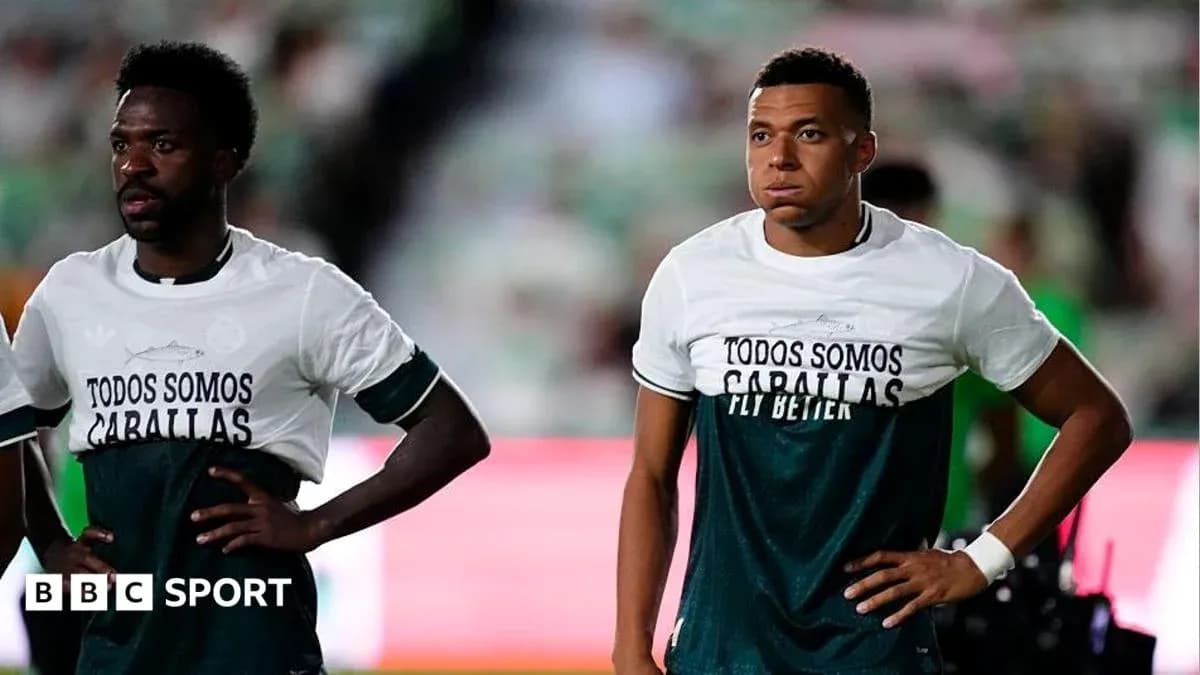
As the players of Real Madrid and Elche emerged from the tunnel, they did so in white T-shirts bearing the slogan “Todos somos caballas” – “We are all Ceutans” – a coordinated gesture of solidarity with the Spanish autonomous city of Ceuta, gripped by a migration crisis on the North African coast.
But three Madrid stars chose a different stance.
A gesture, and a refusal to fully join it
Kylian Mbappé, Vinicius Junior and Ibrahima Konaté all rolled their shirts up to chest height, folding the message away just as the cameras panned across the line of players. Where others showed the full slogan and the references to Ceuta, their versions were abruptly cut off.
Moments later, Mbappé and Vinicius went a step further. Before the traditional pre-match handshake, both removed the T-shirts entirely, leaving their team-mates and the Elche players to complete the formalities still wearing the campaign tops. Konaté kept his rolled-up shirt on a little longer, the wording still obscured.
It was a small act in terms of movement. In terms of optics, it was anything but.
The contrast on the pitch was striking. Around them, players from both sides stood in a neat line, the white shirts clearly visible, the slogan unbroken. The three Madrid players, by choice, stood apart from the collective image.
Ceuta’s crisis on football’s stage
The backdrop is grim and very real.
Ceuta, perched on the North African coast opposite mainland Spain, has been at the centre of a major migration emergency. On 30 and 31 July, at least 72,000 migrants crossed from Morocco into the tiny territory, many of them swimming around a border fence into Spanish waters. According to figures from Ceuta’s mayor, at least 100 people died attempting the crossing.
Most of those who arrived have since returned. Even so, as many as 5,000 people are still living in makeshift camps or sleeping on streets and beaches. Tension in the city has spiked. Local residents have voiced deep safety concerns, with some going as far as destroying shelters and blocking aid deliveries to migrants.
Spanish football has been drawn into the debate. The T-shirt initiative formed part of a wider campaign of support for Ceuta, giving the crisis a powerful, televised platform.
Real Madrid had already nailed their colours to the mast. Before their Champions League meeting with Inter Milan at the Santiago Bernabéu on 8 September, supporters in the south stand held up cards forming the coat of arms of Ceuta. The rest of the stadium responded with a sustained round of applause, a choreographed tribute that left no room for doubt about the club’s public backing.
On Tuesday in Elche, the message was supposed to be unified again. It wasn’t.
Divided signals in La Liga
The choice of Mbappé, Vinicius and Konaté to obscure the slogan threw the spotlight onto the growing split in how players and clubs handle politically and socially charged campaigns.
While players at other La Liga fixtures wore the Ceuta shirts as intended, Barcelona opted not to take part in the initiative at all. Real Madrid, as an institution, clearly did. Their squad walked out in the T-shirts. Their fans have already staged a large-scale display.
Yet within that same Madrid XI, three of the club’s biggest names visibly distanced themselves from the message in front of a global audience.
Their representatives have been asked for comment. For now, the silence only sharpens the questions: was this a political disagreement, discomfort with the campaign itself, a personal stance on how football should engage with complex humanitarian crises? Or simply a refusal to be folded into a gesture they did not choose?
The answers, when they come, will matter.
Drama on the pitch, unease off it
Once the game started, football tried to reclaim the narrative.
Real Madrid raced into a two-goal lead, only to squander it as Elche roared back and dragged the champions into a frantic contest. The Martínez Valero, subdued during the pre-match formalities, came alive as the home side sensed a famous result.
Madrid responded the way they often do – with sheer attacking force. Mbappé, one of the men at the centre of the pre-match controversy, found the net as part of a breathless encounter that swung repeatedly in the closing stages.
The pressure finally told deep into stoppage time. Carlos Espi struck the winner, sealing a 3-2 victory that felt, in pure sporting terms, like a heist. Madrid had almost thrown it away; instead they walked off with three points and another chapter in their long catalogue of late escapes.
But the final whistle didn’t erase the images from before kick-off.
The sight of three marquee players refusing to fully display a message of solidarity lingered long after Espi’s shot hit the net. In a league where some clubs join campaigns wholeheartedly and others stand aside, Madrid now find themselves grappling with a more complicated reality: what happens when the institution takes a stand, but its stars choose their own line?
As the season moves on and the situation in Ceuta remains raw, Spanish football will not escape that question. Nor, after Tuesday night, will Real Madrid’s biggest names.