Ollie Robinson Joins Cricket Greats at Lord's
On a grey Lord’s afternoon built for fast bowlers, Ollie Robinson did more than drive England to the brink of victory. He quietly stepped into a statistical realm reserved for the very best to ever bowl a cricket ball.
With a four-wicket burst that shredded Pakistan’s resistance in the fourth innings of the second Test, Robinson pushed his career average down to around 19.5. That number carries weight. It nudges him past Jasprit Bumrah’s 19.79 and gives the England seamer the best Test bowling average of any bowler to debut this century and play at least 20 matches.
At a ground where numbers are etched into honours boards and whispered through the pavilion, Robinson’s figures now demand attention of their own.
A modern outlier in an old game
Strip away the noise and the bare numbers are stark. At the time of this match, Robinson has played 23 Tests, bowled in 43 innings and taken 99 wickets at 19.53. His best innings return remains 5 for 39. Bumrah, the gold standard of modern fast bowling, stands at 234 wickets in 52 Tests at 19.79, with a best of 6 for 27.
To find better averages among bowlers with at least 20 Tests, you have to go back more than a century.
- W Barnes (England – 1890): 21 Tests, 51 wickets, Ave 15.54, Best 6/28
- SF Barnes (England – 1914): 27 Tests, 189 wickets, Ave 16.43, Best 9/103
- R Peel (England – 1896): 20 Tests, 101 wickets, Ave 16.98, Best 7/31
- J Briggs (England – 1899): 33 Tests, 118 wickets, Ave 17.75, Best 8/11
- OE Robinson* (England – 2026*): 23 Tests, 99 wickets, Ave 19.53, Best 5/39
- JJ Bumrah (India – 2026*): 52 Tests, 234 wickets, Ave 19.79, Best 6/27
In a sport obsessed with sample sizes and context, Robinson has now cleared the 20-Test bar and kept his numbers in the rare air usually reserved for legends and anomalies.
Pakistan’s fight, Robinson’s answer
The landmark arrived in the middle of a hard, tense session. Pakistan, set 389 to win, had slumped to 14 for 3 before mounting a spirited resistance. By tea on day four, they were 140 for 5, the chase still improbable but no longer fanciful.
Saud Shakeel and Shan Masood had done the hard yards. Their 97-run stand dragged the game away from England’s grasp and into that awkward space where doubt starts to creep in. Shakeel, busy and positive, reached his 15th Test fifty from just 54 balls. Masood dug in for 26, content to soak up time and shine from the ball while his partner pressed on.
For almost four hours, they blunted England’s seamers. The hosts grew agitated, asking the umpires repeatedly to inspect the ball as it softened and lost its menace. The crowd, restless early in the session, quietened as Pakistan’s belief slowly grew.
Then Robinson came back.
The spell that broke it open
Jamie Smith stood up to the stumps, a clear signal of England’s plan: deny the batters the comfort of a big stride, attack the pads, and make every misjudgement fatal.
The pressure told almost immediately. Masood was struck by an inswinger and given not out on the field. Robinson turned, convinced. England reviewed. Ball-tracking showed it hitting in line with leg stump. The decision was overturned, the partnership broken, and with it a large chunk of Pakistan’s hope.
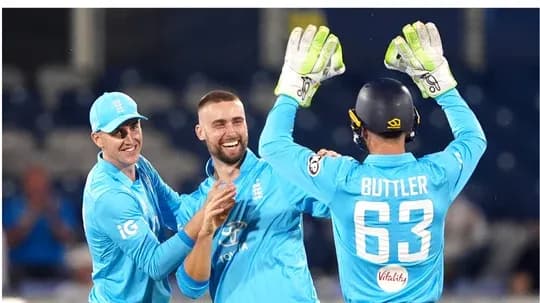
Robinson did not stop there. Mohammad Rizwan, usually a scrapper in these situations, tried to swat a straight one away and missed. Hit in front. Another wicket. Another roar from the bowler. Another step closer to the finish line.
By tea, Robinson’s figures in the innings read 4 for 24. Across the match, he had taken eight wickets for just 35 runs. Shakeel’s 78, Pakistan’s highest score of the innings and his second half-century of the series, stood out as a defiant effort, but it increasingly looked like a lone stand against an attack that refused to relent.
What had briefly looked like a stubborn, potentially match-twisting rearguard suddenly felt fragile again.
A bowler on the brink of three figures
All of this unfolded as Robinson’s career numbers clicked into a new gear. That average hovering around 19.5 is no longer a quirk of a short career or a handful of favourable series. It is built on 23 Tests, on 99 wickets, on spells like this one at Lord’s where he bends a match to his will.
England’s seamers have often been defined by longevity and volume: James Anderson’s mountain of wickets, Stuart Broad’s surges of destruction. Robinson, at least for now, is carving out a different identity – ruthless efficiency, relentless accuracy, and a record that stands up to forensic scrutiny.
One more wicket will take him to 100 in Tests. The next phase of his career will decide where he ultimately sits in the game’s hierarchy. But as he walked off at Lord’s with Pakistan tottering and England on the brink, the numbers already told their story.
For the first time in more than a century of Test cricket, an England seamer stands statistically shoulder to shoulder with the greats of any era. The only question now is how long he can stay there.