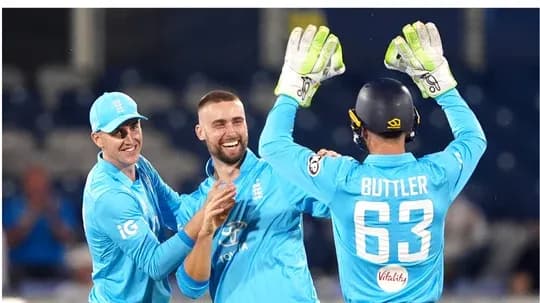
Ollie Robinson: Mastering the Art of Fast Bowling
Ollie Robinson bowls like cricket is the most natural thing in the world.
Five years on from his England debut, after the drops, recalls and more drops, that first impression still holds. In an era obsessed with pace guns and data, Robinson is something rarer: a bowler whose action looks as if it has always existed, waiting only for someone to step into it.
Call him robotic and it sounds cold. For him, it’s the highest praise.
Glenn McGrath had that same quality. Every stride in sync, every wrist position identical, every seam upright. The spell looked the same ball after ball, and batsmen still couldn’t get near him. Robinson lives in that same rhythm. From the moment he turns at the top of his mark, everything flows. The run-up, the coil, the release – all one unbroken movement.
His wrist is a thing of beauty. Seam bolt upright, presentation immaculate. You can see why, in a summer made for bowlers, he has taken 23 wickets in three matches and made Lord’s feel like his private workshop.
Yes, the conditions have been perfect. Cloud cover, helpful pitches, a Dukes ball that has sung for him. If he could, Robinson would tuck these surfaces into his kit bag and take them everywhere. But the ball still has to be put in the right place, again and again, with just enough variation to keep batsmen guessing. That is where he has been outstanding.
Whatever he has asked of the ball, it has obeyed. Swing in, swing away, a late wobble off the seam – the response has been instant. He has not chased wickets. He has let them come to him, trusting that repeatable action, trusting that if he keeps landing it, something will happen.
Right now he must feel he could run in blindfolded and still find the edge. Fast bowlers live for that sensation. It doesn’t come often.
There is more to him than mechanics. Robinson reads a game quickly. He spots a technical flaw, a trigger movement, a bat coming down across the line, and turns it into a plan within an over. That has always been part of his make-up. When he first came into the England side, coaches talked about a newcomer who would stand up in team meetings and explain how to get specific batsmen out. Not many do that early in their careers.
It all feeds into the bowler he has become – not just skilful, but shrewd.
So the question returns: were Ben Stokes, Brendon McCullum and Rob Key wrong to leave him out of the Ashes squad last winter?
Plenty will say this summer’s form proves they were. At the time, the regime went with pace. They wanted bowlers who could hit the high 80s and 90s, and there was also the background noise about trust and fitness. Robinson’s conditioning has wavered at times, and bowling coach Jon Lewis publicly challenged him on it in 2022.
There have been moments when he has not been handled gently. Criticism has been sharp, the scrutiny relentless. Yet the omission may have done something important: it seems to have sharpened his focus. Now Joe Root, back as captain, is the one reaping the benefits of a bowler who looks both driven and settled.
Australia have played their part in this version of Robinson too, albeit unintentionally. Their revival of an old tactic – the wicketkeeper standing up to the stumps to a seamer – has slipped into England’s playbook.
Alex Carey did it superbly in the Ashes. Now Jamie Smith is doing it for Robinson.
It sounds simple. It isn’t. With the keeper up, batsmen cannot march down the pitch to smother movement. One false step and they are stumped. That threat pins them in the crease and lets Robinson push a yard fuller, giving the ball more time to swing and bringing the stumps firmly into play. Instead of banging it in from a safe length and watching it sail over the top, he can attack pads and off stump.
None of it works without a good gloveman. Smith deserves his share of the applause. After a rough time behind the stumps in the Ashes, he has clearly worked hard. Under the eye of wicketkeeping coach Sarah Taylor, he has been put through brutal pre-play drills: tennis balls skidding off the surface, a batter in front feathering, missing, nicking again, while Smith stays low and clings on. The improvement has been obvious. The numbers at Lord’s – Robinson going at just 1.29 runs an over – tell you how secure the operation has become.
Now comes the real examination.
Can Robinson take this form onto harder, flatter pitches? Can he keep doing it when the ball stops talking, when the sun is high, the air is hot and the body starts to sag? England will find out in South Africa this winter. Three Tests there will test his fitness, his stamina and his ability to find a way when the deck is loaded towards the bat.
Historically, England have often left him out when conditions look batter-friendly. That time has passed. He has earned his shot on the tougher surfaces. He has earned the right to prove he can be more than a home-conditions specialist.
Behind the scenes, England are trying to help him get there. The target is simple: hold his pace. Keep him around 82mph, not starting there and drifting down to 77-78mph as spells wear on. If he can maintain that level, the extra bounce he can extract should offset any loss of sideways movement. A slightly quicker, taller Robinson on flatter tracks is still a handful.
Before South Africa, there is a more immediate call. Do not break this attack up.
Robinson, Jofra Archer, Gus Atkinson and Josh Tongue have shown genuine promise as a unit. They lack a frontline spinner, but Robinson’s control offers a workaround. At Lord’s he bowled with a miser’s discipline, his economy rate more like that of a holding off-spinner than a seamer hunting wickets. If Root needs someone to lock down an end, Robinson can do it without losing his threat.
England have been through a poor run. They need wins, yes, but they also need an attack that learns each other’s rhythms, understands who to throw the ball to when, and how to build pressure in pairs. That takes time together, not rotation for its own sake.
Root must learn how to use each of them at their peak. When to unleash Archer in short, violent bursts. When to give Atkinson a longer spell. When to turn to Tongue for awkward angles. And when to let Robinson settle in for those long, relentless overs that squeeze the life out of a batting line-up.
Right now, with Robinson at the head of it, this looks England’s best attack.
Edgbaston awaits. The temptation to tinker will be there. They should resist it. Keep the quartet together, keep Robinson leading it, and see just how far this rhythm can carry them.