Novak Djokovic's Shocking First-Round Exit at the U.S. Open
NEW YORK — Novak Djokovic has walked out of Grand Slams in defeat before, but never like this, never this early, never looking quite so mortal.
On Sunday night in Arthur Ashe Stadium, under a closed roof and an uneasy hush, the 39-year-old fell in the first round of a major for the first time since 2006. His body buckled, his game frayed, and Mariano Navone — a tireless Argentine grinder more at home on clay than concrete — finished the job.
Navone won 7-6(5), 5-7, 4-6, 6-2, 6-1 in four hours and 36 minutes, snapping Djokovic’s streak of 77 straight first-round wins at Grand Slams. The scoreline tells part of the story. The way it unfolded told the rest.
A legend unravels in real time
For 73 minutes, the opening set played out like a puzzle no one quite knew how to solve. Djokovic surged to a 3-0 lead, hammering three aces in his first two service games and looking every bit the greatest hard-court player of the modern era. Navone, playing just his third U.S. Open main draw match and his first ever on Ashe, seemed headed for the role of respectful spectator.
Then the rallies lengthened. The air hung heavy. Djokovic began to miss his spots by inches, then feet. Navone dug in, lengthening points, forcing the Serb to hit one ball, then another, then another. The tiebreak belonged to the Argentine, a small shock that felt like a warning.
The weather turned, too. Rain began to fall seven games into the match, the roof slid shut, the air conditioning kicked in. Conditions should have suited Djokovic, who has long been almost untouchable at night and indoors in New York. Instead, his body started sending distress signals.
By the fourth game, he later said, he was fighting more than just the man across the net.
Vomiting, cramping, and a body that “gave up”
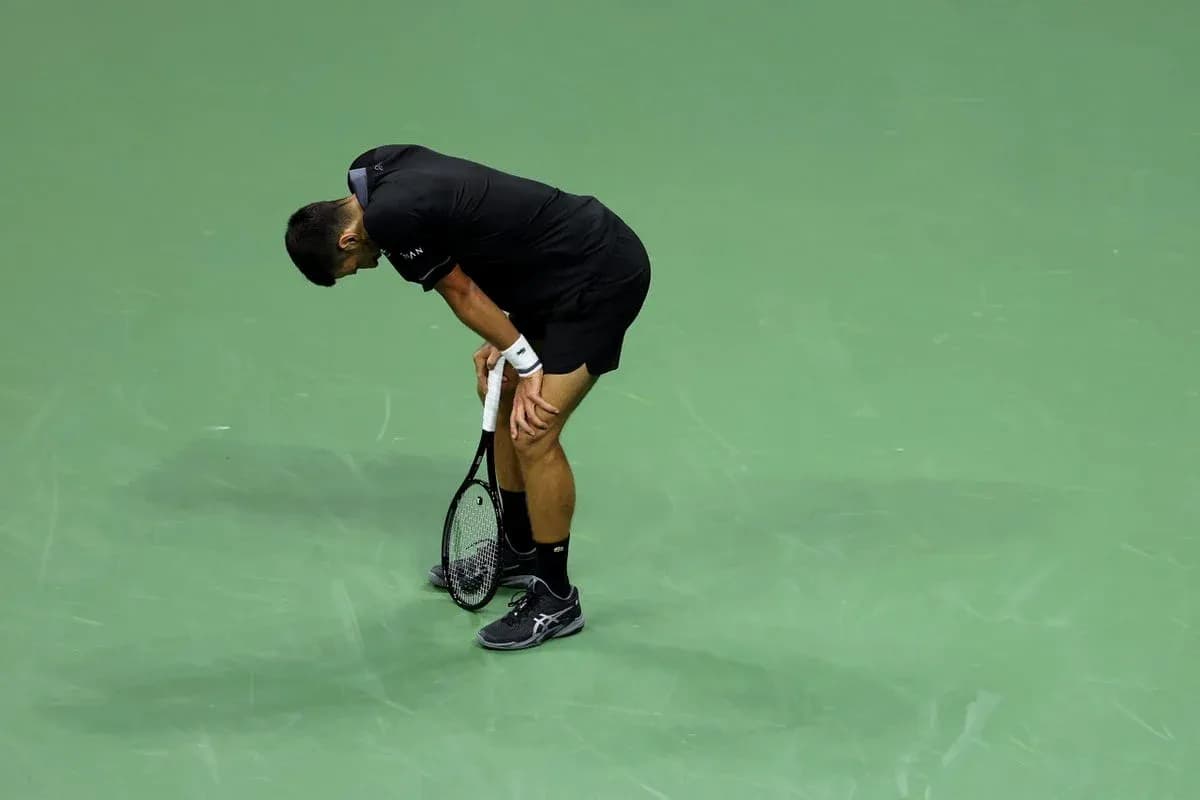
In the third set, the images became jarring. Djokovic bent over between points, hands on knees, sucking in air. When rallies stretched beyond six shots, he often paid for it. On shorter exchanges, he still held the edge. On anything longer, Navone took control.
In the seventh game of that set, Djokovic vomited into a courtside bin in the middle of a game.
“An awful feeling on the court for me,” he said afterward, drained and subdued outside the locker room. “It’s something that I’ve been carrying unfortunately pretty much every match this year. Vomiting, throwing up, a serious issue there. And then my whole body, you know, starts to collapse. Cramping, pain. The back just gave up in the end, and the shoulder, and I couldn’t close it out.”
He admitted he did not know if he could fix the medical issue that has been dogging him.
“I’m trying, man, I’m trying,” he said. “Let’s, let’s see.”
The fourth set exposed that fragility brutally. Djokovic, having clawed back to lead two sets to one after losing the opener, tried to play the percentages: shorten points, swing big, take risks. Rust from having played only one match since his Wimbledon semifinal loss to Jannik Sinner showed, but he still managed to break early in the fourth, teasing the familiar script of a champion surviving on instinct and will.
Navone refused to follow it. He broke back immediately, then again, as Djokovic’s movement grew labored and his serve lost bite. The Serb took a medical timeout before the decider, a trainer working on his lower back in a last attempt to squeeze one more charge out of a body that has carried him to 101 career titles, four of them in this stadium.
The charge never came.
Navone’s dagger and the sound of an era creaking
The defining moment of the night arrived early in the fifth set, in the second game. Navone dragged Djokovic corner to corner, then coaxed him forward. As Djokovic moved in, Navone threaded a backhand down the line. Djokovic lunged for the half-volley and failed. His next steps looked uncertain, almost elderly. He staggered, then limped, wincing between points.
From there, the match took on a grim inevitability. The rallies that once energized Djokovic now seemed to drain him. The crowd sensed it. The noise softened. The atmosphere turned almost funereal as Navone ran away with the set, 6-1.
Courtside, Jelena Djokovic and the couple’s children, Stefan and Tara, watched their husband and father age in real time, their faces growing more despondent with each changeover. By the fifth game of the final set, tears slipped from Djokovic’s eyes.
He had been here emotionally before in New York. Five years ago, one match from a calendar-year Grand Slam, he played one of his poorest matches of the season in the U.S. Open final. The crowd roared for him that day as he broke down on the bench. On Sunday night, as the clock ticked past midnight, they did it again.
The long shadow of Sinner and the limits of best-of-five
This defeat did not come out of nowhere. The signs have been flickering for months.
Djokovic’s straight-sets loss to Jannik Sinner in the Wimbledon semifinals — to a player he once mentored — cut deeper than most. Late in that match, when a fan tried to encourage him that he could still hang with the world No. 1, Djokovic muttered, “Maybe 10 years ago.”
After Wimbledon, he disappeared into family life, vacationing and hitting casually with Jelena and the children. The hard-court grind could wait. When he finally resurfaced at the Cincinnati Open, he looked unprepared and physically vulnerable, losing his first match to Thiago Tirante and struggling in the heat and humidity. He hinted at a long-standing medical condition he had been managing for “the last couple of years,” but chose not to elaborate.
In New York, he insisted the early loss in Cincinnati had been a blessing, giving him “two weeks, to really train and get my body and mind into the right state.” He acknowledged how treacherous opening rounds had become.
“Hopefully I can overcome, you know, the first hurdle and build from there,” he said before the tournament.
That first hurdle turned into a wall.
Djokovic has spoken often about the toll of best-of-five tennis at this stage of his career, how each extra set in the first week chips away at what he has left for the second. Even if he had survived Navone, the way his body unraveled in the third and fifth sets suggested this run was on borrowed time.
The wrong opponent on the right night
On paper, this was a draw Djokovic would have welcomed. Navone, a top-50 regular, had never beaten a player of his stature. His lone ATP Tour title came on clay. He had only one U.S. Open match win to his name and no experience on Ashe, the court where Djokovic has ruled for a decade and a half.
If Djokovic could have picked a first-round opponent to ease into a tournament he cherishes, Navone might have been on the list.
Yet the Argentine brought exactly what Djokovic least needed: stubborn defense, long rallies, and no inclination to fade. He saved two break points early in the third set, prompting Djokovic to sit on his chair at the changeover with two ice bags pressed to his head. He clawed back when Djokovic seemed to have wrested control in the fourth. He stayed relentless as Djokovic’s body betrayed him in the fifth.
Navone did not produce a masterpiece of shot-making. He produced something more dangerous against this version of Djokovic — a four-hour, 36-minute test of stamina and resilience that the Serb could no longer pass.
Facing the winter
This is not the first time Djokovic has stared down the end. Earlier this summer, he released a documentary titled “The Wolf in Winter,” a statement of intent against the encroaching cold of sporting decline. He has built his career on refusing to accept limits — of age, of expectation, of circumstance.
On Sunday night, though, the limits stared back.
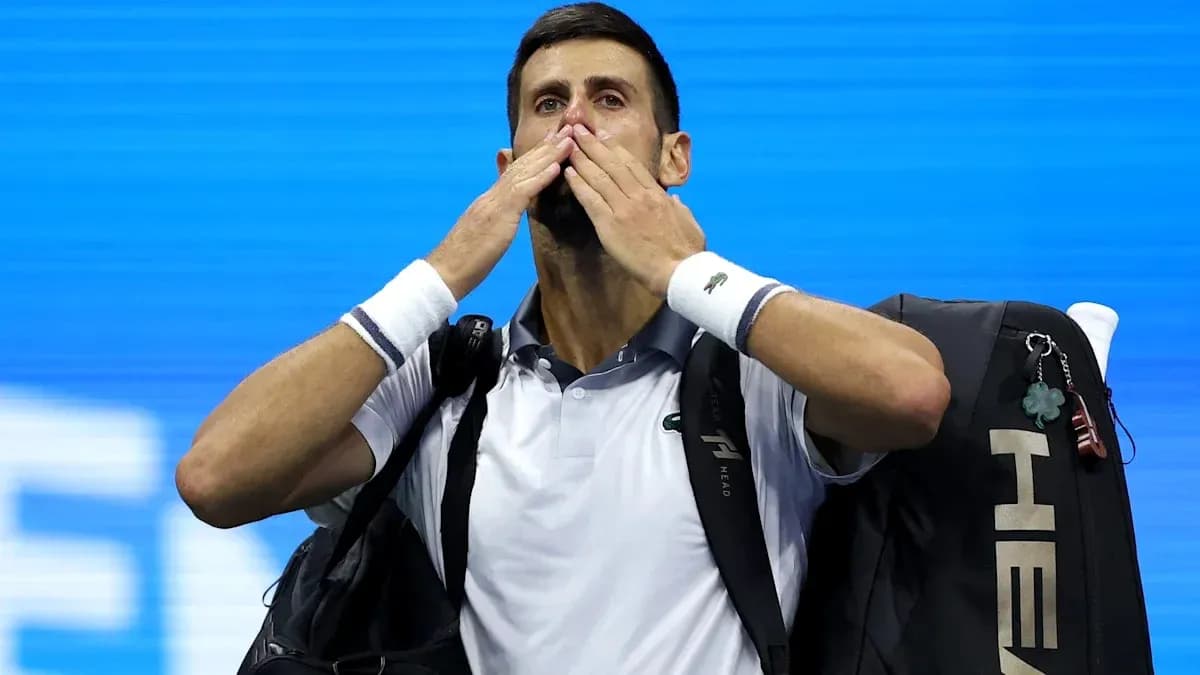
As the match ended and Navone celebrated the biggest win of his life, Djokovic walked slowly to his chair. He gathered his things, then turned to each side of Arthur Ashe Stadium and raised his hands, forming a heart with his fingers. The crowd rose with him, applauding a man who has spent 15 years turning this court into a personal fortress.
This time, there was no trophy to lift, no speech to give, no defiant promise of domination to come. Only a 39-year-old champion, limping into the tunnel, wondering how many more nights like this his body — and his legacy — can withstand.