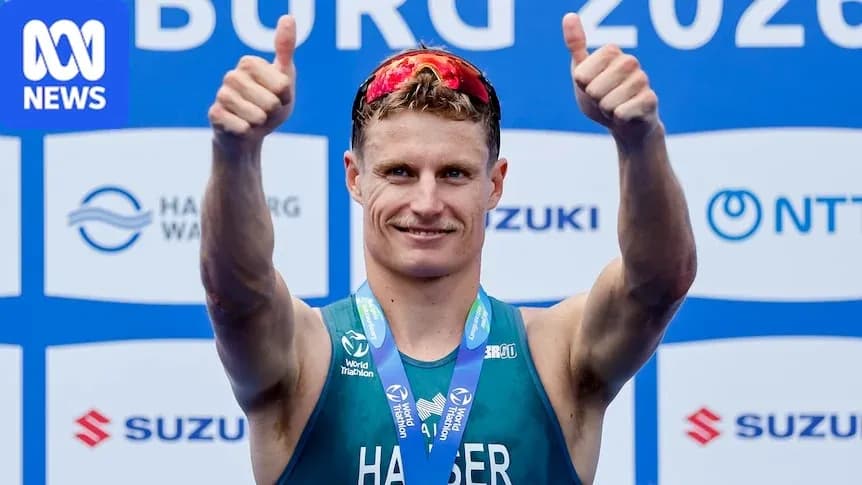
Matt Hauser: Australia’s Triathlon Hope for Los Angeles 2028
Matt Hauser stands on the pool deck at the AusTriathlon Performance Hub on the Gold Coast, still half-surprised to find the sport now orbiting around him.
Australia’s 15-year wait for a men’s world triathlon title ended on home roads in Wollongong. The drought snapped, the narrative flipped. The chaser has become the hunted.
And yet, in Hauser’s mind, the real race is still two years away.
From Wollongong to Los Angeles
Hauser’s surge to the top of the World Triathlon Championship Series has been ruthless rather than romantic.
Three starts. Three wins. Yokohama. Hamburg. London. Each one another marker that the 26-year-old has moved from promise to problem – for everyone else.
Heading into the next leg in Weihai on August 29, he sits third in the overall standings. Only Miguel Hidalgo of Brazil and Portugal’s Vasco Vilaça are ahead of him, and they’ve raced four times to his three. On raw form, Hauser is the man the series is trying to catch.
“It’s a bit of a pinch me moment, honestly,” he told ABC Sport, still sounding like someone getting used to the idea that he is now the benchmark.
He knows the numbers. He knows the streak. But he also knows the clock is really ticking towards Los Angeles 2028, when Olympic gold will be on the line and history will stare back at him from the start pontoon.
No Australian man has ever stood on an Olympic triathlon podium. Not once.
Australia’s Olympic triathlon story has been written almost entirely by women: Emma Snowsill’s golden run in Beijing; medals for Michellie Jones, Loretta Harrop, Emma Moffatt and Erin Densham. The men, for all their talent, have watched those moments from the shadows.
Hauser is trying to change that.
“I think the Olympics is always in the back of my mind,” he said. Training sessions, world championship races, the grind of travel and recovery – all of it, in his head, points to one race every four years.
A Decade in the Making
None of this has happened quickly.
Hauser’s rise has not been a viral leap but a slow, deliberate climb. Ten years with coach Dan Atkins, ten years of systems, structures and standards built into daily life on the Gold Coast.
“It doesn’t feel like a big sudden jump,” Hauser said. “It feels like a lot of smaller goals and processes have added up to accumulate to this world champion persona, I guess.”
That word – persona – is telling. The results say he’s a frontrunner. The mindset still feels new.
Only a few seasons ago, he could flash brilliance but not sustain it. Now he strings it together, race after race, front pack after front pack. The trick, he says, is making that level feel normal, so that when Los Angeles arrives, he isn’t reaching for something extraordinary. He’s simply repeating what has become routine.
“So now, to be at the stage where I’m performing consistently, I’m at the top end of races,” he said. “I need to make that normal in my own mind.”
A New Australian Standard
His dominance since Paris has done more than fill his own trophy cabinet. It has jolted Australian triathlon back into the global conversation.
The sport in this country has deep roots and decorated names, but there was a sense the rest of the world had pushed ahead. Hauser’s run of victories has given the next generation something tangible to chase.
“Looking back at Australia’s history in triathlon, it’s so rich, and now we’re definitely stepping up our game,” 19-year-old Aspen Anderson told ABC Sport.
“Matt’s definitely led the way in that aspect. And I think it’s really cool to see him paving the way for some of us.”
For young athletes like Anderson, Hauser isn’t just a headline. He’s a blueprint. If he can do it from the same training hub, on the same roads and in the same surf, why can’t they?
While Others Wander, Hauser Digs In
The men who shared the Olympic podium in Paris have scattered into other challenges.
Gold medallist Alex Yee has turned to the marathon, clocking 2:06:38 – the second-fastest time ever by a British man, behind only Mo Farah. Silver medallist Hayden Wilde has stepped into longer-distance triathlons in the T100 series.
On the women’s side, Olympic champion Cassandre Beaugrand has used her run talent to tear up the track and road, setting French records over 3,000m, 5,000m and 10km and racing in the Diamond League.
Hauser has watched all of that with admiration. He calls it inspiring. He knows their exploits raise the perception of triathletes as world-class in each individual discipline.
But he has chosen a different path. While others test their limits elsewhere, he has doubled down on the World Triathlon Championship Series, sharpening the very specific, very complex craft of being elite at all three sports at once.
“For me, I guess it’s just about making sure that I’m perfecting my skills in triathlon,” he said. “The sport has grown and developed so much even in the past two years… the sport has always changed and is developing.”
Redrawing the Race
For a while, short-course triathlon seemed to belong to the runners.
Races would bottleneck through the swim and bike, a large pack forming before the fastest legs shredded the field over the closing 10km. The old mantra held: you can’t win the race in the swim, but you can lose it there.
Hauser has helped drag the sport back towards its more brutal, all-in roots.
He attacks from the gun. He uses his swim to split the field, then leans into the bike to press the advantage, forcing the pure runners to chase, often too late and too hard.
It’s a style that echoes the peak years of Alistair and Jonathan Brownlee, when their swim-bike breakaways defined the sport and blew races apart before the run even began.
“The dynamics change from year to year,” Hauser said. “The Brownlees coined their swim-bike breakaways and were able to produce amazing runs off the back of that and split the race apart from the start.
“Then you had the likes of Mario Mola and Jake Birtwhistle and those stronger runners coming from behind and those packs really being quite large and condensed.
“Now we’re kind of seeing the front pack and the breakaways kind of come to fruition again.”
The key for Hauser is simple: don’t let the best runners dictate the terms. Hit them early. Make them uncomfortable. Force them to burn matches before the run even starts.
“For me to drive at the front pack and maybe limit the strengths of those stronger runners and the pack behind has been really crucial to me succeeding,” he said.
The message to the rest of the field is clear: you don’t have to be the best runner to win anymore. You just have to be brave enough to light the race up from the start.
The Art of Balance
Behind that aggression sits an intricate balancing act.
Triathlon is three different sports stitched together by fatigue. Build too much upper-body strength in the pool and you carry dead weight onto the bike and run. Lean too far into running and your swim speed disappears. The margins are thin, the trade-offs constant.
Finding that equilibrium has underpinned Hauser’s transformation from contender to closer.
The daily environment on the Gold Coast – the training group, the structure, the long relationship with Atkins – has given him the platform to refine that balance, to arrive on start lines able to shape races rather than simply survive them.
“There’s a lot of momentum now,” he said, “and there’s a lot of belief that you don’t have to be like one of the best runners to win a race now.”
Two Years to a Moment
The World Triathlon Championship Series moves next to Weihai on August 29, then to its grand final in Pontevedra on September 23. Hauser will chase points, podiums and, if his current streak holds, more wins.
But every stroke, every pedal, every stride is being measured against a different standard – the one that will greet him in Los Angeles.
He talks about “notches in the belt”, about building enough big days and bad days that, when the Olympic gun finally goes, nothing can surprise him.
When that moment arrives, he wants the chaos of an Olympic final to feel like just another race he knows how to control.
Whether that day delivers an “excellent performance or an average performance”, as he puts it, Hauser believes his baseline will now be good enough to contend.
Australia has waited a long time for a male triathlete to step onto an Olympic podium. The question, as the series unfolds in Weihai and Pontevedra and beyond, is no longer whether Matt Hauser belongs in that conversation.
It’s whether anyone can stop him staying there for the next two years.