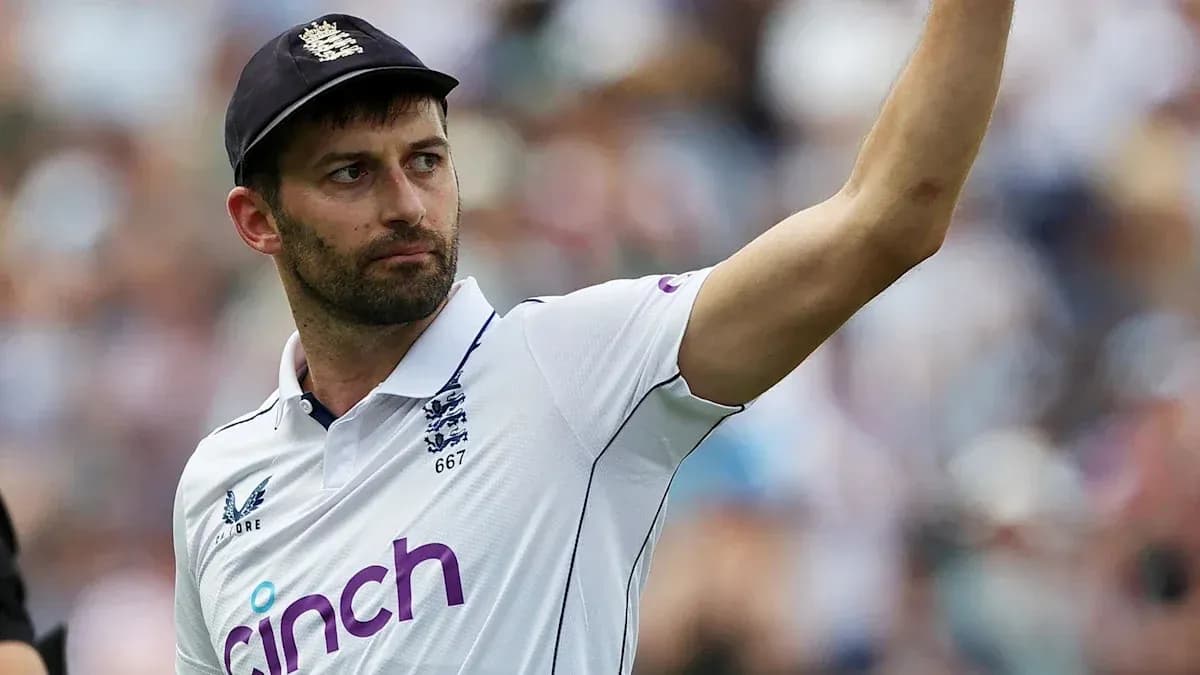
Mark Wood Retires from International Cricket: A Career of Speed and Glory
Mark Wood, the tearaway fast bowler who so often bowled himself off his feet for England, has called time on his international career with immediate effect.
The 36-year-old Durham quick, one of the fastest ever to pull on an England shirt, walks away with 119 Test wickets, two World Cup winner’s medals and an Ashes triumph – and with a body that finally refused to keep pace with his ambition.
Body gives in, contract runs out
Wood’s decision comes at the end of his central contract, after a brutal year in which his long-running battle with injury finally caught up with him.
He had only just fought his way back into the Test side for the first Ashes Test in Perth last November, returning from 15 months out following elbow trouble and knee surgery. The comeback lasted 11 overs. Swelling in the same left knee forced him off, then onto a plane home. He has not played for England since.
“Although this may not come as a surprise given the past year, it just feels like a natural time at the end of my contract,” he said in a statement on social media. “I’ve always tried to be resilient and come back from injury to prove people wrong and show everyone what I can do. Unfortunately, this time I lost the battle.”
Medical advice has been blunt. No more Test cricket. No more 50-over internationals. The format in which he helped England to a first men’s World Cup crown in 2019 is now off limits.
“On medical advice, Test cricket and 50-over cricket are not possible, so the England dream has slowly been ground out of me over the last year,” he said. “Playing for England has been the greatest honour I could have ever wished for and a dream come true.”
He still hopes to play on somewhere, in some capacity. But the days of Mark Wood tearing in for his country are over.
A career of extremes
Wood’s numbers only tell half the story. Thirty-eight Tests, 119 wickets. Eighty wickets in 70 ODIs. Fifty-four in 38 T20 internationals, making him England’s sixth-highest wicket-taker in men’s T20s.
The other half? Noise. Speed. Chaos.
From his debut in 2015, when he helped England reclaim the Ashes on home soil, Wood operated at the edge of what a fast bowler’s body can take. Ankle problems, knee issues, elbow surgeries – the injury list reads like a medical file, not a sporting CV.
He tried to fight back with science and subtlety. In 2018 he lengthened his run-up to ease the strain on his body. The pace stayed. The impact grew.
The remodelled action underpinned some of his finest days. St Lucia in 2019, when he blew away West Indies in a spell that felt like a statement of what he could be in the second half of his career. The 2019 World Cup, where he took 18 wickets and played through pain to be out there on that wild, unforgettable day at Lord’s, coming in to bat alongside Ben Stokes with the trophy on the line.
He was there again when England lifted the T20 World Cup in 2022, even if a calf problem cruelly kept him out of the final stages.
The thrill of pure pace
Anyone who has tried to bowl fast understands the dream. To sprint in, hit the crease, and send the ball down so quickly that batters flinch and stumps cartwheel.
Wood lived that dream for real.
The sight became familiar: Wood charging in, limbs pumping, often finishing his follow-through flat on the turf. It looked reckless. It was exhilarating. It was also one of the most thrilling spectacles in modern cricket.
He did not just win over crowds with speed. He did it with personality. Self-deprecating, open with fans, never seeming to forget that cricket is supposed to be fun, he became one of the most popular figures in the England dressing room and beyond.
There will always be the question of what might have been had his body held together. Fast bowling is a brutal trade. For Wood, it was unforgiving.
Yet when everything clicked, the effect was devastating.
Ashes fire and Headingley thunder
Even in some of England’s darkest recent days, Wood found a way to shine.
On the ill-fated Ashes tour of 2021-22, when England were outclassed, he emerged with rare credit. His pace, hostility and heart cut through the gloom.
Then came the 2023 Ashes. England were 2-0 down, the series slipping away, when Wood was finally unleashed at Headingley for the third Test.
He bowled as if someone had wound him up and let him go. Thunderbolts at 95mph, one of them crashing through Usman Khawaja in a spell that will live long in Ashes folklore. The crowd roared with every ball. Australia flinched.
And when the match tightened into a nerve-shredding chase, Wood was still there, this time with the bat. Alongside his close friend Chris Woakes – another player held back until that third Test – he dragged England over the line. That partnership, that game, turned a looming 5-0 embarrassment into a 2-2 series that felt, to many, like a moral victory.
Without Woakes and Wood that summer, England would have been buried.
World titles and rare company
Wood’s medal haul places him in a select group. He is one of the very few England players to have won both the 50-over and T20 World Cups and to have lifted the Ashes.
He played in the XI on that extraordinary day at Lord’s in 2019 when England edged New Zealand on boundary countback. Even half-fit, he pushed his body to stay in the contest, limping out to join Stokes as the drama reached its peak.
He was in the squad in 2022 when England conquered the T20 world in Australia. And he was part of the last England side to regain the Ashes, back in 2015.
With his departure, the list of active England Test cricketers who have actually won an Ashes series shrinks to one name: Joe Root.
End of an era
The final chapter came quietly. No farewell tour, no last spell in Australia. After a long rehab from elbow and knee injuries, Wood arrived at the 2023-24 Ashes hoping to bring the pace England craved. It never came. He played only the first Test in Perth and later admitted he felt “ashamed” of how it unfolded.
His retirement underlines a stark reality for England. A golden generation of seam and swing has almost entirely gone.
Stuart Broad has stepped away. James Anderson has followed. Chris Woakes has gone. Now Wood. Between them and the all-round brilliance of Stokes, England have lost 1,871 Test wickets in under three years.
Rob Key, managing director of England men’s cricket, captured the scale of Wood’s impact. “To have been a point of difference in Ashes series wins, two World Cup wins, and to have thrilled crowds every time he got the ball in his hand is something very few players achieve. He can look back with enormous pride on a career very well spent.”
England will search for the next express quick, the next bowler to make batters hop and crowds gasp. They may find someone with pace. They may even find someone with Wood’s numbers.
Finding another who bowled that fast, lived that hard, and made it look that much fun? That is a different challenge altogether.