Katie Taylor Retires as Undisputed Champion at Croke Park
On a cool Dublin night, under fireworks and floodlights, Katie Taylor walked into Croke Park knowing there would be no next time.
She left it as the undisputed world super-lightweight champion, a 40-year-old with every major belt around her waist and 83,000 people on their feet, watching the final chapter of a career that has redrawn the map of women’s boxing.
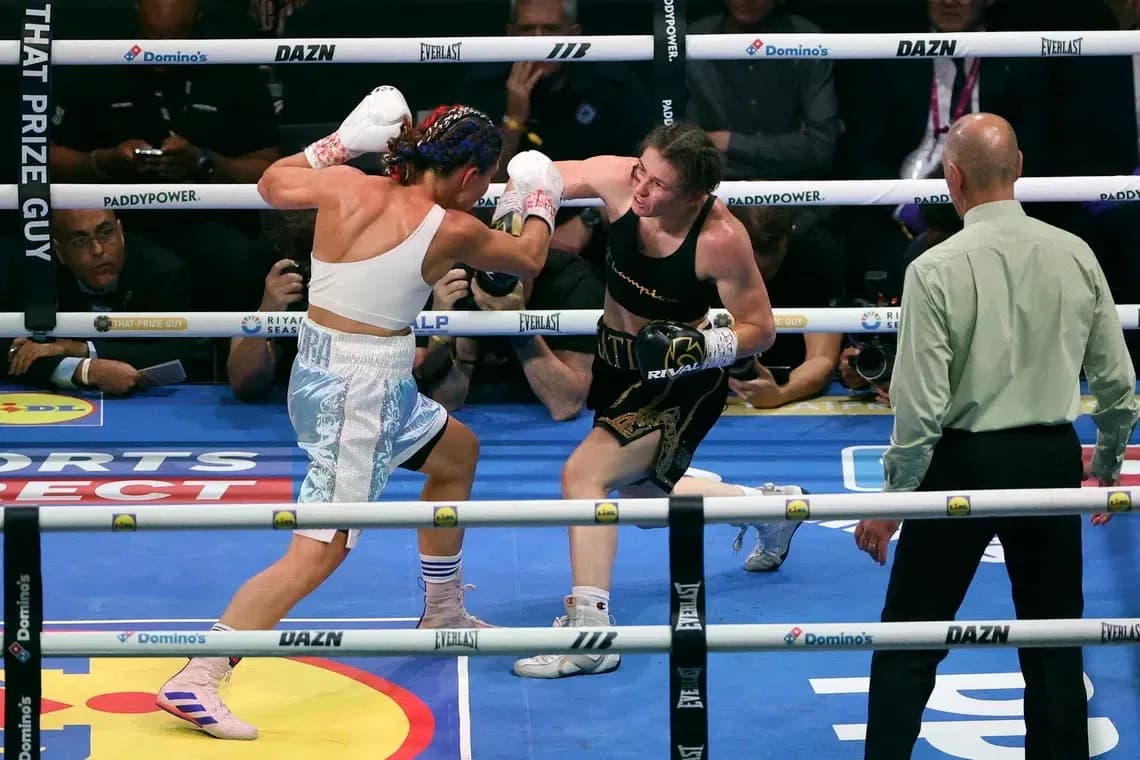
The performance matched the occasion. Taylor outboxed France’s Flora Pili across ten rounds, winning by unanimous decision with scores of 100-90, 100-90 and 98-91. It was controlled, disciplined, ruthless in its own quiet way. Exactly how she has done it for years.
Pili arrived with momentum and an unbeaten record in 13 fights. She left with her first professional defeat, handed to her by one of Ireland’s greatest sporting figures on a night when the result felt almost secondary to the symbolism.
Croke Park shook when Taylor appeared. This was not just a ring walk; it was a procession. The 2012 Olympic gold medallist stepped out for the last time, emotion etched across her face, as the crowd rose and the noise surged. Above her, a barrage of fireworks tore through the Dublin sky, framing the end of an era in Irish sport.
Inside the ropes, there was no sentimentality. Taylor, now 26-1 as a professional, boxed with the authority of a fighter who still knows every angle, every rhythm. She dictated distance, picked her moments, and never allowed Pili to turn the night into a brawl. The Frenchwoman pressed, as an unbeaten challenger must, but kept running into a champion who has seen every style and solved every puzzle.
Two judges saw it as a shutout. The third gave Pili a single round. The belts — WBO, WBA, WBC, IBO and IBF — stayed where they have so often been in the last decade: draped across Taylor’s shoulders, stacked in her arms, symbols of a dominance that stretched from London 2012 to this final stand at what she calls the “Cathedral of Irish sport”.
When it was over, the roar rolled down from the stands again. Taylor, exhausted and elated, took the microphone and gave the stadium the line it wanted and deserved.
“Croke Park! We did it,” she cried, saluting the sea of green, white and gold. “I don't know of any other country that would sell 80,000 tickets.”
It was more than 80,000. Officially, around 83,000 people had packed into the Gaelic games fortress, a venue that has staged All-Ireland finals, historic internationals and defining cultural moments. On this night, it belonged to a boxer who had waited years to fight here and chose it as the place to say goodbye.
Hours earlier, Irish band Westlife had warmed up the crowd, turning the stadium into a concert long before the main event. By the time Taylor emerged, the atmosphere had shifted from party to pilgrimage.
This was not just a title defence. It was a curtain call.
She retires with a record that speaks for itself: 26 wins, one defeat, undisputed at super-lightweight, Olympic champion, and a trailblazer whose impact can be measured in the number of women now headlining cards, filling arenas, and treating world title fights as standard, not novelty.
On Saturday night, all of that history narrowed to a single ring in the middle of Croke Park, one fighter, one final walk, one last decision.
Taylor left with her belts, her legacy secure, and a stadium full of people who will talk about the night they saw her off.
The gloves are hung up now. The question, for Irish sport and for women’s boxing, is who dares step into the space she leaves behind.