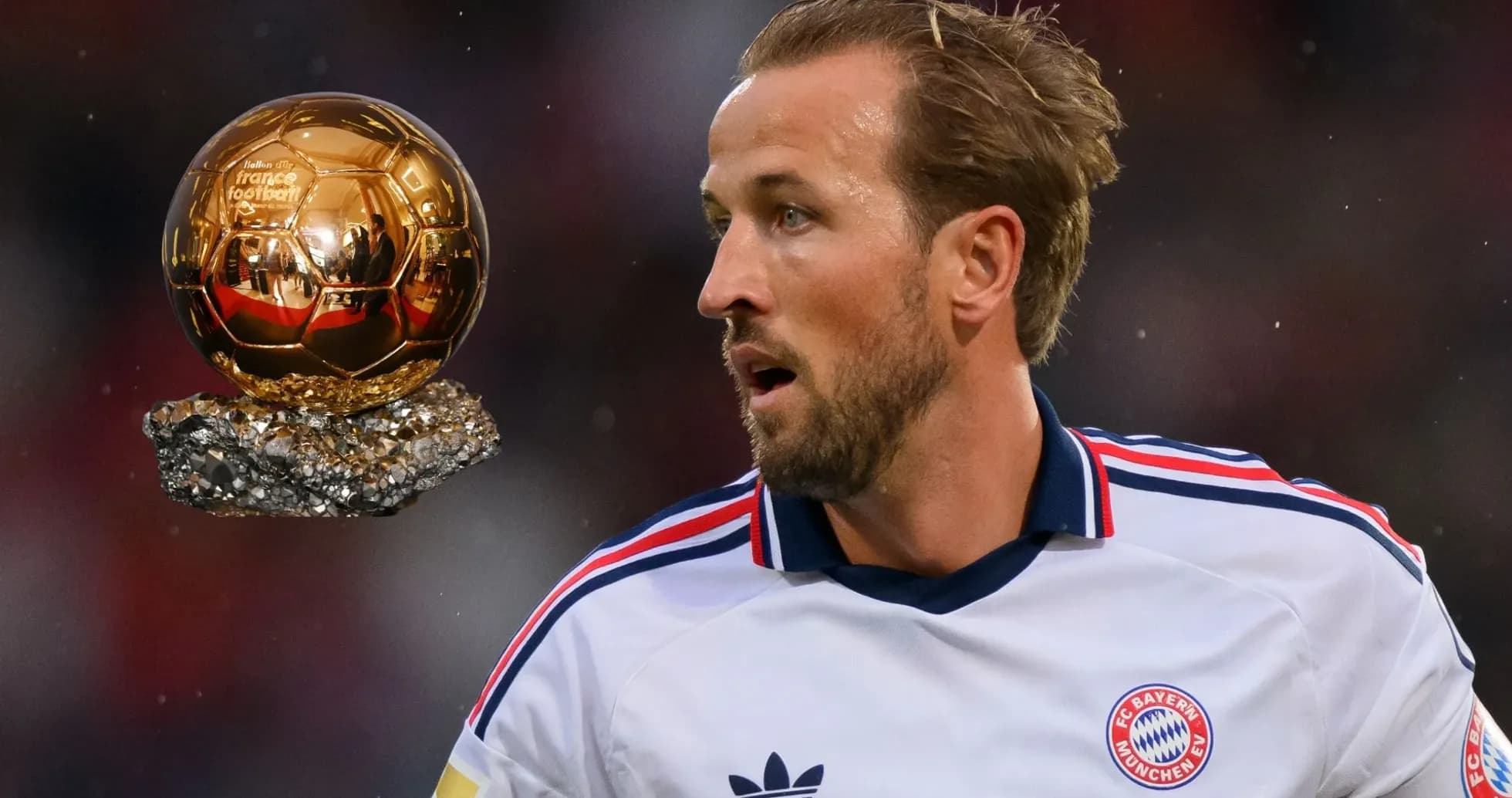
Harry Kane: Can He Bring the Ballon d'Or Back to England?
For a quarter of a century, English football has lived with the same nagging question: when will one of its own be crowned the world’s best again?
Michael Owen was the last to do it, lifting the Ballon d’Or in 2001. Since then, a stream of English greats have walked the red carpet, sat near the front, heard their names read out in the final reckoning – and still gone home empty-handed. Billy Wright, Duncan Edwards, Johnny Haynes, Jimmy Greaves, Bobby Moore, Gary Lineker, Alan Shearer, David Beckham, Frank Lampard, Steven Gerrard, Jude Bellingham: all close, none crowned.
For years, that frustration was overshadowed by a different story. Lionel Messi and Cristiano Ronaldo turned the Ballon d’Or into a private duel, a 15-year empire built on impossible numbers and unrelenting brilliance. Thirteen awards between them, eight of them Messi’s, the Argentine ripping up every scoring chart the game had known.
That era has finally loosened its grip. The trophy has started to move again. Rodri and Ousmane Dembele have helped usher in a new phase across the last two Ballon d’Or polls, anchoring World Cup and Champions League triumphs and reminding voters that influence comes in different shapes. Both are in the running again after adding more World Cup and Champions League medals in 2026.
Yet this year, the spotlight feels fixed on someone else.
Harry Kane stands at the front of the queue. Not because of sentiment, not because of a narrative, but because of numbers that once belonged only to Messi and Ronaldo. Sixty-one goals for Bayern Munich last season, another 12 for England. Seventy-three in total. A second Bundesliga title in his pocket. It is the sort of “silly” output Kane himself admits he never truly imagined.
Only Messi, with a peak of 82 in a single season, has ever gone higher. Ronaldo’s best sits at 69. Kane has moved beyond that line.
No wonder Owen, now an ambassador for Casino.org and still the last Englishman to know the weight of the Golden Ball in his hands, looks at this race and senses an opening. Speaking to GOAL, he did not dress it up.
“Obviously, Harry's got a good shot at it. I do think it's quite an open year, but I do think Harry Kane's got a great chance of winning it. It'd be a fabulous achievement if he did.”
Owen also knows the scale of what Kane is chasing. Only four Englishmen have ever won the Ballon d’Or. Stanley Matthews, the very first recipient in 1956. Bobby Charlton, the World Cup winner who defined an era. Kevin Keegan, who went back-to-back in 1978 and 1979. Then Owen himself, the teenage phenomenon of 2001.
Four winners across roughly three-quarters of a century. As Owen points out, that works out at roughly one every 20 years. The clock is already ticking past that average.
The competition this time is fierce, and modern. Kylian Mbappe, already a global icon. Lamine Yamal, the prodigy rewriting age records. Michael Olise and Khvicha Kvaratskhelia, both capable of the kind of season that can tilt a vote. Rodri, Dembele, and others with medals and highlight reels of their own.
Yet the bookmakers and the mood music say the same thing: Kane is favourite to be named “best player on the planet”.
He is trying to treat it like any other challenge. Speaking to TNT Sports, Kane framed the Ballon d’Or as an extension of a boyhood dream that has already gone far beyond what that boy could reasonably have drawn on a bedroom wall.
“Not that long ago, I was that fan wanting to become a professional footballer, and I am here now and winning awards and the Ballon d'Or is the same,” he said.
“Of course, now it is out of my hands, it is down to the voters and the people who decide it. The season I had was my best season by far, and we'll have to wait and see. It is a weird one because I am already focused on this season now, and the next season. Can I be better? Can I improve? But I also want to appreciate what I did.”
That tension – between reflection and relentlessness – runs through every Ballon d’Or contender. The moment the season ends, the campaign for the next one begins. Yet the debate never stops. Kane knows that as well as anyone.
“The thing with football opinions - there are so many opinions, so many arguments for different players, and people love this player because 'he's fast' and 'he's got great IQ' and 'his finishing is great'. So I think that is what makes football special, all those debates, and the Ballon d'Or is definitely one of them. I'm happy that I am in contention, so we will have to wait and see.”
The arguments this year will rage around more than goals. Mbappe’s explosiveness, Yamal’s precocity, Rodri’s control, Dembele’s trophies. Yet 73 goals from a centre-forward who also drops deep, links play, and carries the expectations of a nation is a hard case to ignore.
For England, the symbolism would run deep. From Matthews’ artistry to Charlton’s authority, from Keegan’s European dominance to Owen’s teenage fearlessness, every English Ballon d’Or winner has captured a moment in the sport’s evolution. Kane, the modern No.9 who creates as much as he finishes, would stand as the emblem of a new age.
The verdict will come at the London Palladium Theatre on October 26, when the famous golden sphere is lifted again under the stage lights. Messi and Ronaldo once made that night feel predictable. This time, the script is wide open.
The question is not whether Harry Kane belongs in that conversation. His numbers have already settled that. The only question now is whether this is the year English football finally climbs back to the very top of the world game.