England’s quicks dominate Pakistan at Lord’s
Score:
England 290 (Smith 61, Cox 55; Abbas 4-73) & 81-3 (Gay 30*)
Pakistan 110 (Awais 46; Robinson 4-11, Archer 3-26)
England lead by 261 runs
By the close at Lord’s, it felt less like a contest and more like a statement.
England’s new-look pace pack – Ollie Robinson, Jofra Archer, Josh Tongue and Gus Atkinson – tore through Pakistan for 110 and then calmly stretched the lead to 261, leaving a series win within touching distance despite a grim weather forecast for Saturday.
The numbers barely capture the mood. Pakistan, already short on confidence and robbed of injured opener Imam-ul-Haq, were harried, hurried and eventually humbled. Only Azan Awais, with a battling 46, offered any kind of resistance. Extras, tellingly, was the next highest score.
England’s quicks turn the screw
The tone was set early. Atkinson and Tongue, England’s No 10 and No 11, resumed on Friday morning and added 42 more runs to their 10th-wicket stand, dragging the first-innings total from handy to imposing. Their partnership of 47 did more than pad the scorecard; it shifted the entire feel of the match.
Once England had 290, their bowlers showed exactly why that total mattered.
Archer, back on his favourite stage, thundered in from the Pavilion End. His opening burst was hostile and relentless, the speed gun climbing to 95mph and barely dipping below 90.7mph on average. The ball hissed past the bat again and again. Shan Masood eventually fell, but Archer deserved more than a solitary early wicket from a spell that rattled Pakistan’s top order.
At the other end, Robinson was the polar opposite in style, identical in menace. Barely touching 80mph, he operated with wicketkeeper Jamie Smith standing up to the stumps – a rarity at this level for a seamer, and a sign of supreme control. Robinson hit the same spot, over and over, drawing late movement in the air and off the pitch. Pakistan’s batters found no release, only a forensic examination.
Behind them, Tongue attacked the stumps with a fuller length and was rewarded twice. His strike-rate in this series – a wicket every 13.3 balls – underlines just how often he forces an error. Atkinson again bowled better than his figures, stuck on just one wicket in three innings. He thought he had Awais caught behind, only for the left-hander to successfully review as the players were already heading off for a brief rain break.
When they came back, the dam burst.
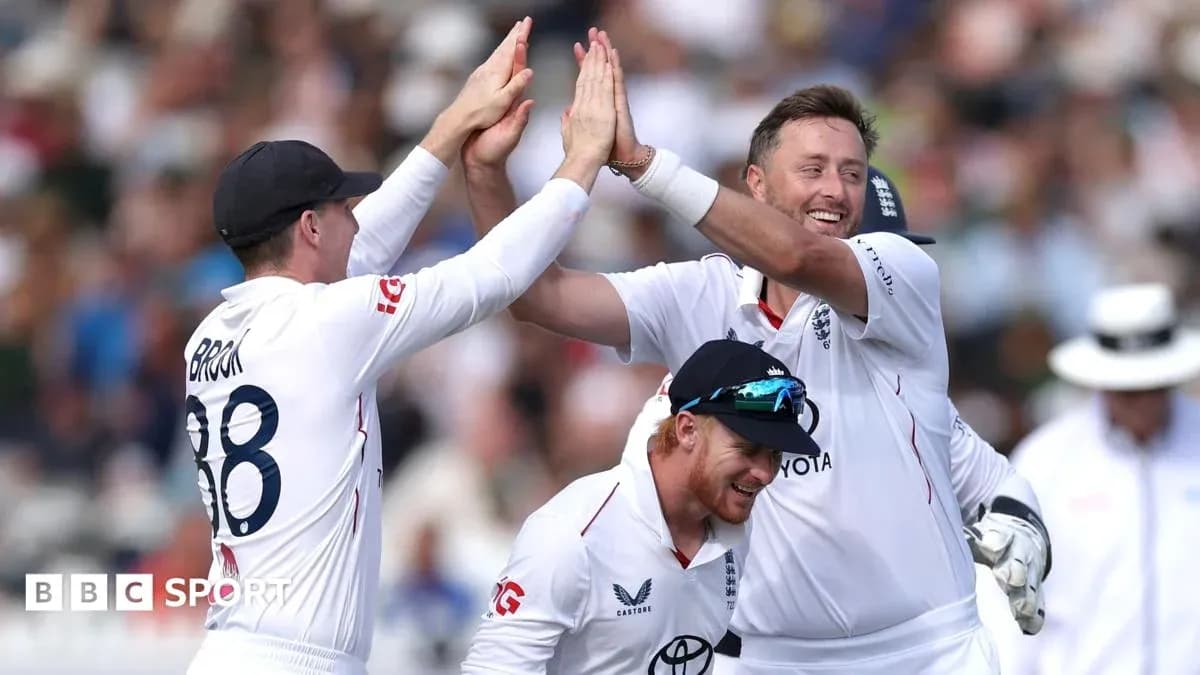
Robinson and Archer hunted in tandem. Robinson trapped Saud Shakeel and Muhammad Rizwan lbw, both dismissals confirmed by sharp reviews, then bounced out Awais to end the only serious resistance. His summer tally now stands at 19 wickets in three matches at a staggering average of 8.84.
Archer finally got the extra reward his spell deserved, spearing through the defences of Ali Usman and Muhammad Abbas. His record at Lord’s grows more remarkable: a bowling average of 17 here, compared to more than 30 everywhere else.
Pakistan’s innings lasted just 110 runs. Three attempts on this tour have yet to produce a total above 171 or an effort that lasts 50 overs. Against this England attack, they have looked outgunned and out of ideas.
England wobble, then settle
With a lead of 180, England could have crushed Pakistan immediately. Instead, they offered a brief glimmer of hope.
Ben Duckett fell to a poor stroke, slicing a loose drive to mid-off. Jordan Cox, fresh from his first-innings 55 and another half-century earlier in the series, was pinned lbw by Khurram Shahzad, stuck on the crease. Two down inside 19 balls, and Lord’s quietened for the first time all day.
The situation demanded calm, not panic. Emilio Gay and Joe Root supplied it.
Gay, under pressure for his place with Jacob Bethell due back from a knee injury and England’s top order suddenly crowded, dug in. The left-hander picked off anything too wide, nudging and driving through the off side, and refused to be drawn into the kind of airy stroke that cost Duckett.
Root looked, initially, like Root again – balanced, busy, quietly accumulating. Then a familiar problem resurfaced. Mohammad Ali nipped one back, thudded into the pad, and the England captain reviewed in hope more than expectation. The verdict went against him. It was the ninth time in seven Tests he has fallen lbw to seam, after suffering the same fate only three times in his previous 39 matches. Whether the keeper is up to the stumps or not, it has become a clear trend.
The drama almost doubled a ball later. Harry Brook, on his first delivery, was struck in front by Ali with a near-identical delivery. This time, a thin inside edge saved him on review. England exhaled.
From there, the light deteriorated quickly. Batting turned into a scrap for survival rather than a chance to gallop away. Gay edged Abbas short of the cordon, a slice of fortune that kept him unbeaten on 30 at stumps. Brook stayed with him, and England closed on 81-3.
A new attack, a familiar dominance
This England pace unit has been assembled out of necessity after Ben Stokes’ retirement from bowling, yet it already feels like something more than a stopgap. Archer’s raw pace, Robinson’s precision, Tongue’s attacking length, Atkinson’s promise – it is a blend that has given Pakistan no breathing space.
The caveat is obvious: this is a fragile touring side, short on runs and shorn of key players. Any talk of a long-term revolution in England’s attack must be tempered by the quality of the opposition. But across this series, the evidence is hard to ignore. England’s bowlers have been outstanding.
The forecast for Saturday is bleak, with the threat of a complete washout. Even so, England have a lead of 261, a rampant seam attack, and two more days after that to finish the job.
Gay, on 30 not out, has his own battle to win inside that larger story. With Cox scoring runs and Bethell on the way back, England’s top order is getting crowded. This innings at Lord’s, on a pitch still offering plenty to the bowlers, is his chance to make sure he is not the one squeezed out.
England already look to have enough runs to take the match and the series. The only real question now is how long Pakistan can delay the inevitable.