Cricket Dream Comes True for Japan Against India
For years, when Naoki Alex Miyaji spoke about bringing India to Japan, it sounded like fantasy. The CEO of the Japan Cricket Association was talking about world champions boarding a long-haul flight to face the 41st‑ranked Associate nation. Nice idea. Not happening.
Then the Asian Games arrived. And the fantasy found a date, a venue, and a captain.
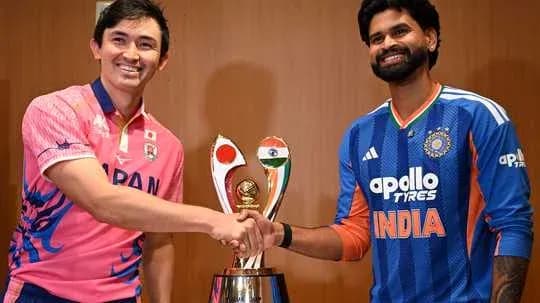
On Tuesday, at Sano International Stadium, Japan will walk out to face India.
A CEO’s dream, a captain’s reality
“The CEO has had this dream for a long time,” Japan captain Kendel Kadowaki Fleming tells Cricbuzz. He remembers when the first whispers started.
“When news first came up that we were hosting the Asian Games, Naoki had been talking about the concept of having India here for a game. So, for it to turn into reality is extremely special for a lot of people involved, and as a men's team, we can't wait.”
This is not a fixture that fell from the sky. It has been pushed, planned, and negotiated into existence.
Kendel knows exactly how much work went into it. “It's taken a massive effort from a lot of people involved to make it happen.” The Board of Control for Cricket in India had to say yes. Japan had to convince them it was worth their time. “Also to our leadership team here at the Japan Cricket Association (JCA), and in particular, the CEO,” he adds, making sure the credit lands where it belongs.
The payoff is enormous. India have never played a bilateral match against an Associate nation. For Japan, that makes this more than a one-off glamour tie. It is a door swinging open.
A rare stage, a rare chance
For the Japanese players, this is an “extremely exciting opportunity” in every sense. They are not just playing the reigning world champions; they are doing it at home, in front of the biggest cricket crowd the country has seen.
“It's got the potential to accelerate the growth of cricket across the country,” Kendel says. This isn’t hyperbole. Visibility is currency in a sporting landscape dominated by other games.
“There's going to be more people here than ever before for a cricket match. And clearly the best quality players that we've ever had here as well.”
Those “best quality players” include Jasprit Bumrah, Abhishek Sharma, Shreyas Iyer. Names that dominate global broadcasts, now appearing on a team sheet in Sano. For a Japanese side more used to grinding through regional qualifiers and development tours, it is almost disorienting.
“It still does sound quite surreal to be hearing about them playing here in Japan,” Kendel admits.
Surreal, yes. Intimidating, no.
“I can't guarantee any outcome, but what I can guarantee is that we will try our best. We'll compete and hopefully we'll give it our best shot.” The realism is clear; so is the intent. They know the gulf, but they are not turning up for photographs.
A team built quietly, ready for noise
Kendel, 30, is a left-handed batter and right-arm off-spinner, a captain who straddles roles just as his team straddles eras. Japan arrive at this moment with a squad that blends hardened regulars with fresh products of their pathway system.
Among the new wave is 17-year-old all-rounder Charlie Hara-Hinze, a left-arm spinner already marked as one to watch. He represents the slow, patient work Japan have done beneath the radar, building structures long before a giant like India agreed to visit.
Historically, Japan have leaned heavily on spin. Not by design at first, but by necessity. The conditions they encounter across their circuit — in Japan, PNG, Thailand, Oman — favour slow bowling. So they adapted. They learned to squeeze, to scrap, to stay in contests even when outgunned.
And they have started to land punches.
At the ICC Men’s T20 World Cup Qualifier 2026, Japan recorded a landmark win over Kuwait, chasing down their target with five wickets in hand. It was more than a result; it was a signal that they could compete with higher-ranked sides, not just participate.
This India game is another level again. But it sits on that same trajectory.
ICC’s big-picture moment
The significance of the fixture is not lost on the International Cricket Council.
“It's enormous, one of our aspirations as an international federation,” says William Glenwright, ICC Head of Global Development.
The numbers underline his point. More than 1,000 bilateral games were played last year, over 860 already this year. Yet this one, between a full member and a low-ranked Associate, stands out in the ICC’s calendar.
“Having a full member and the world champions playing any associate member is hugely important to us from a cricket perspective,” Glenwright explains. The importance stretches beyond the boundary rope.
“And then there's the other element of that – which is what does it mean for the country of Japan and cricket's significance in Japan? And that's the ripple effect of a fixture like this. Because it reflects a growing confidence in the game and in the full members' belief in the abilities of our associate members to host full members in major international cricket.”
For Japan, that confidence is priceless. It says they are no longer just a development story tucked away in ICC reports. They are a host.
Cricket in a baseball nation
Kendel understands the context he is working in. In Japan, cricketers do not live on billboards. They are not household names. The country’s sporting icon is Shohei Ohtani, a two-way superstar who has redefined what is possible in baseball.
“He’s the Virat Kohli of baseball,” Kendel says. The comparison is deliberate. It translates cricket’s biggest modern icon into Japanese terms.
Baseball is the sport that fills stadiums, dominates prime time, and commands loyalty across generations. “It’s definitely a sport that many of the supporters get behind in Japan,” he notes.
Cricket, by contrast, is still a niche, a curiosity, a game many in Japan have never seen live. That is why Tuesday matters. It is not just about a result against India; it is about a first impression for thousands of new eyes.
Kendel is not naive about the scale of the task. But he is not shy about ambition either.
“There's no reason why we can't aspire to become like that in cricket someday. We've got a long road ahead if we can try to replicate the full-member countries for sure,” he says.
The road begins with small steps: pathway systems, youth players like Hara-Hinze, spin-heavy line-ups grinding in qualifiers. On Tuesday, it takes a giant stride under the gaze of Jasprit Bumrah and company.
For Japan, this is not just a dream fulfilled for a CEO. It is a chance to show a baseball nation what cricket looks like at full volume — and to ask, quietly but firmly: why can’t this be ours too?