Carlos Alcaraz Returns to Grand Slam Tennis with Dominant Performance
Carlos Alcaraz didn’t just return. He walked back into grand slam tennis with a reminder of why the sport has missed him.
At 5-4, 30-15 in his first singles set for more than four and a half months, the instinct that separates him from almost everyone else on tour took charge. A wide serve dragged Roman Safiullin off the court, the reply came low and skidding straight at his feet, and Alcaraz, without breaking stride, caressed a half‑volley over the net for a clean winner.
One touch. One gasp from the crowd. One familiar, wide grin.
Moments later the set was his, the nerves had cleared, and the comeback was fully under way. By the end of the night, the scoreboard told a simple story: 6-4, 6-4, 6-4 to Alcaraz. The performance behind it was anything but simple.
Questions about the wrist, answers from the forehand
This was no gentle reintroduction. No warm‑up events, no soft landing, just a best‑of‑five first round against Safiullin, a man who hits through the court with heavy, unforgiving pace. The doubts were obvious. How would a recently injured wrist absorb that kind of power over three, maybe four, maybe five sets? How would Alcaraz cope with the physical shock of full‑throttle grand slam tennis after months on the sidelines?
He chose the most direct possible response: he hit through the ball as if the layoff had never happened.
From the opening games, Alcaraz leaned on his forehand, the shot many already call the best in the sport. He didn’t guide it. He ripped it. He bullied rallies from the baseline, repeatedly stepping inside the court and dictating with that heavy, whiplash motion that has become his signature. The numbers backed up the eye test: 20 forehand winners against just nine unforced errors on that wing.
Whenever Safiullin threatened on return, Alcaraz simply raised the speed and depth. A break point here, a 0-30 there – and each time the Spaniard hit his way out of trouble, choosing aggression over caution, trusting the joint that had betrayed him earlier in the year.
“It’s pain-free right now,” he said afterwards, speaking about the wrist that has dominated every conversation around his season. “I felt great. I don’t know how it looked from outside but, from inside, my feeling was that I was hitting normal. I was playing pretty normal, playing my style, and the arm, the wrist, everything felt great. I’m going to still take care of it, obviously, these days and before the matches and everything, but I’m just really happy it’s pain-free finally.”
For a player whose game is built on fearless acceleration through the ball, that sentence – pain-free – may be the most important part of his entire night.
The one note of caution
Not everything in his arsenal was unleashed at full power. The serve, in particular, told a slightly different story.
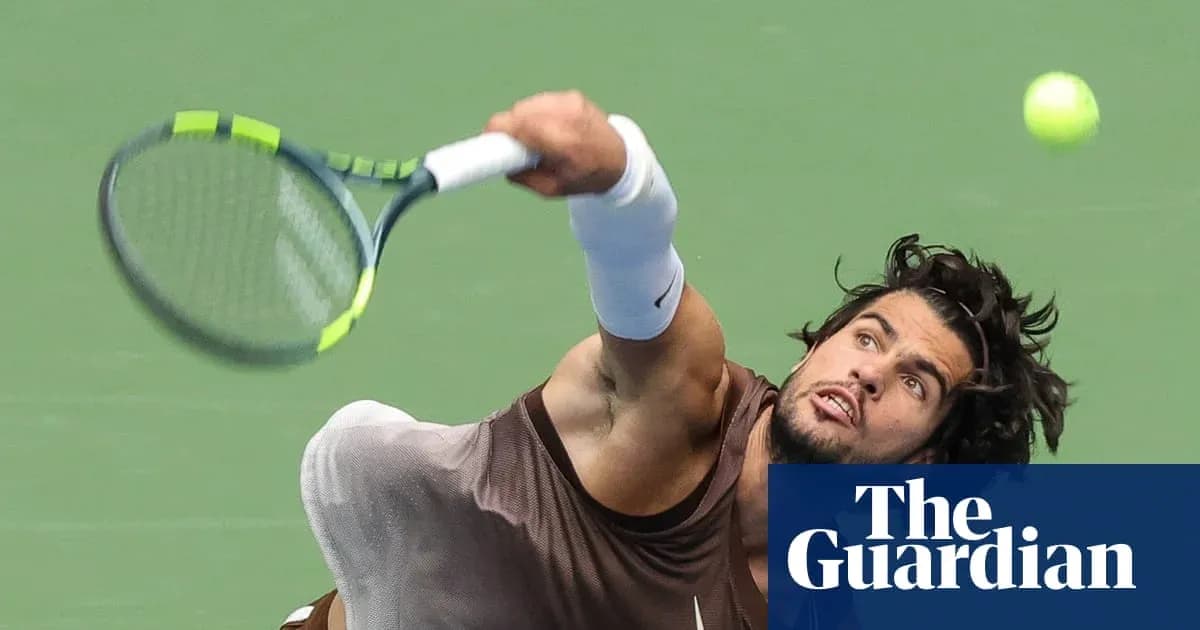
Alcaraz kept his first‑serve speeds down, averaging around 113mph. For a player capable of far more, that’s a clear choice, not a limitation of talent. He has been wearing tape under an arm sleeve in matches and practices, a visible reminder that this is still a comeback, not a clean slate. Less strain on the wrist on serve is the obvious calculation.
That approach comes with a cost. Fewer free points. More rallies. More physical load over the course of a long tournament. At this level, that can shape how deep a player can realistically go.
Yet on this night, against this opponent, his return game and baseline dominance more than covered the gap. Safiullin’s power never truly pinned him back for long enough, never turned into sustained scoreboard pressure. Alcaraz controlled the patterns, controlled the crowd, and, crucially, controlled the doubts that have followed him for months.
Nerves, family, and a different kind of goal
Strip away the shot‑making and the numbers, and this was still an emotional day. Alcaraz admitted as much.
“It was a difficult day for me, to be honest, but at the same time, a really beautiful one,” he said. His parents were in the stands, his brothers, his team, and even rapper Travis Scott watching from the box. This wasn’t just a first round; it was a reunion.
“[I] started the day really nervous. Really, really nervous, thinking: ‘I’m going to make it, I’m going to compete again.’ I had more nerves than usual, but just happy, because for me, my goal here is to compete, to enjoy, and let’s see how my body’s going to react after the matches, after the competition again.”
That is the other striking shift. Alcaraz, usually spoken of only in the language of titles and rankings, is talking in smaller, more immediate terms. Not trophies. Not destiny. Just the simple act of walking on court, feeling the noise around him, and testing his body against the highest level again.
“I don’t know how far I’m going to go in the tournament,” he admitted. “I didn’t know if I was going to lose this one, if I’m going to make the second round, final. I don’t know how far I’m going to go. But what I just really want to do is enjoy every time that I’m going to walk into the court feeling the energy from the people, feel the competition, walking up, I’m thinking, all right, it’s match day. That’s what I’m going to do this tournament.”
For now, that is the deal. Day by day. Match by match. A measured serve, a liberated forehand, and a wrist that, at least for one night, stayed silent.
The bigger questions – about how long that will last, how far that will carry him, and whether this cautious version of his serve can survive the late‑tournament storm – will be answered only if he keeps winning.
On this first step back, though, the only answer that mattered came off the strings of that forehand, thudding into the corners, announcing that Carlos Alcaraz is not just back on the court, but back in the fight.