Alcaraz, Sabalenka, and Osaka: Stars Return to US Open
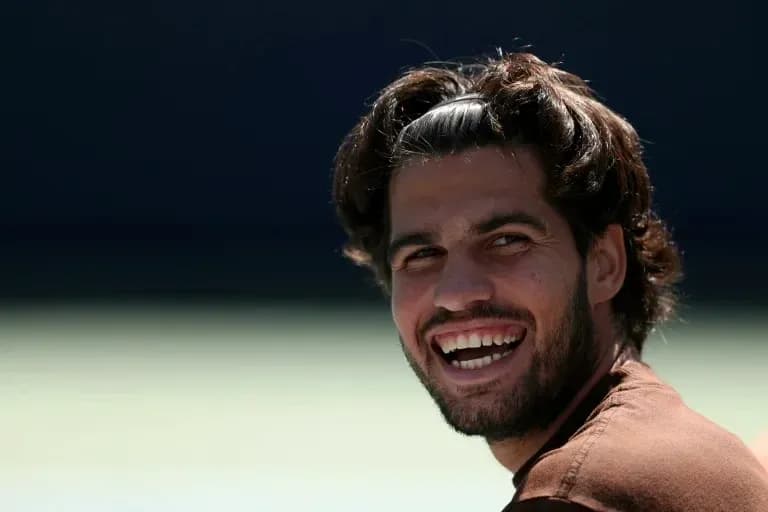
Carlos Alcaraz returns to the New York spotlight on Monday night with a question hanging over Arthur Ashe Stadium: how quickly can a champion remember how to dominate?
The defending US Open winner has not struck a ball in anger on tour since April, his season stalled by a right wrist injury just as it seemed destined to become an era-defining campaign. He already owns the Australian Open crown from January, a title that made him the youngest man ever to complete a career Grand Slam. Now he walks back into the noise and glare of Flushing Meadows trying to bookend the year with majors and reassert control over a season that moved on without him.
Across the net in his opener stands Roman Safiullin, and that is no gentle reintroduction.
Alcaraz vs Safiullin: Rust meets risk
Their head-to-head is locked at 1-1, and the Russian has already shown he can make Alcaraz deeply uncomfortable. Safiullin stunned him at the ATP Paris Masters in 2023, bullying the Spaniard from the baseline and exposing a rare lack of rhythm. Alcaraz struck back at the Paris Olympics the following year, but the scar tissue from that upset remains a reminder: this is a dangerous first step.
Safiullin, 29, brings heavy, flat power and a willingness to stand on the baseline and trade. His Wimbledon run this year underlined that threat. Wins over Andrey Rublev and Joao Fonseca carried him into the fourth round, where he only bowed out to Novak Djokovic in four sets. That kind of form does not disappear, especially on a hard court that rewards first-strike tennis.
Alcaraz insists the wrist has held up to “demanding” practice blocks and says he is ready to “go 100 percent.” The question is whether that intensity translates under match pressure after more than four months away. If the timing is off early, Safiullin has the weapons to punish him and turn a routine opening round into a long night.
For the champion, it is a test of rust, resilience and reputation—all at once.
Sabalenka’s slide under New York’s hard lights
On the women’s side, Aryna Sabalenka arrives as a two-time defending champion and current world number one, yet the mood around her campaign feels oddly fragile.
Her season once looked like a statement of dominance. A title in Brisbane, then the Australian Open final in January. A ruthless sweep of the March hard-court swing with back-to-back trophies at Indian Wells and Miami. She was the player setting the pace.
Then the wheels wobbled.
A quarter-final exit at Roland Garros. A fourth-round loss at Wimbledon. Results that, taken alone, do not scream crisis, but when stacked against her own standards, mark a clear drop. The slump has cut so deep that Sabalenka could lose the top ranking even if she becomes only the third woman—after Chris Evert and Serena Williams—to win three US Open titles in a row.
Her first assignment is Camila Osorio, ranked 59 in the world and beaten twice by Sabalenka already. Those wins came on very different surfaces: grass at Wimbledon in 2021 and clay in Madrid in 2023. Both times, Sabalenka’s raw pace and first-strike aggression overwhelmed the Colombian.
Osorio knows exactly what is coming. The challenge is surviving it long enough to drag the match into longer rallies, into questions, into doubt.
Sabalenka, for her part, has chosen defiance over anxiety. “Throw tough challenges at me, I will come back stronger,” she says. New York will quickly reveal whether that is a mantra or a promise.
Osaka back where her story changed
Naomi Osaka walks into Flushing Meadows with something no ranking can measure: history on this court.
The Japanese star owns two US Open titles, in 2018 and 2020, part of a four-major haul that once made her the face of the sport’s future. “I think I've proven myself here, so I can kind of bank on that and use that to have confidence,” she said recently, and in New York that belief carries weight. She has lifted the trophy here. Twice.
Yet it has been five years since her last Grand Slam triumph, at the 2019 Australian Open. The intervening seasons have been defined as much by what she has revealed as what she has won. Osaka has spoken openly and repeatedly about her mental health, stepped away from the tour to protect it, and then took 15 months off to focus on motherhood before returning in 2023.
The comeback has not been a nostalgic farewell tour. It has been a serious attempt to rebuild.
This summer brought tangible signs of that. A semi-final run at the Washington hard-court event, followed by a quarter-final appearance in Toronto. On grass, traditionally her least comfortable surface, she produced her best-ever Wimbledon showing by reaching the quarter-finals, a run highlighted by an upset of Sabalenka.
Now she returns to the faster, truer bounce of Flushing Meadows, a surface that suits her clean, explosive ball-striking. Her first opponent is Anastasia Zakharova, ranked 101 in the world and facing Osaka for the first time.
On paper, it is the sort of match Osaka once dispatched without fuss. Today, it is something else: a chance to assert that the hard work, the honesty, the time away have all been building toward another deep run at a major.
Day 2 in New York offers a familiar cast—Alcaraz, Sabalenka, Osaka—but each steps on court with something to prove. The titles they already own will not help them hit a single forehand on Monday. The real story now is simple: who still knows how to win here when the lights go up and the noise rises?