2026 U.S. Open Preview: Djokovic, Pegula, and the Williams Sisters
The gates swing open on another New York fortnight today, and the 2026 U.S. Open walks straight into the spotlight with storylines already stacked to the rafters at the USTA Billie Jean King National Tennis Center.
By lunchtime, Arthur Ashe Stadium will be full and loud. By nightfall, it belongs to Novak Djokovic and Venus Williams. Somewhere in between, the sport will take another hard look at its future, its past, and the long American wait in the middle.
Pegula opens, Medvedev resets, Djokovic returns
Jessica Pegula, a U.S. Open finalist two years ago, gets the honor of striking the first competitive ball on Ashe. At 12 p.m. ET she faces Elena-Gabriela Ruse, the kind of tricky opening opponent who can turn a routine day into a long one if the favorite blinks.
Daniil Medvedev knows all about bad first days in New York. The 2021 champion, who crashed out in the opening round last year, faces Hugo Gaston in his latest attempt to reset his relationship with this tournament. For a player who once looked built for these courts, another early stumble would sting.
Then comes the night.
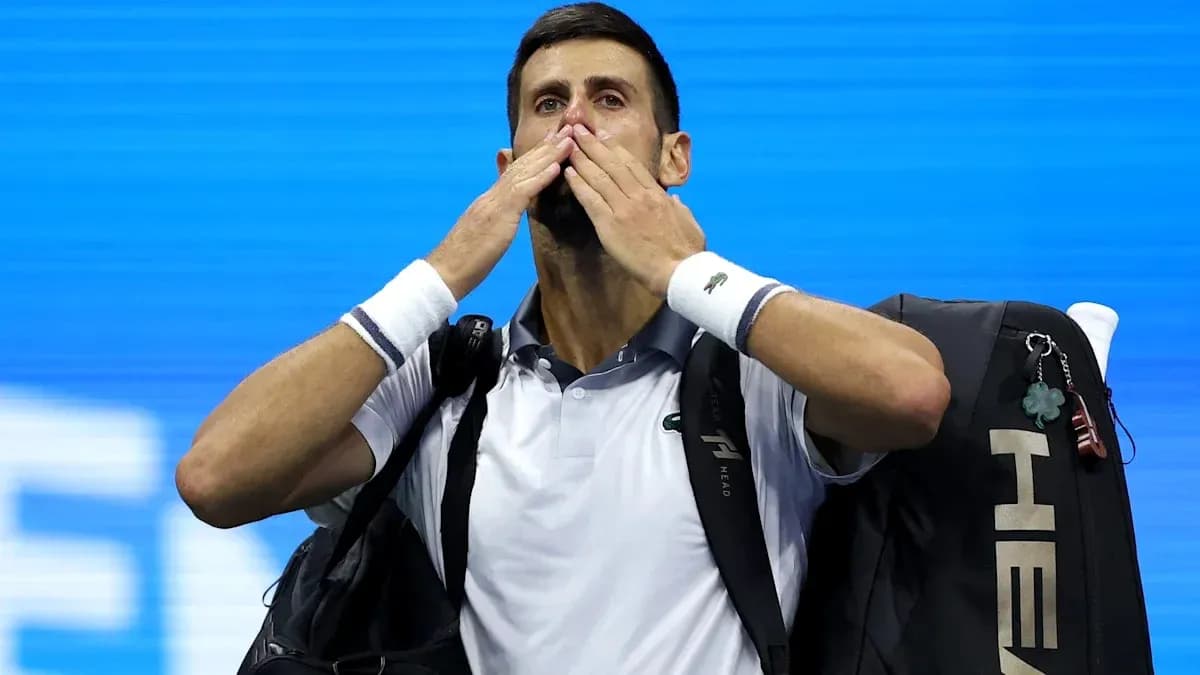
Novak Djokovic, 39 years old, still chasing that 25th Grand Slam title, steps into the evening session having played just one match since Wimbledon. The questions around his sharpness won’t stop until the ball leaves his strings under the Ashe lights. Venus Williams, a symbol of this tournament’s modern history, shares the marquee, still drawing the kind of attention that cuts through an already crowded first day.
Venus and Serena: one more New York act
The Williams sisters were supposed to light up Wimbledon together in doubles this summer. Serena’s knee injury in her singles loss to Australian Maya Joint ended that plan before it began.
So their reunion in New York carries extra weight.
They last played doubles together at a major here in 2022, the year Serena “evolved” away from tennis. That run ended quickly, a first-round loss to a Czech team led by then-17-year-old Linda Nosková. Doubles felt secondary that year, a side dish to the main event of Serena’s farewell singles campaign.
This time, it feels different. Doubles sits closer to the center of the story.
Venus is expected to face fellow American and former Grand Slam champion Sofia Kenin in singles, but Serena is not in the singles draw. Her energy, her preparation, her competitive edge — all of it can funnel into doubles. She has looked sharp there in recent months, fueling the popular theory that her return this summer was driven by one thing: one more run with Venus in New York, near what could be the closing chapters of her sister’s career.
Her mixed doubles pairing with Carlos Alcaraz showcased that balance only she can produce: loose, playful, yet underpinned by serious shot-making. In Cincinnati, she and Venus pushed Marta Kostyuk and Peyton Stearns to a third-set tiebreak, coming within a few points of a stirring comeback.
Whatever the result here, the instruction is simple: watch them. Soak in every changeover, every shared look, every last-ditch return. Because at some point, a match point will fall the wrong way, and there won’t be another tournament to circle.
A 23-year American wait meets a wounded field
On the men’s side, the numbers are blunt. Twenty-three years without an American Grand Slam singles champion. Andy Roddick, U.S. Open, 2003. Nothing since.
This year, the drought runs into opportunity.
World No. 1 Jannik Sinner is out with a knee injury. Defending champion Carlos Alcaraz hasn’t played in four months and returns from wrist surgery, an ominous phrase for any tennis player. Djokovic is 39 and short on matches. Top seed Alexander Zverev struggled in his tuneups.
The field isn’t empty, but the armor is dented.
Taylor Fritz arrives with the D.C. Open title. Ben Shelton carries the Canadian Open trophy. Frances Tiafoe came within a set of winning the Cincinnati Open. Yes, Sinner and Alcaraz skipped those events and Djokovic lost early in Cincinnati, but form is form, and the Americans have it.
Tiafoe has lived with the weight of the drought talk for years. To him, the math hasn’t changed.
“It’s the same conversation,” he said Friday. “Still gotta beat seven guys, however way you slice it.”
The U.S. Open has also become a fortress against repeat champions. No man has defended the title here since Roger Federer completed his five-in-a-row run in 2008. A fully fit Alcaraz would have walked in as the clear favorite to break that trend. Instead, he arrives as a question mark, a 23-year-old who has already spent much of his career doing what others called impossible, now testing his body after missing a third of the season.
Gauff surges, Sabalenka stalks, Pegula and Andreeva chase
Cincinnati usually hints at what’s coming in New York. If that holds, Coco Gauff has sent a warning.
She dominated her way to the title there and looks ready to surge back into the WTA top three from her current No. 4. More importantly for this fortnight, she looks ready to add a second U.S. Open trophy to her cabinet.
Yet the women’s draw still tilts toward Aryna Sabalenka. Her power, her hard-court pedigree, her status — this remains her tournament to lose.
Behind them, the plot thickens. Pegula, who opens the show on Ashe, will be eyeing a chance to avenge her Cincinnati defeat to Gauff. Mirra Andreeva, already a Roland Garros champion this year, has the game and the nerve to turn a breakthrough season into something bigger with a second major.
Then there is Iga Świątek. Six Grand Slam titles already, but only one on a hard court: the 2022 U.S. Open. She arrives with a clear target — a seventh major and a reminder that her dominance is not confined to clay.
A fractured men’s hierarchy
Not long ago, the men’s tour looked headed for a clean new order: Sinner and Alcaraz, trading blows in finals for years to come.
They split the biggest stages last season — Alcaraz at Roland Garros, Sinner at Wimbledon, Alcaraz again at the U.S. Open. When Alcaraz completed the career Grand Slam by winning the Australian Open, the script seemed locked in.
Then it tore.
Alcaraz injured his wrist in April, needed surgery, and missed Roland Garros and Wimbledon. Sinner fell early in Paris, opening the door for Zverev to finally win his first Grand Slam, before Sinner recovered to win Wimbledon. Now Sinner’s knee keeps him out of New York, while no one can say with certainty what level Alcaraz will bring on his return.
That uncertainty creates a lane.
Zverev, now world No. 2, has the ranking and the recent Slam title. World No. 6 Flavio Cobolli arrives buoyed by a crowd-pleasing run to the final of the revamped mixed doubles event alongside Belinda Bencic. World No. 4 Felix Auger-Aliassime stands as the highest-ranked North American on the ATP Tour; the question is whether that status, plus the energy of New York, can finally translate into a deep run.
Shelton and Fritz lurk just inside the top 10, armed with big serves, bigger forehands, and the sense that this might be as open a draw as they will ever see.
And still, Djokovic waits, a past champion with history in his sights. One more major would take him to 25. One more run here, at 39, would redraw the limits of longevity again.
Morning calm before the storm
For now, the noise is still building.
At 9 a.m. ET, the Billie Jean King National Tennis Center sits in that rare state of calm. Gates closed. Vendors setting up. Staff moving into position for the thousands about to pour in.
On the practice courts, players steal a quiet hour before the chaos. Paula Badosa and her coaches walk past, heading to hit under a flawless blue sky. The temperature sits at 71.6 F (22 C), with a warm afternoon ahead, pushing toward 82 F (28 C).
Less than 90 minutes to first ball.
The waits, the comebacks, the farewells — all of it is about to be dragged into the New York light.