Alexander Zverev Wins U.S. Open, Ends American Men's Drought
NEW YORK — The sound hit first.
A full Arthur Ashe Stadium rose as Ben Shelton burst from the tunnel, headphones on, swagger unmistakable. Nineteen years of American men’s frustration poured down from the stands in one long, hopeful roar.
Alexander Zverev silenced it in four cold, commanding sets.
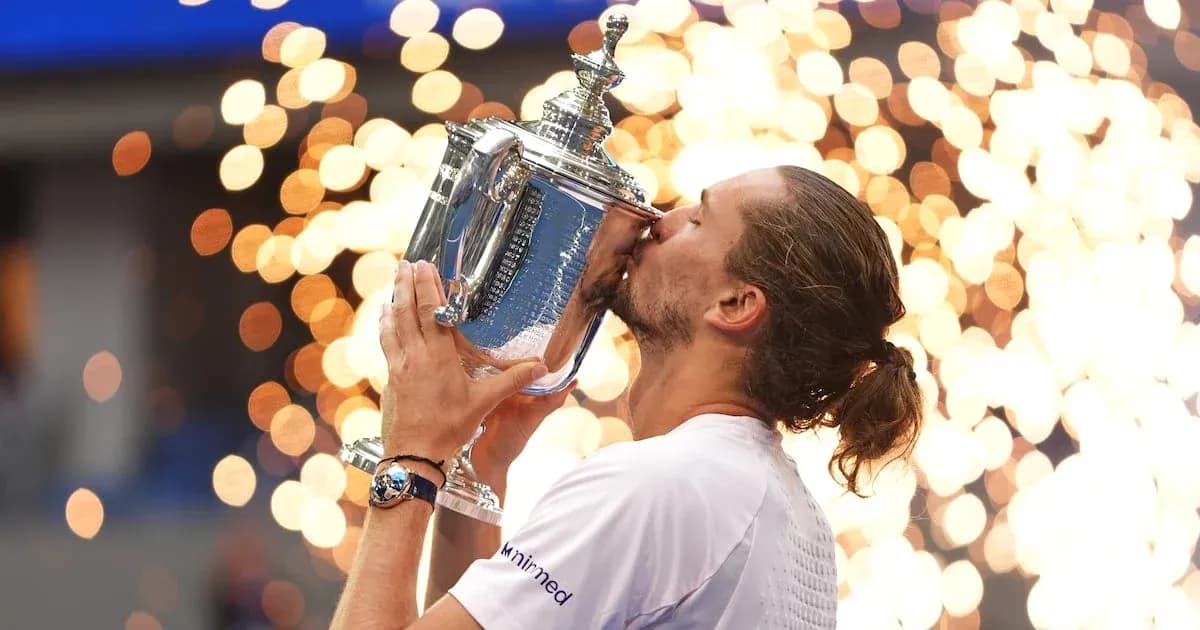
The German, playing the most complete season of his career, beat Shelton 6-3, 7-6 (2), 5-7, 6-2 on Sunday to win the U.S. Open and claim his second Grand Slam title of the year. The French Open champion leaves New York with the trophy that slipped through his fingers in 2020 — and with the American drought stretching into a third decade.
Zverev’s year of reckoning
For years, Zverev carried the label: contender, not closer. That changed in Paris. It hardened in New York.
Top seed at a major for the first time, elevated when world No. 1 Jannik Sinner withdrew with a knee injury, Zverev arrived with pressure and expectation strapped to his shoulders. He walked out of Ashe looking like a man who has finally learned how to carry both.
He had history to confront here. Four years ago, he led Dominic Thiem by two sets in this same final and stood two points from the title before unraveling, becoming the first man since 1949 to lose a U.S. Open final from two sets up. Those ghosts hovered over this fortnight, at least in the retelling.
On Sunday, they never came close.
Zverev controlled the opening stages with a kind of icy precision that drained the atmosphere from a partisan crowd desperate for an American breakthrough. He broke immediately, then never let go of the first set lead. Shelton donated that opening game with a double fault. He finished the set the same way, another double fault handing Zverev the frame 6-3.
The tone was set. Zverev was not in New York to play the role of supporting actor in a feel-good home story.
The crowd roars, Zverev slows the noise
Shelton, the No. 8 seed, had already lit up the tournament. He’d knocked out defending champion Carlos Alcaraz in a five-set quarterfinal that ended at 3:33 a.m., the latest finish in U.S. Open history. He brought electricity, athleticism, and a fearless game that had many in Ashe believing they might finally see the first American men’s major champion since Andy Roddick in 2003, and the first Black man to win the title since Arthur Ashe in 1968.
But this was a different stage. A different opponent. And a very different tempo.
Zverev used his deliberate routine to suffocate the crowd’s rhythm. He bounced the ball again and again — sometimes 10 times, sometimes closer to 20, no pattern, no hurry. Each sequence created long pockets of hush, enforced by tennis etiquette and the umpire’s reminders, that dulled the home support’s edge.
Fans tried to puncture that calm, cheering when Zverev missed first serves, drawing a scolding from the chair. The German, who said before the match he relished hostile environments, simply reset, bounced, and served again.
The match turned on the second-set tiebreak, the one moment when Shelton had a clear path to level the contest and ignite the stadium.
Instead, Zverev slammed the door.
Shelton pushed Zverev’s first serve long on the opening point. Then Zverev threaded a brilliant passing shot. Then he outlasted Shelton in a 16-shot rally. In a blink, it was 3-0.
The German cranked a 147 mph serve, then 124 mph, both unreturnable. Shelton clawed back to 5-2 and finally got a return in play, only for Zverev to win that point as well and close the breaker with another bomb at 139 mph.
Two sets to love. The No. 1 seed in full control. The noise that had greeted Shelton’s entrance now sounded strained, almost hopeful out of habit.
Shelton swings back
Shelton did not fold.
The 23-year-old, playing in his first Grand Slam final, has already built a reputation for stubborn resistance. He leaned on it again in the third set, refusing to let Zverev walk to the finish line.
The American finally found enough first serves, enough forehands, enough adrenaline to push the match into a fourth set, taking the third 7-5 and jolting Ashe back to life. For a few minutes, it felt as if the night might tilt, as if Shelton might add another wild chapter to a run that had already included a historic late-night epic.
But this version of Zverev is not the one who blinked in 2020.
Any trace of doubt vanished as he reset for the fourth. The German tightened his patterns, cleaned up the errors, and reasserted control from the baseline. Shelton, who had spent so much emotional and physical energy just to get back into the match, couldn’t sustain the charge.
Zverev broke, then broke again. The fourth set raced away 6-2, the contest ending not with a twist but with a statement: this is his era-defining season, not someone else’s fairy tale.
A drought that won’t end — yet
Shelton’s loss keeps the American men’s Grand Slam title drought intact at 21 years and counting. Roddick’s 2003 triumph in Flushing Meadows remains the last, a reference point that grows more distant with every September.
Shelton, now 0-6 against Zverev and with only his second set ever taken from him on Sunday, still looks like a player built for many more shots at this stage. His game, his charisma, and his ability to take out giants — as Alcaraz discovered — mark him as a future threat at every major.
But for now, the moment belongs to Zverev.
He leaves New York as a two-time major champion in the same season, a Wimbledon finalist, and the man who finally turned promise into a sustained run of dominance. The title he once let slip has been reclaimed, not by miracle, but by method and nerve.
The American wait goes on. Zverev’s surge does too.