Alexander Zverev's Historic US Open Victory
Alexander Zverev walked to the baseline with history on his shoulder and a scar in his memory.
Six years earlier on this same court, he had served for the US Open title and watched it all fall apart. Two sets up on Dominic Thiem, then serving for the match in the fifth, he saw the trophy slip through his fingers. That night has followed him ever since, the defining image of a talent that might never quite get there.
This time, it was different.
Now he came as a Grand Slam champion, the French Open winner from June, the world number two, the man who has turned potential into proof. Across the net stood Ben Shelton, the American hope with the thunderbolt serve and a crowd of 24,000 almost entirely behind him. New York roared for the home player. Zverev shut it all out.
He won 6-3 7-6 (7-2) 5-7 6-2, but in the moment of victory, he didn’t even realise.
The last serve was brutal, another unreturnable dart. Shelton couldn’t touch it. The stadium reacted instantly, a wall of sound. Zverev didn’t. He calmly walked back to the baseline, bouncing the ball, ready to play what he thought was the next point.
His team had to tell him it was over.
"In that moment I was in the zone a lot. I didn't hear noise at all," he said later. Tennis coaches preach the mantra: play the next point, forget the score. Zverev took it so literally that he lost track of the finish line. "At that moment I forgot about the score and it helped me."
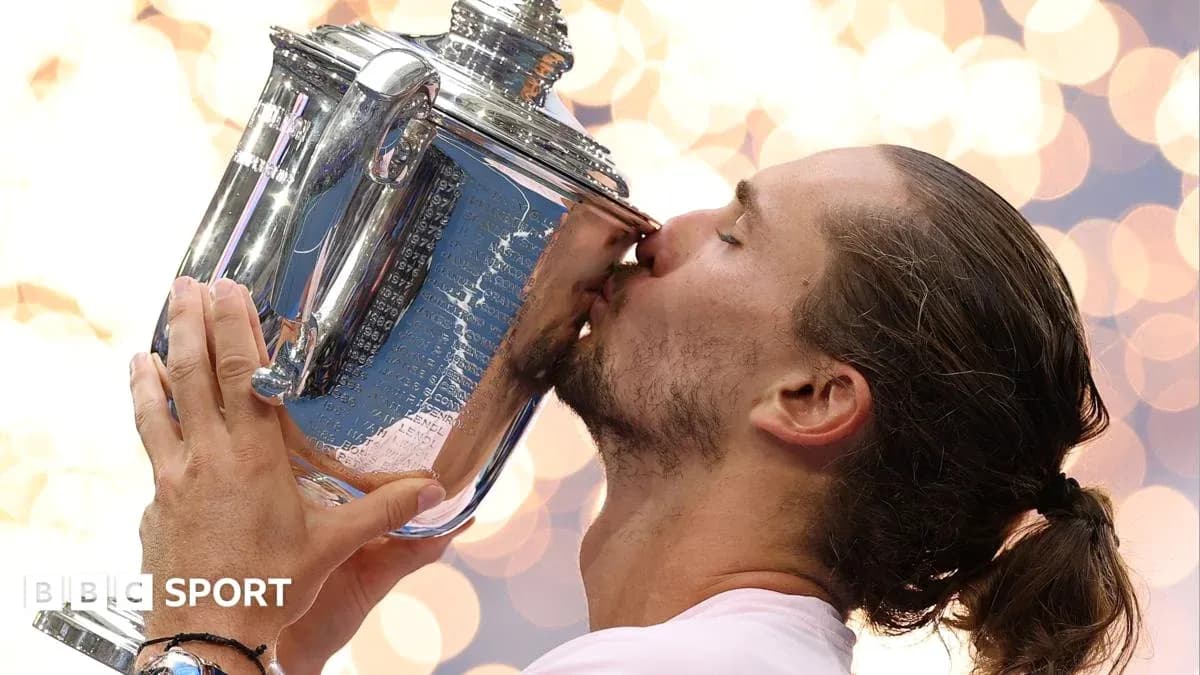
Only when the truth hit did his face crack. The 29-year-old broke into a broad, almost disbelieving smile, then raised his arms to the sky. The picture could not have been more different from 2020, when he stood here in tears after losing to Thiem and said during the ceremony: "I wish one day I can bring the trophy home."
Now, that wish sits in his hands.
"We went 30 years without winning a Grand Slam title and now we've won two in three months," Zverev said, speaking not just for himself but for German tennis. "2026 is the outcome of all the years that happened before." The line summed up his journey: not an overnight breakthrough, but a long, sometimes painful climb.
There was another key difference from that first US Open final. Back then, his parents watched from afar. This time, his father and coach, Alexander Zverev Sr, stood courtside, living every point with him. The son made sure to acknowledge the man who built his game, then turned to the person who built his life.
Diagnosed with type 1 diabetes as a child, Zverev grew up with doctors warning of limits, of what he might never be able to do. His mother refused to accept that.
"When doctors tell you that life and sports will be very limited for that child, it takes a very strong mother to say: 'my son will be whatever he wants to be'," he said. "My mother is the most important and strongest person I know."
This season has become the vindication of all of that defiance. Semi-finals at the Australian Open. Final at Wimbledon. Titles at Roland Garros and now in New York. He has benefited from the injuries that have stalled Jannik Sinner and Carlos Alcaraz, the two men who had dominated the majors over the previous two years, but the gap they left did not fill itself. Zverev ran into it, fitter, harder, more relentless than ever.
"There is no-one as fit as Zverev, he is right up there," said former Wimbledon champion Marion Bartoli on BBC Radio 5 Live. "You can argue about Alcaraz and Sinner, and Novak [Djokovic] and Rafa [Nadal] when they were in their prime physically, but Zverev is right up there as one of the best athletes to play the sport."
New York has seen that resilience up close over the past fortnight. Zverev’s first two matches went the distance, five-set marathons that ended in the early hours. He stood two points from defeat in the opening round, dug himself out, and from the third round onward he did not drop a set until Shelton finally grabbed one in the final.
The atmosphere against the American was hostile, loud, and partisan. Shelton fed off it. Zverev refused to.
He kept his emotions under lock and key, almost expressionless between points. When he lost the third set, the stadium sensed a shift, a possible comeback brewing. Zverev did not blink. He tightened his patterns, leaned on his serve, and reasserted control.
"I'm so admiring of his strength of character and the zen-like state he's been in since the very beginning of the match," said former British number one Annabel Croft. What stunned her most was that trance at the end. "The most extraordinary thing was - and I don't think I've ever witnessed it - was that he didn't realise he had won. It was so bizarre, but it was like he was in a trance-like state while he was playing."
That trance has carried him through a year that now looks like a turning point, not a one-off. The player who once let the biggest moment of his life slip away has come back to the same stage, with the same serve for the title, and this time he did not flinch.
The trophy he once begged to take home is finally his. The question now is how many more he plans to collect.