Zverev's Grand Slam Victory Sparks Serve Clock Debate
Alexander Zverev walked away with another grand slam trophy. He left behind a rule-book storm.
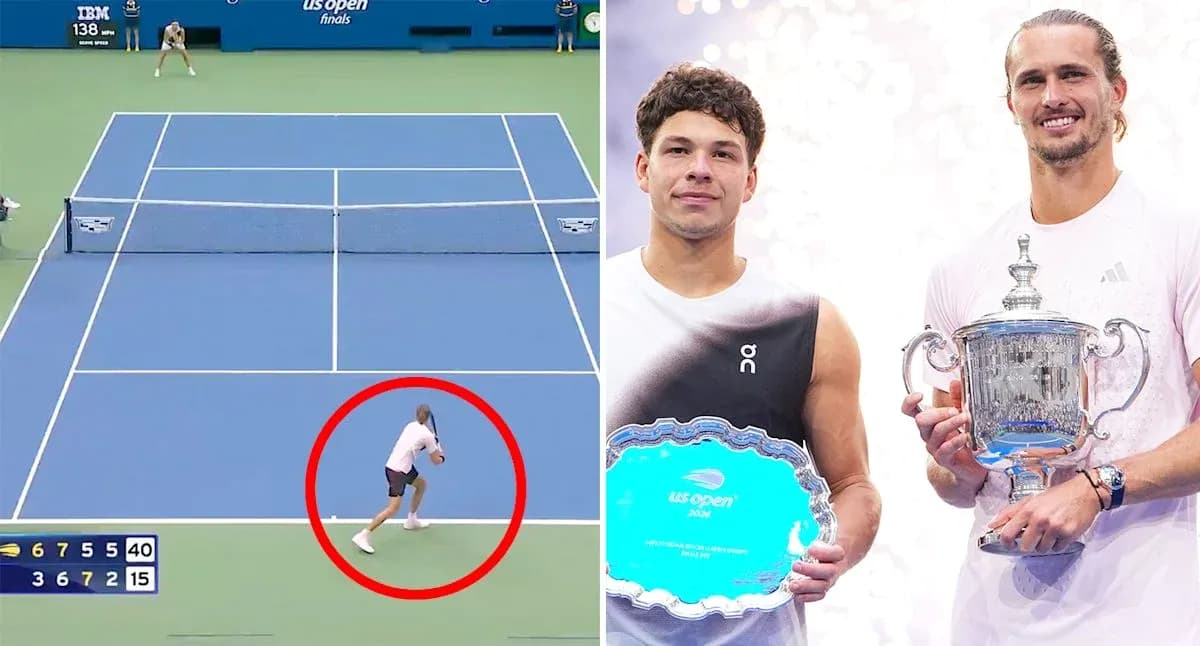
The German beat Ben Shelton 6-3 7-6 (7-2) 5-7 6-2 in the US Open final to claim back-to-back majors, but the tennis itself shared the stage with something far less glamorous: the endless wait between serves.
Point after point, Zverev bounced and bounced and bounced, testing not only Shelton’s patience but that of the crowd, the commentators and, crucially, the rulebook.
Under current regulations, players have 25 seconds from the end of the previous point to start the next one. Once they begin their service motion for the first serve, the clock’s job is done. Miss that first serve, and the second comes under a much looser standard: an umpire’s judgment that it must be taken “without delay”.
That grey area became the most talked-about part of the men’s final.
Zverev picked up multiple time violations across his semi-final and the championship match. Yet officials were effectively powerless on the second serve, where his ritual of ball-bouncing and aborted tosses repeatedly dragged out the rhythm of the contest and frayed tempers in the stands.
Shelton, fresh from the biggest fortnight of his career, did not hide his frustration.
In his post-match press conference, the American called for a clear, separate shot clock between first and second serves. The first ball, he argued, can have the full 25 seconds. The second should not be a free-for-all.
“For a first serve you should be able to do whatever you want and use the full 25 seconds every time,” Shelton said. “There should be some sort of rule limiting time on second serves. There shouldn’t be unlimited time. It’s tough to be sitting there for that long for the next action to happen.”
Shelton is not alone. Far from it.
Andy Roddick, never shy about calling out the sport’s blind spots, has been hammering the same point. Speaking on his “Served” podcast, the former US Open champion said the game has to move with the times.
“The rules should change,” Roddick said. “As long as he’s doing it within the 25-second shot clock, yeah, what are you going to say? There needs to be a shot clock for the second serve.
“You cannot bounce the ball 20-something times between first and second serve. And then act shocked when we finish at 3 in the morning. Like, we just can’t do it.”
The frustration in New York wasn’t limited to the locker room or the studio.
On ESPN’s commentary, John McEnroe grew increasingly irritated as Zverev repeatedly tossed the ball, aborted, reset and started again, all while the stadium held its breath.
For McEnroe, the answer lies in tightening another loophole. If a player lets the serve clock run down while fiddling with their ball toss, he believes they should pay the price.
“This should be over the serve clock. It was at two (seconds left) when he tossed it. Should be a fault,” McEnroe said on air, arguing that the toss itself should not be a way to game the countdown.
His brother Patrick McEnroe focused on the other side of the net. If a server’s routine becomes a drawn-out ordeal, he said, the returner should be given more freedom to break that spell.
“As a returner, when a guy’s doing this (bouncing the ball so many times) you should be able to step away, just before he serves,” Patrick said, hinting at a kind of tactical reset for the player waiting to receive.
The discontent has been building for a while. Karen Khachanov, beaten by Zverev in the semi-finals, admitted the German’s serving routine grates on his rivals.
Zverev’s ball-bouncing, Khachanov said, “annoys” not only him but others on tour. “It takes so much time,” he added.
Yet even Khachanov circled back to the same blunt truth: as long as Zverev stays within the current framework, there is little opponents can do beyond complaining.
“At the end of the day, if it’s within the rules with the time between points, I cannot say anything against that,” Khachanov said. “If he extends the time, then he gets a time violation, so it’s as simple as that.”
And that is where the debate now sits. The sport’s laws have created a strange contradiction: a visible shot clock for the first serve, and a murky, discretionary world for the second. A world that, on the biggest stage, allowed one player’s routine to dominate the tempo of a grand slam final.
Shelton wants a second-serve clock. Roddick wants it. Broadcasters are openly pushing for change. Players like Khachanov are clearly fed up, even while acknowledging Zverev is operating inside the rules.
Tennis has modernised plenty in recent years — electronic line-calling, on-court coaching, visible serve clocks. The question now is simple: after a US Open final that finished with a trophy in one hand and a rulebook in the other, how long will the sport wait to time the second serve?