Alexander Zverev: From Prodigy to Grand Slam Champion
Alexander Zverev has finally broken the dam.
After years of near-misses, a shredded ankle, and a career stalked by controversy, the 29-year-old German now owns two Grand Slam titles in the space of four months. His US Open triumph in New York, coming on the heels of his French Open victory in June, feels less like a breakthrough and more like a long-delayed confirmation: he is firmly installed among tennis’s elite.
He has been chasing this version of himself for more than a decade.
From prodigy to survivor
Zverev grew up with expectation as a constant companion. The 6-foot-6 right-hander was earmarked for the top before he could drive a car, the son of parents who both played to a high level in the former Soviet Union and passed on the sport, the discipline and the obsession.
"For me, my family is everything and I owe them a lot for helping me to become the tennis player that I am today," he has said. It is a line that sounds almost routine until you place it against the backdrop of what followed.
He lives with diabetes. He has navigated a tour career while managing a chronic condition that demands vigilance every single day. On court, the pressures mounted early: the big serve, the height, the clean technique, the junior results — all of it screamed future No. 1.
The road bent sharply instead.
The scars of New York and Paris
His first taste of a major final came at the 2020 US Open, and it left a wound. Two sets up on Dominic Thiem, Zverev froze as his serve deserted him and the match slipped away in five. It became the defining image of his early career: the towering talent who could not quite hold his nerve when the biggest prize stood in front of him.
"That was exactly the time when I had real struggles with my serve and my second serve," he later admitted. "I knew that my serve could break down at any moment. That's one difference that I do feel now, luckily for me."
Just when he began to rebuild, Paris struck. In the 2022 Roland Garros semi-finals, locked in a brutal contest with Rafael Nadal, Zverev crumpled to the clay, ankle ligaments torn. Surgery followed. A career that had always seemed to be on fast-forward suddenly hit pause.
He returned in January 2023 and clawed his way back, lifting a 20th career title in Hamburg and quietly piecing together the version of himself that would re-emerge in 2024: fitter, more resilient, and far less fragile in the tightest moments.
Tennis under a shadow
Zverev’s story cannot be told purely in forehands and trophies. Away from the court, allegations of domestic violence by two former partners, Olga Sharypova and Brenda Patea, have followed him for years. He has consistently and strenuously denied the accusations.
The ATP Tour investigated one claim and said it found insufficient evidence to sanction him. In Germany, the case involving Patea, the mother of his daughter, led to a penalty order and fine in 2023. Zverev appealed, and the two sides reached a settlement in June 2024 — on the very day he was due to contest the French Open semi-finals.
He walked out to play with legal headlines swirling around him, another reminder that his ascent has never been clean or uncomplicated.
Highs, lows, and a new steel
On the court, the numbers tell one story; the scars tell another.
Zverev, who grew up idolizing Roger Federer, has now played three consecutive Grand Slam finals. The run started with a Wimbledon appearance that ended one step short, then rolled into the French Open title — his long-sought "happy end" in Paris — and now this US Open crown, secured against rising American Ben Shelton.
The journey between those peaks is littered with setbacks. A third defeat in a major final arrived at the 2025 Australian Open, where Jannik Sinner swept him aside in straight sets. Before that, there was the sense that the new era had passed him by as Sinner and Carlos Alcaraz carved up the sport’s biggest prizes, winning nine straight majors between them and turning Zverev’s chase for a first Slam into a running question.
Yet he kept collecting evidence that his game belonged at the very top. The Olympic gold medal in Tokyo in 2021 was a key marker: he stunned Novak Djokovic there before beating Karen Khachanov in the final, a week that showed he could handle suffocating expectation on the grandest stage.
"In the life of a professional athlete, you will have the highest highs and the lowest lows," Zverev has said. "Getting caught up in the lows is the biggest mistake that you can make. You shouldn't try to evaluate everything when times are tough, you should try to find ways to get better when you're on a high."
The words read like a mission statement now. His 2024 season, built on a deep run in Paris and a surge to world number two, has largely silenced the old doubts about his mentality. The serve that once betrayed him has become a weapon he can trust under pressure.
Belief finally rewarded
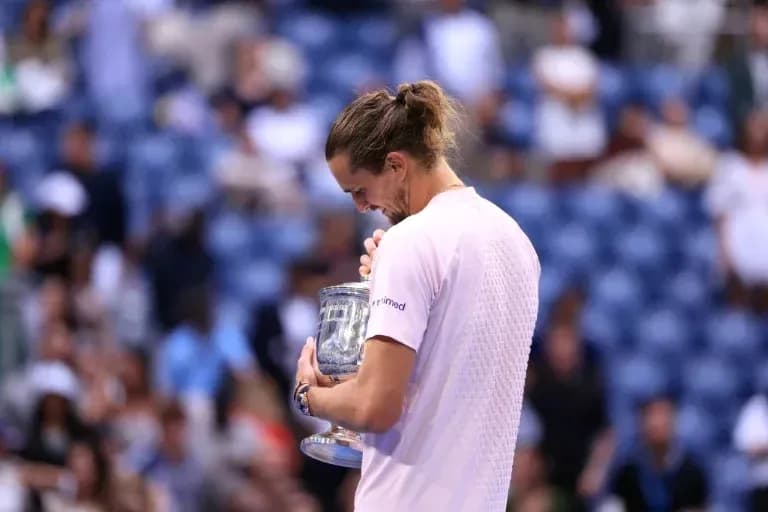
In New York, as he held the US Open trophy at last, Zverev insisted his faith had never wavered, even when the sport’s next generation seemed to sprint away from him.
"I believed in it. I believed that it's possible," he told reporters, before adding with a laugh: "I think not many of you guys did."
That line carried no bitterness, only the satisfaction of a player who has spent years living with the gap between his potential and his résumé. Now the numbers are catching up. Two majors in four months. Three Slam finals in a row. World number two.
For a decade, Alexander Zverev was the player who might. Today, he is the player who does — and the question no longer concerns whether he will win one, but how many this late-blooming surge will bring.