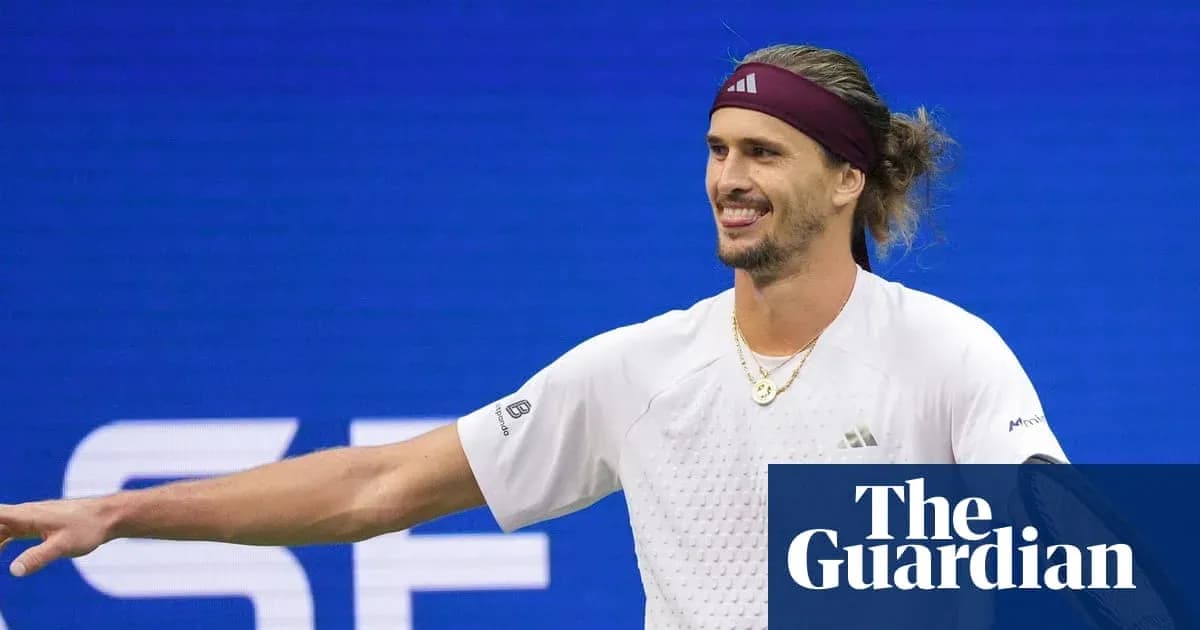
Alexander Zverev Advances to US Open Final with Solid Win Over Khachanov
On a languid semi-final afternoon on Arthur Ashe Stadium, it took nearly two hours for the match to feel as if it might actually catch fire. For 107 minutes, Alexander Zverev had Karen Khachanov at arm’s length, their long-running rivalry reduced to a one-sided beating. Then, almost out of nowhere, the Russian found a foothold.
Down a set and a break, Khachanov clawed his way back into the second, dragging Zverev into a tie-break that finally pulsed with jeopardy. At 5-6, facing set point on his own serve, he ripped a fearless forehand winner, line-hugging and audacious. At 6-7, he went bigger still, threading a screaming backhand passing shot and unleashing a roar that echoed around the sparsely engaged stands.
Once upon a time, that might have been enough to rattle Zverev. Not this version.
The German blinked, then reset. The wobble passed in a couple of points. Zverev steadied his serve, tightened his patterns and, as he has done all season, played the bigger moments on his terms. He edged that tie-break, then another, closing out a 6-3, 7-6 (7), 7-6 (6) win to move within one match of a second grand slam title in his last three majors.
This is uncharted consistency for him. Zverev has now reached three consecutive grand slam finals for the first time in his career, backing up his breakthrough triumph at Roland Garros and his maiden Wimbledon final with another deep run in New York. It was here, in 2020, that he first stepped into a major final, losing a wild five-setter to Dominic Thiem in a silent, Covid-era stadium after leading by two sets and serving for the title. Four years on, he returns to the same stage chasing redemption in his sixth grand slam final.
On paper, this semi-final always leaned heavily in Zverev’s favour. Reality was a touch more nuanced. Khachanov’s current ranking of No 50 masks the weight of his résumé. The 30-year-old has been a fixture near the top of the game, peaking at No 8, winning the Paris Masters in 2018 and claiming an Olympic silver medal in Tokyo, finishing behind Zverev there as well. He also came into the day with a better record against Zverev than the other two semi-finalists combined; Zverev led their head-to-head 6-3, but Khachanov had beaten him as recently as last year in Canada.
Any upset hopes, though, ran into the cold, relentless efficiency of Zverev’s game. His serve set the tone, heavy and precise, repeatedly dragging Khachanov into defensive positions. From the back of the court he was unyielding, sending back one more ball, then another, forcing the Russian to play closer and closer to the lines. Khachanov’s forehand, never the most reliable stroke under pressure, began to fray. By the closing stages of the second and third sets, it was leaking errors in bunches, especially when the scoreboard tightened.
The pressure finally told in both tie-breaks. Zverev didn’t need brilliance; he needed solidity. He found it, landing first serves, working the rallies to Khachanov’s weaker wing, refusing to offer the free points that had briefly opened the door in that tense second-set shootout.
His route to this final will not silence those who question the strength of his opposition. At Roland Garros, the narrative revolved around whether anyone could stop him once Jannik Sinner crashed out early, Carlos Alcaraz withdrew injured and Novak Djokovic’s late-career struggles deepened. Zverev marched through that draw and he has walked a similar path here in New York.
From the top half of the US Open field, his highest-ranked opponents en route to the final have been No 22 Luciano Darderi and No 28 Alejandro Tabilo. If he lifts the trophy on Sunday, he will have claimed his first two grand slam titles without facing a single top-eight player. It is an odd statistical quirk for a man now entrenched near the summit of the rankings.
Yet the old cliché holds: you can only beat the player across the net. After being dragged into back-to-back five-setters in the first two rounds, Zverev has not dropped a set since. His body has held up, his game has sharpened, and his confidence has grown with each straight-sets win. Whoever emerges from the all-American semi-final between Ben Shelton and Frances Tiafoe will walk into a brutal head-to-head history: Zverev owns a combined 15-1 record against the pair, with his only loss to Tiafoe coming nine years ago, in a very different phase of all their careers.
If the tennis has been efficient, the occasion has not exactly gripped New York. For a men’s grand slam semi-final featuring the world No 2 and a former semi-finalist at this very tournament, the sense of apathy was striking. The atmosphere felt more like a solid fourth-round match than a step away from a major final, the low hum in the stands never quite rising into a roar.
One reason sits far from the baseline. The US Open’s ticket resale market has been a running controversy this fortnight, with secondary prices for marquee sessions soaring into the stratosphere. There was no such frenzy here. Before Zverev and Khachanov walked on court, seats were going for as little as $21 (£15.50) on StubHub, a figure that would be unthinkable for most showpiece nights at Flushing Meadows.
So Zverev moves on, largely untroubled, his season of major consistency intact, his record against the remaining contenders overwhelmingly in his favour. The stadium may not yet be fully invested, but the question now is simple: who, if anyone, can stop him from turning this run of finals into another piece of silverware?